Information
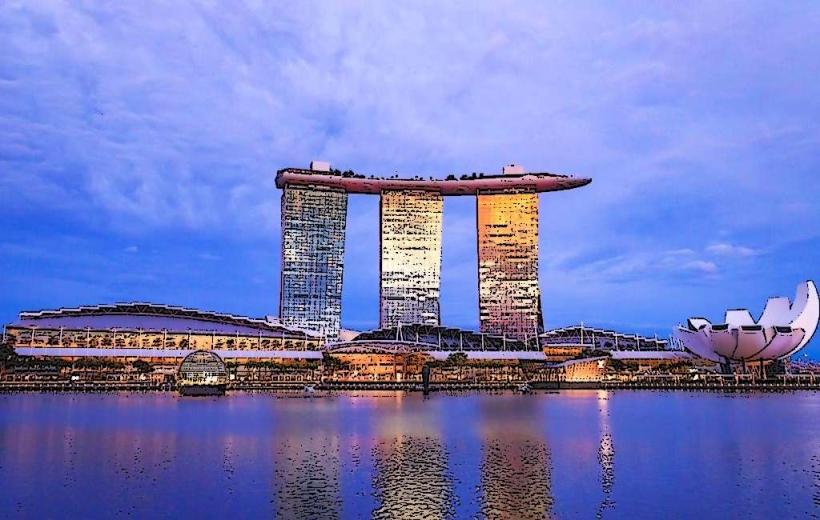
Landmark: ArtScience MuseumCity: Central Region
Country: Singapore
Continent: Asia
ArtScience Museum, Central Region, Singapore, Asia
Gyeonggijeon Shrine is a historical site located in the city of Jeonju, South Korea. It houses the portrait of King Taejo, the founder of the Joseon Dynasty.
Visual Characteristics
The shrine complex is constructed primarily from wood, with dark, polished timber framing and grey tiled roofs. The main building, the Jeonjeon, is a single-story structure with a gabled roof. The walls are painted in traditional Korean colors, predominantly white and red. The grounds are enclosed by a stone wall and feature a central courtyard with paved pathways. The architectural style is representative of Joseon Dynasty palace and shrine construction.
Location & Access Logistics
Gyeonggijeon Shrine is situated within the Hanok Village in Jeonju. It is approximately 1.5 kilometers southwest of Jeonju Station. Access is via local roads within the Hanok Village. Limited street parking is available in the vicinity, with larger parking lots located at the entrances to the Hanok Village. Several city bus lines, including routes 79, 100, and 119, stop near the Hanok Village, requiring a short walk to the shrine.
Historical & Ecological Origin
Gyeonggijeon Shrine was established in 1410 during the Joseon Dynasty. Its original purpose was to enshrine the portrait of King Taejo (Yi Seong-gye). The shrine has been rebuilt multiple times due to fires, with the current structures dating from the 17th century. The site itself is a historically significant area within the Jeonju Hanok Village, which is characterized by traditional Korean houses.
Key Highlights & Activities
Visitors can view the portrait of King Taejo within the Jeonjeon (requires separate ticket). The adjacent building houses the Joseon Dynasty Royal Portrait Museum, displaying other royal portraits. Walking the grounds and observing the traditional architecture is a primary activity. Photography is permitted in most outdoor areas.
Infrastructure & Amenities
Restrooms are available within the shrine complex. Shaded areas are provided by the building overhangs and trees on the grounds. Cell phone signal (4G/5G) is generally strong within the shrine complex. Food vendors and restaurants are abundant in the surrounding Jeonju Hanok Village.
Best Time to Visit
For optimal lighting on the shrine's architecture, early morning or late afternoon is recommended. The best months for visiting are April, May, September, and October, offering mild temperatures and clear skies. There are no tide-dependent activities at this location.
Facts & Legends
A unique historical detail is that the portrait of King Taejo housed here is one of only two surviving portraits of the founder of the Joseon Dynasty. The other is located at Jeonju National Museum. A local legend suggests that the spirit of King Taejo watches over the city from within the shrine.
Nearby Landmarks
- Omokdae viewpoint (0.3km Northeast)
- Jeonju Hyanggyo (Confucian School) (0.4km Southwest)
- Jeonju National Museum (2.1km West)
- Jaman Mural Village (0.6km East)
- Jeondong Catholic Cathedral (0.7km Northwest)