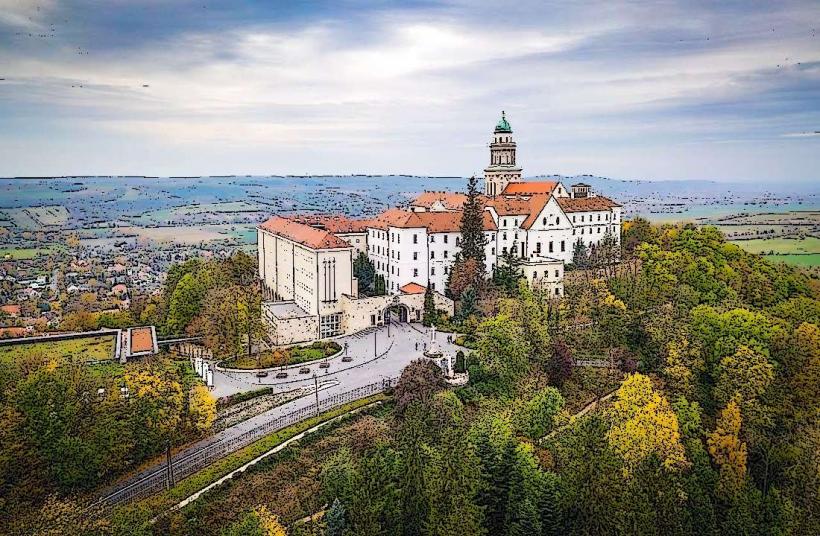
Information
Landmark: Abbey GardensCity: Pannonhalma
Country: Hungary
Continent: Europe
Abbey Gardens, Pannonhalma, Hungary, Europe
The Abbey Gardens (officially the Arboretum and Conservation Area of Pannonhalma) is a 22-hectare botanical and herbal garden integrated into the Pannonhalma Archabbey complex in western Hungary. It serves as both a biological research site and a historical reconstruction of monastic horticultural practices.
Visual Characteristics
The site is divided into an English-style landscape park (Arboretum) and a structured Herbal Garden. The Arboretum features a dense collection of over 400 tree and shrub species, including centuries-old oaks and exotic conifers. The Herbal Garden is characterized by geometric lavender fields, sage, and mint plantations, centered around a modern timber and glass distillation building (The Officina).
Location & Access Logistics
The gardens are located at Várkerület 1, surrounding the southern and eastern slopes of the Abbey hill. Access is through the main Archabbey visitor center (Kosaras-domb). It is 20km from Győr via Route 82. Paved paths connect the various garden sections, though some peripheral trails are gravel. Dedicated parking is available at the foot of the hill.
Historical & Ecological Origin
Monastic gardening at this site dates back to 996 AD, initially focused on medicinal plants for the abbey's infirmary. The current Arboretum was formalized in the 1830s during the Neoclassical reconstruction of the Abbey. It is a strictly protected nature conservation area, managed to preserve the microclimate of the Sokoró Hills.
Key Highlights & Activities
Visitors can walk the Herbal Garden to observe the cultivation of lavender and medicinal herbs. The Lavender Officina provides demonstrations on essential oil extraction. The Canopy Walkway (Lombkorona Sétány) offers an elevated perspective over the forest floor and the surrounding Pannonian Basin. Seasonal activities include lavender harvesting workshops in early summer.
Infrastructure & Amenities
The area includes a tea house, a herbal shop selling abbey-made soaps and oils, and a modern visitor center with restrooms. The site is equipped with 5G cellular coverage. Most main paths are accessible, though the incline of the hill may require assistance for manual wheelchair users. Shaded seating is abundant throughout the Arboretum.
Best Time to Visit
The peak period is late June to early July when the lavender is in full bloom. For the Arboretum, October provides high visual contrast due to the autumn foliage of the diverse tree collection. The gardens are open daily from 9:00 AM to 7:00 PM during the high season.
Facts & Legends
The Arboretum contains several "living fossils," including Gingko Biloba trees planted in the 19th century. According to local monastic tradition, the recipes for the herbal liqueurs and balms sold today are derived from manuscripts found in the Abbey Library dating back to the 17th century.
Nearby Landmarks
Pannonhalma Archabbey – 0.2km North
Canopy Walkway – 0.1km East
Abbey Winery – 0.6km West
Millennium Monument – 0.4km Southeast
Our Lady Chapel – 0.3km South