Information
Landmark: Veles BridgeCity: Veles
Country: North Macedonia
Continent: Europe
Veles Bridge, Veles, North Macedonia, Europe
The Veles Bridge is a historic railway bridge spanning the Vardar River in the city of Veles, North Macedonia. It serves as a critical railway link and a prominent architectural feature of the city.
Visual Characteristics
The bridge is constructed primarily from cut stone blocks, exhibiting a grey-brown coloration that blends with the river environment. It features multiple semi-circular arches, typically numbering around 10-12 depending on the specific section, supported by robust stone piers. The overall structure is linear, designed for railway traffic, with a flat deck. Its height above the river varies with water levels but maintains a consistent elevation for train passage.
Location & Access Logistics
The Veles Bridge is centrally located within the city of Veles, immediately adjacent to the Veles Railway Station. It is accessible from the city center via local roads such as Marshal Tito Street, approximately 0.5km from the main square. Parking is available in designated street parking areas within the city, typically paid. Public transport includes local bus lines that serve the city center and the railway station area, providing direct access to the bridge's vicinity.
Historical & Ecological Origin
Construction of the Veles Bridge commenced in 1873 and was completed in 1874, built by Ottoman engineers as part of the Salonika-Skopje railway line. Its original purpose was to facilitate railway transport, connecting the Aegean Sea port of Salonika with the interior of the Balkans. The bridge has undergone several reconstructions and repairs due to damage during conflicts, notably during World War I and World War II, but retains its original design principles.
Key Highlights & Activities
Observing the railway operations as trains cross the bridge is a primary activity. Photography of the bridge's stone architecture and its interaction with the Vardar River is common. Walking along the riverbanks near the bridge offers different perspectives of its structure. The bridge itself is not designed for pedestrian access.
Infrastructure & Amenities
Directly on the bridge, there are no amenities. Restrooms and food vendors are available in the immediate vicinity within the city of Veles, particularly near the Veles Railway Station and the city center. Shade is minimal on or directly under the bridge structure. Cell phone signal (4G/5G) is consistently available throughout the area.
Best Time to Visit
The bridge is visible year-round. For photography, early morning (sunrise) or late afternoon (sunset) provides optimal lighting, highlighting the stone texture and arch details. The spring and autumn months (April-May, September-October) offer temperate weather conditions. River levels are typically higher in spring due to snowmelt, which can affect the visual context of the bridge piers.
Facts & Legends
A local anecdote suggests that during its initial construction, the bridge's stability was tested by running multiple fully loaded trains across it simultaneously. Another historical fact is that the bridge was strategically important during both World Wars, leading to its repeated targeting and subsequent reconstruction, making it a symbol of resilience for the city of Veles.
Nearby Landmarks
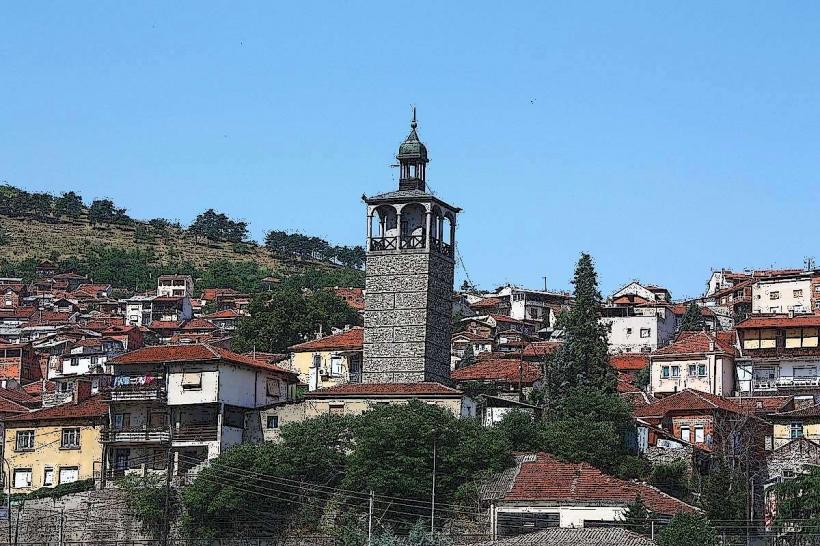
- Veles Clock Tower: 0.8km West
- House of Kosta Abrašević: 0.7km Northwest
- Veles City Museum: 1.0km Northwest
- St. Panteleimon Monastery: 2.5km East
- Lake Mladost: 4.0km North