Information
City: BueaCountry: Cameroon
Continent: Africa
Buea, Cameroon, Africa
Buea serves as the administrative capital of the South West Region of Cameroon and functions as a primary center for higher education and technology. It is situated on the eastern slopes of Mount Cameroon at an elevation of approximately 870 meters.
Historical Timeline
The city was established as a colonial administrative station by the German governor Jesko von Puttkamer in 1901. Primary eras of governance include German Kamerun (1901–1919), during which it served as the national capital, British Southern Cameroons (1922–1961), and the post-unification era. The most significant architectural reconstruction occurred in the late 1990s and early 2000s with the expansion of the University of Buea. The primary event shaping its current urban form was its role as the capital of German West Africa, which left a legacy of Prussian-style architecture and a tiered administrative layout.
Demographics & Population
The total population is approximately 300,000 residents. The top three ethnic demographics are the Bakweri, Bamileke, and significant student populations from across the CEMAC region. The median age is 19.1 years.
Urban Layout & Key Districts
The city is organized linearly along a main uphill axis (the Long Street). Key districts include Upper Cost (Administrative and Historic district) at the highest elevation and Molyko (Educational and Commercial hub) in the lower valley. The city is bounded to the west by the primary ascent routes of Mount Cameroon and to the east by the transition toward the Tiko plains.
Top City Landmarks
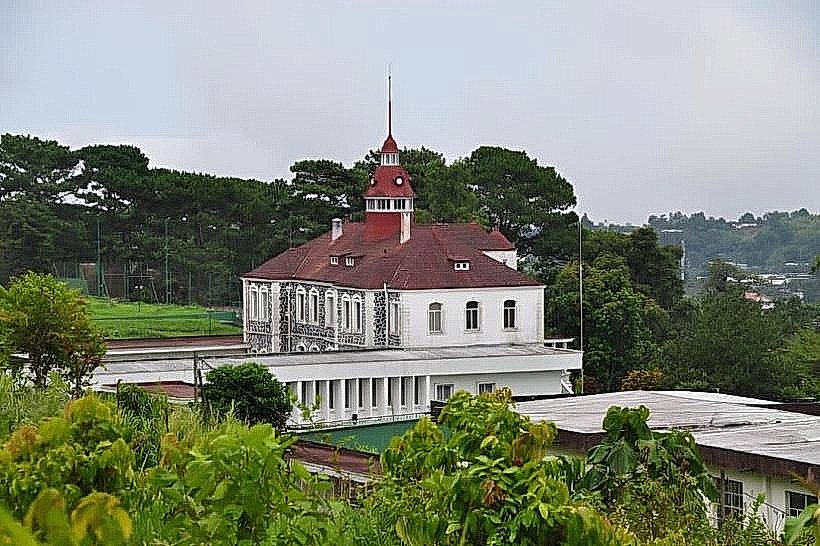
Schloss Buea (The Bismarck Fountain/Governor's Residence)
University of Buea
The Reunification Monument (Buea)
German Post Office (Historical Site)
Mount Cameroon (Trailhead 1)
Transportation Network
Movement within the city relies on "Taxis Collectifs" (yellow shared taxis) and motorcycle taxis (Benskins). There is no metro or rail system. Official taxis are yellow. Traffic density is high along the main Molyko-Mile 17 corridor. The city serves as a major transit node between Limbe and the northern interior.
Safety & "Red Zones"
The general safety level is low to moderate due to the ongoing Anglophone Crisis. Avoid the peripheral mountain-side areas and the Mile 16/17 junctions after dark. Explicitly avoid travel during "Ghost Town" lockdowns (Mondays). Common risks include localized security checkpoints and occasional civil unrest.
Digital & Financial Infrastructure
Average internet speed is 10–25 Mbps (4G). The city is nicknamed "Silicon Mountain" due to its high density of tech startups. Main mobile carriers are MTN, Orange, and Camtel. Card acceptance is low, restricted to major hotels. ATMs are concentrated in the Molyko district.
Climate & Air Quality
Temperatures range from 18°C to 25°C. Due to its elevation, Buea is significantly cooler than the surrounding coastal plains. Air quality is exceptionally high, though Saharan dust (Harmattan) can affect visibility from December to February. The city experiences a prolonged misty rainy season from June to October.
Culture & Social Norms
Tipping is not mandatory; 500 XAF is standard for service. Handshakes are the standard greeting; use of titles (Prof, Chief, Pa) is required for social respect. Dress code is conservative; due to the mountain climate, jackets and sweaters are standard attire. Public behavior is influenced by the "Bakweri" traditional council and the high student population.
Accommodation Zones
Upper Cost / Government Station: Recommended for security, historical architecture, and cooler temperatures.
Molyko: Recommended for logistical access to banks, restaurants, and tech hubs, though it is noisier.
Local Cost Index
1 Espresso: 1,300 XAF ($2.12)
1 Standard Lunch: 4,000 XAF ($6.50)
1 Metro/Bus Ticket: 300 XAF ($0.49) - (Standard shared taxi fare)
Nearby Day Trips
Mount Cameroon Summit (variable distance/multi-day)
Limbe Botanical Garden (20 km)
Tiko Wharf (25 km)
Ekona Agricultural Research Center (15 km)
Facts & Legends
A verified historical oddity is Schloss Buea, which was built with materials imported entirely from Germany to mimic a Prussian castle, making it one of the few examples of such architecture in sub-Saharan Africa. Local legend surrounds the "Mount Cameroon Race of Hope," where athletes compete to climb the volcano; locals believe that those who do not respect the mountain deity, Efasa Moto, will be hindered by sudden mist or stones that appear to move on their own during the ascent.