Information
City: GarniCountry: Armenia
Continent: Asia
Garni, Armenia, Asia
Garni is a historic village in Armenia’s Kotayk Province, situated approximately 28 km east of Yerevan. It is defined by its role as a former royal summer residence and its home to the only standing Greco-Roman colonnaded building in the former Soviet Union.
Historical Timeline
Bronze Age: Site established as a cyclopean fortress.
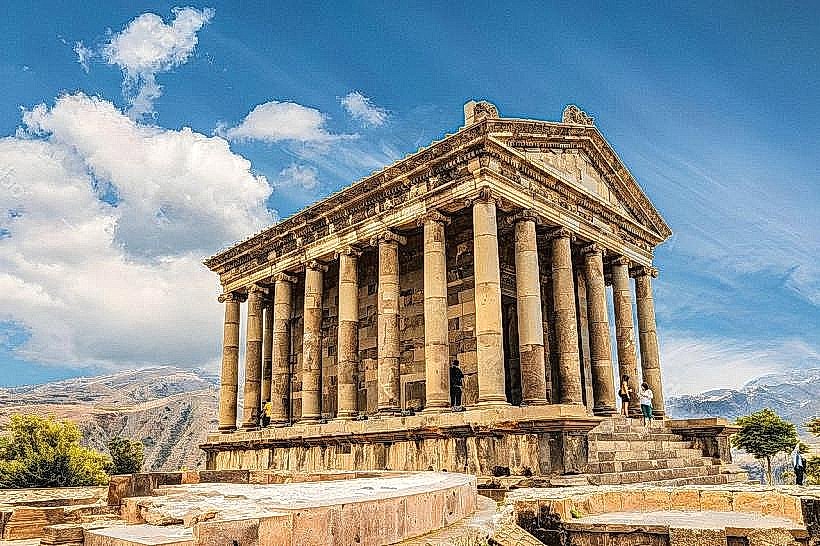
1st Century AD: The Temple of Garni was built by King Tiridates I, likely dedicated to Mihr, the Armenian sun god.
1679: A catastrophic earthquake destroyed the temple, leaving it in ruins for nearly three centuries.
1969–1975: The temple was reconstructed using the original stones found on-site (anastylosis).
2025–2026: Garni Temple and the "Symphony of Stones" were officially added to the UNESCO World Heritage tentative list (July 2025).
Demographics & Population
The 2026 estimated population of Garni village is approximately 7,500. The residents are predominantly Ethnic Armenians. The local economy is centered on Tourism, Traditional Agriculture, and Boutique Hospitality.
Top Landmarks
Temple of Garni: A classical Hellenistic structure featuring 24 Ionic columns (symbolizing the hours of the day). It stands on a triangular cliff edge overlooking the Azat River Gorge.
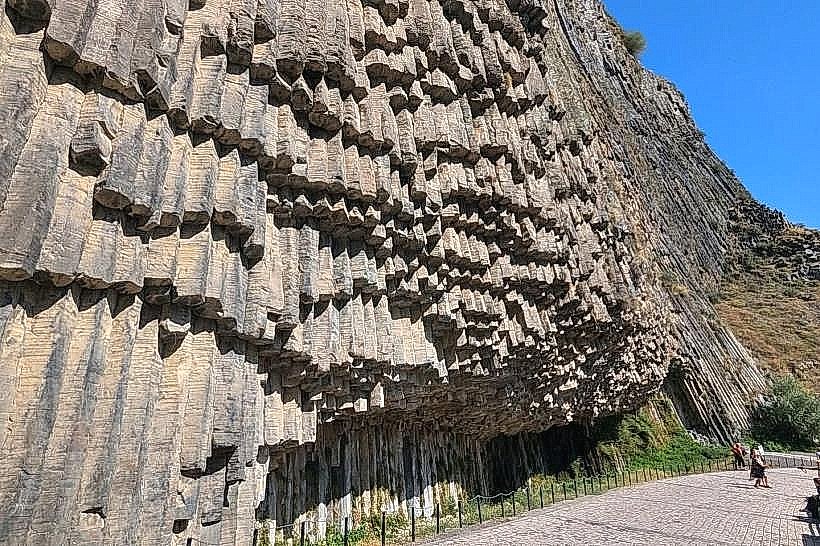
Symphony of Stones: Located in the Garni Gorge below the temple; a natural geological monument of massive, hexagonal basalt columns that resemble a giant organ.
Roman Baths: Ruins of a 3rd-century bathhouse containing a partially preserved mosaic floor with Greek inscriptions.
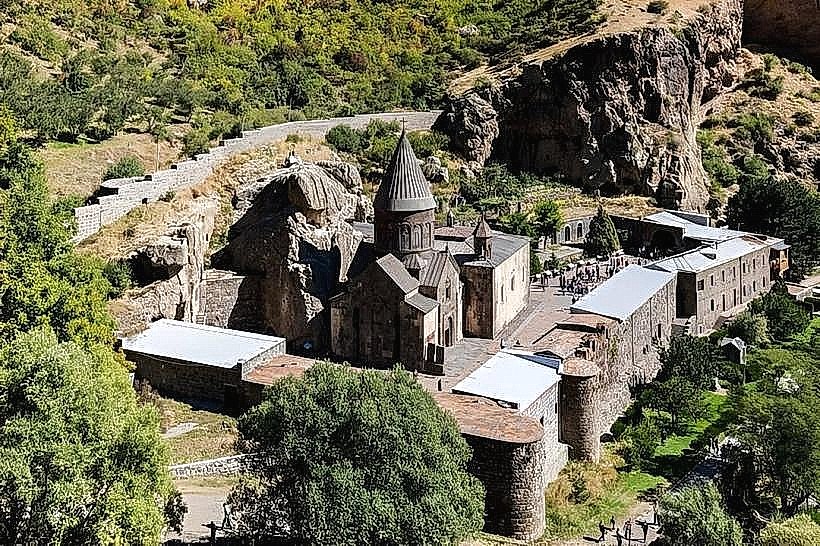
Geghard Monastery: (10 km northeast); a UNESCO World Heritage site partially carved into the adjacent mountain cliffs, famously associated with the spear that pierced Christ.
Charents Arch: A roadside monument on the way from Yerevan that frames a "perfect" view of Mount Ararat.
Transportation Network
From Yerevan: Garni is a 45-minute drive. Minibuses (marshrutkas) depart regularly from the Gai Bus Station in Yerevan (approx. 500 AMD).
Private Tours: Most visitors combine Garni and Geghard into a single day trip. As of 2026, private car services (Yandex, Bolt) are common, costing roughly 12,000–15,000 AMD for a return trip.
Hiking: A popular trail connects Garni village to the Symphony of Stones in the gorge and continues toward the Khosrov State Reserve.
Safety & Health
Garni is exceptionally safe for travelers.
Terrain: The path down to the Garni Gorge is steep and can be slippery; sturdy footwear is recommended.
Mandatory Insurance: As of January 1, 2026, all international tourists in Armenia must have valid health insurance (minimum 30,000 GEL/equivalent coverage) as part of new regional transit regulations.
Water: Public fountains (pulpulaks) in the village provide fresh, potable mountain water.
Digital & Financial Infrastructure
4G/5G coverage is robust throughout the village via Viva-MTS and Team.
Payments: Entry to the Garni Historical-Cultural Museum Reserve is 1,500 AMD (~$3.75 USD).
Currency: While major restaurants accept cards, cash is required for the Symphony of Stones entry fee (approx. 200 AMD) and for purchasing local "Garni Gata" (sweet bread) from village vendors.
Climate & Ecology
Dfb (Humid continental). Garni is significantly warmer and drier than the higher mountain regions. In 2026, the Khosrov State Reserve (accessible via Garni) remains a critical conservation zone for the Caucasian leopard and various endemic flora.
Culture & Social Norms
Garni is a center for Armenian Neopaganism, where rituals are occasionally held at the temple during the spring equinox.
Lavash Baking: The village is famous for traditional "tonir" (clay oven) baking demonstrations.
Gata: Garni is the undisputed capital of Gata, a traditional pastry often filled with koritz (flour, butter, and sugar).
Local Cost Index
Temple Entry Fee: $3.75 USD.
Symphony of Stones Entry: $0.50 USD.
Standard Lunch (Village Tavern): $12.00–$20.00 USD.
Garni Gata (Large): $2.50–$4.00 USD.
Facts & Legends
Legend says that the temple was spared from the general destruction of pagan sites when Armenia converted to Christianity in 301 AD because it was a beloved summer retreat for the king’s sister, Princess Khosrovidukht. A modern fact: in 2011, the complex received the UNESCO-Greece Melina Mercouri International Prize for its exceptional preservation of cultural landscapes.