Information
City: MunsterCountry: Germany
Continent: Europe
Munster, Germany, Europe
Münster is a major independent city in North Rhine-Westphalia and the cultural center of the Westphalia region. Known as the "Bicycle Capital of Germany," it balances a 1,200-year history as a Hanseatic and episcopal seat with a vibrant, youthful energy driven by its massive student population.
Historical Timeline
Founded in 793 as a monastery (hence the name Münster), it became a powerful Hanseatic city in the 13th century. In 1534, it was the site of the radical Anabaptist rebellion, whose leaders' iron cages still hang from St. Lambert's Church. The most defining global event was the 1648 Peace of Westphalia, signed here and in Osnabrück, which ended the Thirty Years' War. Despite near-total destruction in WWII, the historic core was meticulously rebuilt in the 1950s using traditional designs.
Demographics & Population
The population is approximately 320,000. The demographic is notably young for a German city, with over 65,000 students enrolled across eight higher education institutions. The median age is roughly 40 years, significantly lower than the German national average.
Urban Layout & Key Districts
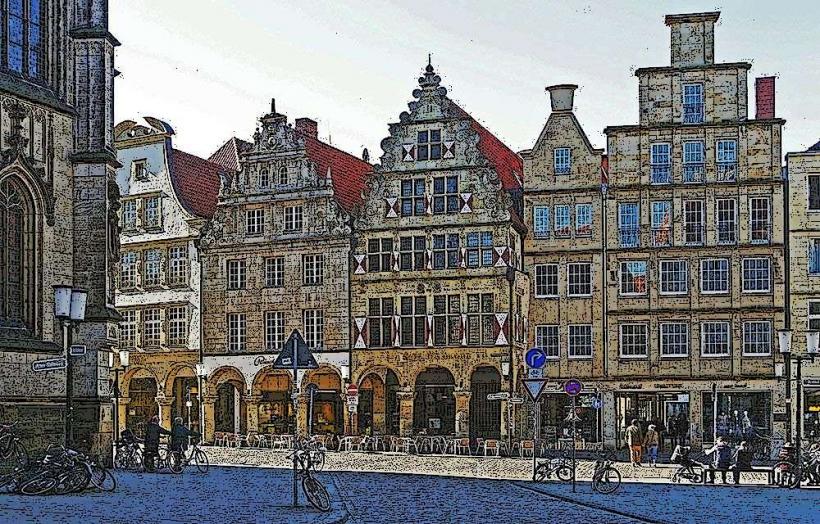
Prinzipalmarkt: The historic "main market" and commercial heart, famous for its gabled houses and arcades.
Kuhviertel: One of the oldest quarters, known for its winding alleys, traditional pubs, and student nightlife.
Kreativkai (City Harbor): A revitalized industrial port now serving as the city’s top nightlife and arts district, filled with lofts and waterfront dining.
Hiltrup: The largest outlying district, primarily residential and industrial, located south of the center.
Sentruper Höhe: A scenic residential area adjacent to the Aasee lake and the zoo.
Top City Landmarks
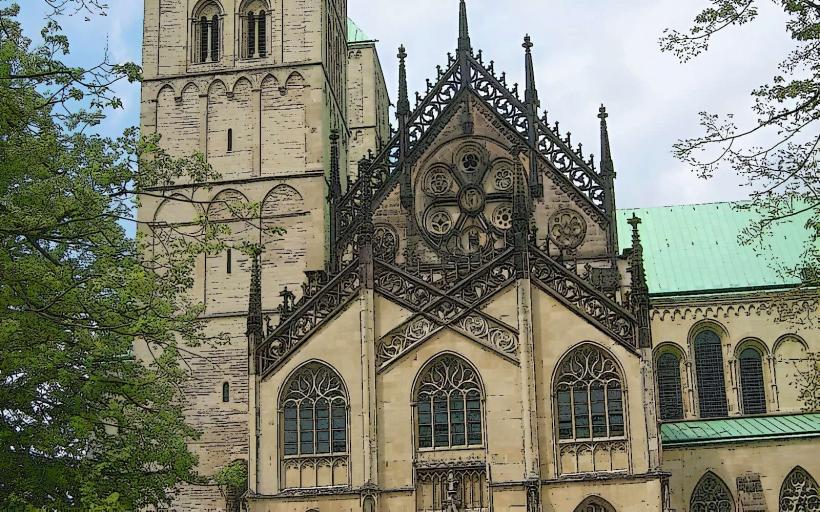
St. Paulus Dom (Münster Cathedral): A 13th-century cathedral featuring a world-famous astronomical clock from the late Middle Ages.
Historisches Rathaus (Historic Town Hall): Home to the Friedenssaal (Peace Hall), where the 1648 peace treaties were negotiated.
St. Lamberti Church: Notable for the three iron cages on its spire and its traditional night watchman (Türmerin).
Schloss Münster: The former prince-bishop's palace, now the administrative seat of the University of Münster.
Aasee: A large central lake surrounded by parkland and large-scale public sculptures.
Transportation Network
Münster is internationally recognized for its cycling infrastructure; the Promenade, a car-free green belt, encircles the city center on the site of former walls.
Cycling: Over 500,000 bicycles in the city; the primary mode of transport for 39% of trips.
Rail: Münster Hauptbahnhof is a major IC/ICE hub connecting to Hamburg, Cologne, and Berlin.
Public Transit: Extensive bus network operated by Stadtwerke Münster; no trams or metro.
Air: Münster Osnabrück International Airport (FMO) is 25 km north.
Safety & "Red Zones"
The general safety level is very high. Crime is largely limited to bicycle theft, which is exceptionally common. There are no definitive "red zones," though standard caution is advised in the high-density nightlife areas of the Hafen (Harbor) and Kuhviertel during late-night weekend hours.
Digital & Financial Infrastructure
Average internet speed is 250–1,000 Mbps. The city is a hub for "Battery Science" and research, with high fiber-optic penetration. Mobile 5G coverage is universal. Card acceptance is standard, though some smaller traditional Westphalian gasthouses still prefer cash or "Girocard."
Climate & Air Quality
Temperate oceanic climate. A local proverb states: "Either it rains or the bells ring; if both happen, it's Sunday." Annual rainfall is 758 mm, average for Germany, but spread over many days. Summer temperatures range from 14°C to 24°C; winters are mild, averaging 0°C to 5°C. Air quality is high due to the lack of heavy industry and high bicycle usage.
Culture & Social Norms
Tipping is expected at 5–10% (rounding up). The city is deeply Catholic but socially liberal due to the student influence. The Send (large fair held three times a year) and the Rosenmontag carnival parade are major social events. Smoking is prohibited in all public buildings and restaurants.
Accommodation Zones
Stay in the Altstadt (Old Town) for proximity to Prinzipalmarkt and historic sites.
Stay near the Aasee for a quieter, nature-oriented experience within walking distance of the center.
Local Cost Index
Espresso: €3.50
Standard Lunch: €16.00
Bus Ticket: €3.00 (Single trip; cheaper via app)
Nearby Day Trips
Burg Hülshoff: 10 km (Birthplace of poet Annette von Droste-Hülshoff).
Schloss Nordkirchen: 30 km (The "Westphalian Versailles").
Osnabrück: 50 km (The other "City of Peace").
Facts & Legends
Münster has a "Türmerin" (female tower watchman) at St. Lamberti who blows a horn every night to signal all is well, a tradition dating back to 1379. A verified historical oddity is that the city has more bicycles than residents. Local legend surrounds the Anabaptist cages: it is said that as long as the cages remain on the church spire, the city will never again fall to radical zealotry.