Information
City: Pigeon ForgeCountry: USA Tennessee
Continent: North America
Pigeon Forge, USA Tennessee, North America
Pigeon Forge is an independent city in Sevier County, situated in the foothills of the Great Smoky Mountains. It is a major mountain resort destination, defined by its massive concentration of themed entertainment, its role as the home of Dollywood, and its function as a high-volume commercial corridor serving millions of national park visitors annually.
Historical Timeline
Inhabited by the Cherokee people for millennia. Primary governance eras include its late 18th-century settlement along the Little Pigeon River and its 1961 incorporation as a city. A critical historical event was the 1830 construction of The Old Mill, which served as the community's industrial heart for over a century. The city's trajectory was fundamentally altered in 1986 when the "Silver Dollar City" park was rebranded as Dollywood in partnership with Dolly Parton, catalyzing its evolution into a top-tier international tourist destination.
Demographics & Population
The permanent population is approximately 6,300, though the city frequently hosts over 50,000 transient visitors at any given time. The demographics are White (78%), Hispanic or Latino (14%), and Black or African American (2%). The economy is entirely dominated by the tourism, hospitality, and entertainment sectors.
Urban Layout & Key Districts
Pigeon Forge is organized almost entirely along a single, high-density 8-km (5-mile) corridor.
The Parkway: The central artery, featuring multiple lanes of traffic flanked by neon signs, dinner theaters, go-kart tracks, and outlet malls.
The Island in Pigeon Forge: A massive, walkable entertainment and retail complex located on an island in the Little Pigeon River.
Old Mill District: The historic sector of the city, featuring 19th-century structures, traditional Appalachian crafts, and dining.
Dollywood / Splash Country Area: A massive gated resort district located on the eastern edge of the city.
Wears Valley: A more scenic, less commercialized valley to the west offering cabin rentals and mountain views.
Top City Landmarks
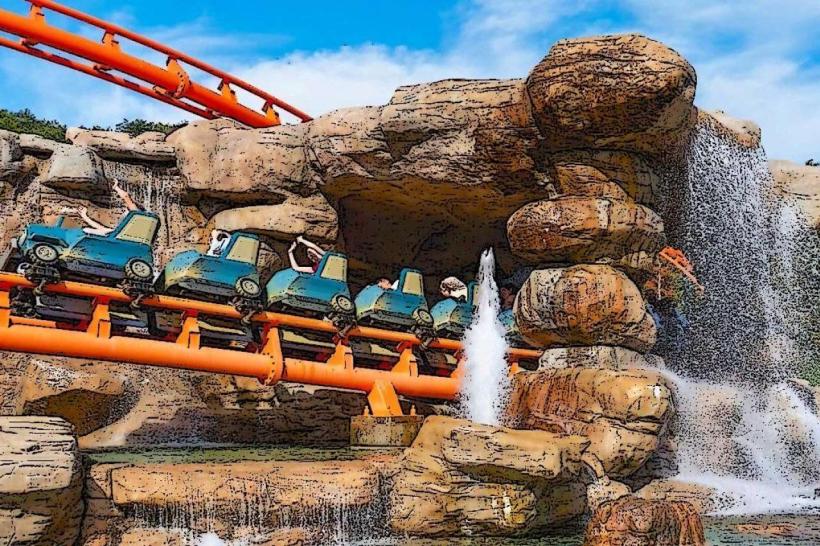
Dollywood: A 150-acre theme park featuring world-class roller coasters, traditional crafts, and live musical performances.
The Old Mill: A working gristmill built in 1830; it is the most photographed landmark in the city and is listed on the National Register of Historic Places.
The Island Show Fountain: A multi-tiered fountain synced to light and music, located at the center of the Island complex.
Titanic Museum Attraction: A massive, half-scale structural replica of the original ship, housing over 400 artifacts.
Hatfield & McCoy Dinner Feud: One of several high-production dinner theaters that define the city's nightlife.
Parrot Mountain and Gardens: A tropical bird sanctuary and botanical garden located on a ridge overlooking the city.
Transportation Network
Movement is serviced by the Fun Time Trolley, a mass-transit system designed to reduce extreme Parkway congestion. The city is primarily accessed via US-441, which connects to Sevierville and Gatlinburg. Commercial air service is via McGhee Tyson Airport (TYS) in Knoxville. Ride-sharing is universal. Traffic density is extreme, particularly during "Rod Run" car shows, summer break, and the winter "Winterfest" light display.
Safety & "Red Zones"
The general safety level is high. Property crime, specifically "theft from auto" in high-volume parking lots and "shoplifting" at outlet malls, is the primary issue. There are no designated "red zones." The primary hazards are pedestrian-related; the Parkway is extremely busy and crossing outside of marked signalized intersections is dangerous. Environmental hazards include sudden mountain thunderstorms.
Digital & Financial Infrastructure
Internet speeds average 400+ Mbps with fiber availability via Charter Spectrum. Main mobile carriers are Verizon and AT&T. Card acceptance is universal. ATMs are ubiquitous along the Parkway.
Climate & Air Quality
Temperatures range from -2°C to 10°C in winter and 19°C to 31°C in summer. The valley location can lead to high humidity and the characteristic "blue haze" of the Smokies. Air quality is high, though impacted by heavy seasonal vehicle emissions along the Parkway.
Culture & Social Norms
The standard tipping percentage is 20–25%. A friendly, "Southern" hospitality-focused greeting is the standard. Dress codes are "Theme-Park-Casual" (shorts, t-shirts, and walking shoes are standard everywhere). The city is culturally defined by its "Dolly-centric" pride, its family-oriented entertainment values, and its embrace of "Neon-Appalachian" commercialism.
Accommodation Zones
The Parkway: Recommended for those seeking immediate access to attractions and the trolley system.
Dollywood Lane: Recommended for luxury resort stays and proximity to the theme park.
Wears Valley Road: Recommended for mountain cabin rentals and quieter environments.
Local Cost Index
1 Espresso: $4.50 (USD)
1 Standard Lunch: $18.00 (USD)
1 Dollywood One-Day Ticket: $92.00 (Adult/Variable).
Nearby Day Trips
Great Smoky Mountains National Park: (8 km south; Sugarlands entrance).
Gatlinburg: (10 km south).
Douglas Lake: (20 km north; boating and fishing).
Facts & Legends
Pigeon Forge is named after a historic iron forge and the massive flocks of passenger pigeons that once inhabited the river valley. Historically, the city remained a tiny farming community until the mid-20th century. A local legend involves the "Ghost of the Old Mill," rumored spectral activity in the grain storage areas. Another legend concerns "The Hidden Cave of the Smokies," a rumored subterranean passage used during the Civil War that is said to be hidden behind one of the waterfalls in the neighboring national park.