Information
City: Saint GeorgesCountry: French Guiana
Continent: South America
Saint Georges, French Guiana, South America
Saint-Georges, often referred to as Saint-Georges de l’Oyapock, is the easternmost commune of French Guiana. It serves as the primary land border crossing with Brazil, situated on the left bank of the Oyapock River opposite the Brazilian town of Oiapoque.
Historical Timeline
The area was the site of several failed 17th-century British and Dutch colonial attempts before being formally established by the French.
1853: Founded as a penal colony (Bagne de Saint-Georges); it was named after a Dutch coin discovered during construction.
1885: A gold rush in the nearby Camopi River revived the settlement after the penal camp closed.
1947: Officially established as a commune.
2003–2004: Completion of the RN2 highway ended the town's isolation, connecting it to Cayenne by road for the first time.
2017: The Oyapock River Bridge opened to the public, creating the first and only land link between France (Europe) and Brazil.
Demographics & Population
The population is approximately 4,900 (2023 estimate). The demographic is uniquely diverse even for French Guiana:
Palikur Amerindians: A significant population (approx. 500) lives in the commune, particularly in the village of Trois-Palétuviers.
Brazilians: A large community of Brazilian nationals resides here, driven by cross-border trade and labor.
Creoles & French Expatriates: Administrative and military personnel, including a detachment of the French Foreign Legion.
Urban Layout & Landmarks
The town is concentrated along the riverbank, functioning as a "bridge-town" that facilitates international transit.
The Franco-Brazilian Binational Bridge: A 378-meter cable-stayed bridge and the town's most prominent landmark.
Town Hall (Mairie): A central administrative building reflecting the town's sub-prefecture status.
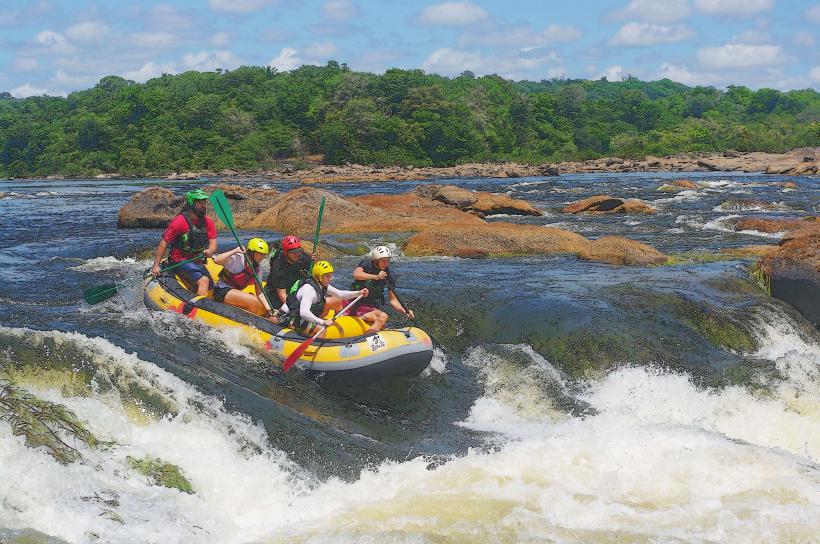
Saut Maripa: A spectacular series of rapids on the Oyapock River located a few kilometers upstream, accessible via a former railway track used for portage.
Trois-Palétuviers: A traditional Palikur village reachable only by boat, known for its preservation of indigenous culture.
Transportation Network
Road: The RN2 connects Saint-Georges to Cayenne (approx. 2.5–3 hours).
Bridge: The bridge to Brazil is open to vehicles and pedestrians, though border hours are strictly regulated (typically 08:00–12:00 and 14:00–18:00).
River: While the bridge has reduced demand, pirogues (motorized canoes) still transport locals and goods between the French and Brazilian riverbanks.
Air: A small airstrip exists, but it has no regular scheduled commercial passenger service.
Safety & Health
Yellow Fever: Vaccination is mandatory for entry.
Malaria: The commune is a high-risk zone for malaria; local health authorities regularly perform "mosquito fogging" (la baygonneuse).
Border Controls: Immigration and customs checkpoints are located at the bridge entrance. Travelers must ensure they have the correct visas or a "Border Card" (Carte Transfrontalière) for short-term stays in Oiapoque.
Digital & Financial Infrastructure
4G/5G coverage is available via French carriers (Orange, SFR). There is a Bank of Maldives (BML) style equivalent local branch, though most residents use the Postal Bank (La Banque Postale). The currency is the Euro (€), but the Brazilian Real (BRL) is frequently accepted in informal trade.
Culture & Social Norms
Language: French is official, but Portuguese and Palikur are widely spoken.
Traditional Craft: The Palikur are known for intricate basketry and beadwork.
Modesty: While a border town, it remains a traditional community; respectful attire is expected in municipal buildings and indigenous villages.
Local Cost Index
1 Espresso: ~€2.50 ($2.70)
1 Shared Taxi (to Cayenne): ~€30.00 – €40.00
1 Pirogue crossing to Oiapoque: ~€5.00
Facts & Legends
A verified geographical fact is that the bridge at Saint-Georges is the only place in the world where France shares a land border with Brazil. Local legend speaks of "Le Hollandais" (The Dutchman), a ghost of a 17th-century sailor said to haunt the riverbanks, searching for the treasure that the Saint-George coin was supposedly part of.