Information
City: SenakiCountry: Georgia
Continent: Asia
Senaki, Georgia, Asia
Senaki is a strategic city in western Georgia’s Samegrelo-Zemo Svaneti region, situated between the Tekhura and Tsivi rivers. It is defined by its role as a vital railway junction, its neoclassical "red brick" architecture, and its history as an educational and military hub.
Historical Timeline
The name "Senaki" (meaning "small room" or "chapel") appeared in the 17th century, but the modern city developed rapidly after 1872 following the construction of the Poti-Tbilisi railway. A critical historical event occurred in August 2008, when the city and its military base were temporarily occupied by Russian forces during the Russo-Georgian War. In 1998, it was also the center of a military mutiny. In 2026, Senaki is recognized as a member of the UNESCO Global Network of Learning Cities, emphasizing modern educational and sustainable development.
Demographics & Population
The 2026 estimated population is approximately 21,000 for the city and 39,000 for the wider municipality. The population is nearly mono-ethnic, with over 99% Ethnic Georgians (Megrelians). Georgian is the official language, though Megrelian is the primary language of daily life. The economy is driven by Agro-processing (hazelnuts, laurel, tea), Logistics, and small-scale manufacturing.
Urban Layout & Key Districts
Senaki is known for its orderly, grid-like streets and distinctive red-brick houses.
Central District: Houses the municipal administration and the iconic Akaki Khorava Drama Theater.
Dzveli Senaki (Old Senaki): The historic site of the city, located 5 km from the current center, known for its noble schools.
Military Base District: A modern facility housing the Second Infantry Brigade of the Georgian Army, upgraded to NATO standards.
Menji: A suburban balneological resort area known for its curative mineral waters.
Top Landmarks
Akaki Khorava State Drama Theater: A 1959 Neo-Baroque masterpiece; it is the architectural symbol of the city.
Nokalakevi (Archaeopolis): Located 16 km north; the massive ruins of the ancient capital of the Kingdom of Colchis/Egrisi, often identified as the mythical city of "Aia."
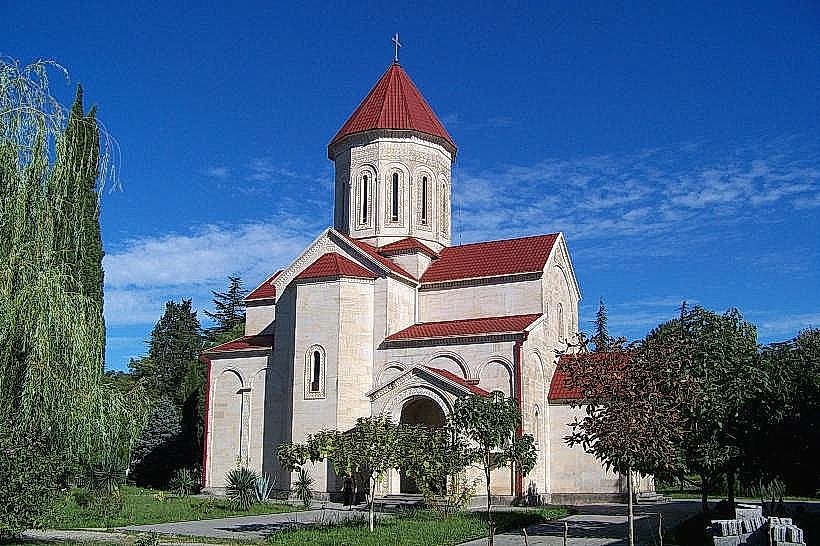
Archangel Hill Church: Built in 1908 by the monk Alex Shushania; it was one of the few Georgian churches to remain active throughout the Soviet era.
Shkhepi Fortress: A 4th-century citadel perched on a hill, historically protecting the road to the northern mountains.
Teklati Convent: A 19th-century nunnery located just north of the city center.
Transportation Network
Senaki is 270 km west of Tbilisi and 35 km east of Poti.
Rail: A primary junction for the Tbilisi–Poti and Tbilisi–Zugdidi lines. The station is a central landmark.
Road: Situated on the international S1 highway. In 2026, it serves as a major rest stop and logistics point for traffic moving toward the Black Sea ports.
Air: Travelers use Kutaisi International Airport (KUT), located approximately 40 minutes (42 km) away.
Safety & Health
Senaki is very safe for tourists. As of January 1, 2026, all international visitors must provide proof of mandatory health and accident insurance with a minimum coverage of 30,000 GEL. The city is generally quiet, though drivers should be cautious of heavy transit trucks on the main S1 artery. Tap water is safe.
Digital & Financial Infrastructure
4G and 5G connectivity are robust via Magti and Silknet. The Lari (GEL) is the currency. ATMs are concentrated in the central square and near the railway station. Most large pharmacies and supermarkets accept international card payments.
Climate & Ecology
Cfa (Humid subtropical). The region is characterized by lush, damp vegetation and very mild winters. In 2026, the "Green City" project is active, focusing on rehabilitating the city’s drainage systems and expanding urban parks to manage the high annual rainfall typical of the Colchis lowlands.
Culture & Social Norms
The city hosts the annual Egrisoba festival in early November (often at Nokalakevi), celebrating Megrelian history with folk music, horse racing, and traditional cuisine. Megrelian culture here is centered on intense hospitality and the famous spicy cuisine, including Elarji and Ghomi (cornmeal dishes).
Local Cost Index
1 Standard Meal: $6.00–$12.00 USD.
Marshrutka to Kutaisi: $2.00–$4.00 USD.
Mid-range Guesthouse Night: $30.00–$60.00 USD.
Facts & Legends
During the Soviet era, the city was renamed Tskhakaia (after a Bolshevik leader) before reverting to Senaki in 1989. A local legend identifies the nearby Nokalakevi as the destination where the Argonauts sought the Golden Fleece. Another fact: the city's theater was built so grandly because Senaki was once intended to be a much larger regional capital under Soviet planning. In 2026, Senaki remains the "Transit Heart of Samegrelo."