Information
City: Umm SalalCountry: Qatar
Continent: Asia
Umm Salal, Qatar, Asia
Umm Salal is a municipality in central Qatar, located approximately $15\text{–}20\text{ km}$ north of Doha. Known as the "Mother of Rocks" (Umm Salal) due to its limestone-heavy terrain, it serves as a historic and residential transition zone between the capital and the northern territories. In 2026, the municipality is a focus of Qatar's $22B$ infrastructure roadmap, with major sub-tunnelling and drainage projects beginning in early 2026 to enhance urban climate resilience.
Historical Timeline
Prehistoric: The area contains burial mounds and grave sites dating back to the Dilmun culture (3000 BCE).
Late 1800s: Served as a strategic lookout point for the Al Thani family to protect local wells and monitor pearl diving routes.
1972: Formally established as one of Qatar's original municipalities.
2026: In January 2026, the municipality is overseeing the final integration of the Strategic Mega Reservoirs project, designed to provide seven days of potable water security for the entire country.
Demographics & Population
As of early 2026, the municipality's population is approximately 115,000.
Umm Salal Mohammed: The administrative center, with a population of roughly 29,500.
Composition: Unlike the high-density expatriate hubs of Doha, Umm Salal has a higher concentration of Qatari nationals living in sprawling villa compounds, alongside a stable expatriate workforce in the construction and logistics sectors.
Gender Ratio: Remains heavily skewed toward males ($74\%+$), consistent with national trends, though residential districts like Al Kharaitiyat are increasingly family-oriented.
Urban Layout & Key Districts
Umm Salal Mohammed: The historic and administrative hub, home to the municipality's famous towers and the local market.
Umm Salal Ali: Located slightly further north; known for its sports culture and the Barzan Olympic Park.
Al Kharaitiyat: A major residential and commercial extension near the Doha border, home to large retail outlets and cafes.
Izghawa: A rapidly developing district shared with Al Rayyan, popular for its modern villas and proximity to Doha Festival City.
Umm Ebairiya: A quieter, more rural district currently receiving $4.6B in road and sewage infrastructure upgrades in 2026.
Top Landmarks
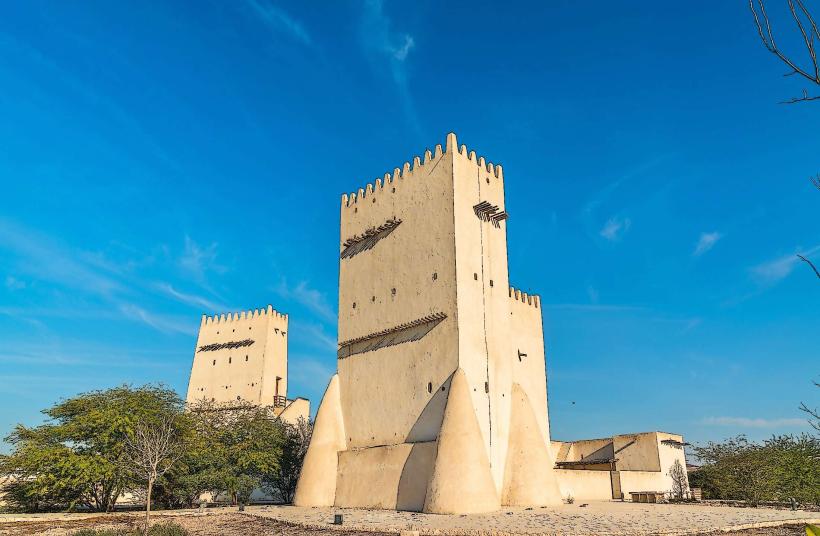
Barzan Towers: Restored $14\text{ m}$ watchtowers built between 1910 and 1916. The western tower features a unique "T" shape and was originally used to monitor the moon for the lunar calendar and guard local wells.
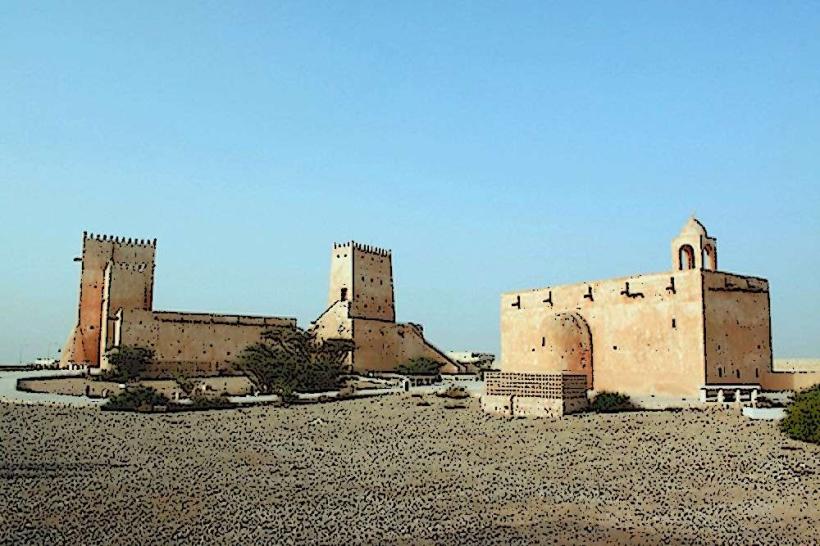
Umm Salal Fortress: A 19th-century white-walled palace built for Sheikh Mohammed bin Jassim Al Thani. While parts remain a private residence, the exterior is a landmark of Qatari defensive architecture.
Doha Festival City: One of Qatar’s largest malls, located on the southern edge of the municipality. It features Snow Dunes (an indoor cold park) and the country’s first IKEA.
Barzan Olympic Park: A comprehensive sports facility featuring a motor racing circuit, football pitches, and a public swimming pool.
Al Mazrouah Farmer's Market: A seasonal destination (active in January 2026) where local farmers sell fresh Qatari produce directly to the public.
Transportation & Infrastructure
Doha Expressway: The primary artery (Al Shamal Road) connects the municipality to Doha in 15–20 minutes.
Transit: There is no direct Metro station in the heart of Umm Salal; however, the Lusail QMN station and Doha Festival City shuttle links provide access to the Red and Green lines.
Project 2026: In early 2026, Ashghal (Public Works Authority) is executing "Package 01" of a local roads project, installing $8.9\text{ km}$ of treated sewage effluent (TSE) networks for irrigation.
Logistics: The municipality is home to the Umm Salal Logistics Hub, a critical node for the country's food security and supply chain operations.
Safety & Health
Safety: Extremely high. It is one of the quietest and safest residential zones in the country.
Health: Residents primarily use the Umm Salal Health Centre. For specialized care, the municipality is within 10 minutes of Sidra Medicine and the Al Wajba health facilities.
Climate & Environment
Current Status (Jan 22, 2026): Ideal weather for heritage tours. Temperatures range from $14^{\circ}\text{C}$ to $21^{\circ}\text{C}$.
Terrain: Higher elevation than Doha, which historically provided better protection from the humidity and flooding that affects the coastal regions.
Local Cost Index (2026 Estimates)
1 Coffee (Local Cafe): 12–18 QAR
1 Monthly 1-Bedroom Rent (Kharaitiyat): 4,500–5,500 QAR
1 Entrance to Barzan Towers: Free
1 Standard Villa Rent (5-Bedroom): 12,000–18,000 QAR
Facts & Legends
A verified historical oddity is that the Barzan Towers were built with walls $1\text{ m}$ thick and used a "marazim" drainage system to protect the mud-and-coral structure from rare but intense desert rain. A prominent local legend suggests the prehistoric mounds in Umm Salal Ali are the remains of an ancient "Lost City of the Sands," though archeological evidence links them more concretely to the Dilmun trade routes that spanned the Gulf five millennia ago.