Information
City: ZugdidiCountry: Georgia
Continent: Asia
Zugdidi, Georgia, Asia
Zugdidi is the administrative capital of the Samegrelo-Zemo Svaneti region in western Georgia. It is defined by its role as the seat of the Dadiani dynasty, its lush subtropical landscape, and its strategic position as the primary gateway to the high Caucasus of Svaneti and the Black Sea coast.
Historical Timeline
Historically the capital of the Principality of Mingrelia (Odishi). A critical historical event occurred in 1855 when Ottoman forces occupied the city during the Crimean War, only to be expelled by the Mingrelian Militia led by Prince Grigol Dadiani. In 1993, following the war in Abkhazia, Zugdidi became a major humanitarian hub, hosting one of the highest concentrations of internally displaced persons (IDPs) in Georgia. In 2026, the city is a focal point for the "Subtropical Agro-Smart" initiative, aimed at modernizing tea and citrus production.
Demographics & Population
The 2026 estimated population is approximately 73,000 for the city, making it the fifth or sixth most populous in Georgia. The population is predominantly Ethnic Georgian (Megrelian). Georgian is the official language, but Megrelian-a distinct Kartvelian language-is widely spoken in daily life. The economy is driven by Agriculture (hazelnuts, tea, and citrus), Retail, and Transit Tourism.
Urban Layout & Key Districts
The city is situated on the Odishi lowlands at the foot of a "Big Hill" (Zugdidi in Megrelian).
Palace District: The central cultural zone containing the Dadiani residence, botanical garden, and main cathedral.
Central Market: A bustling commercial hub known for authentic Megrelian spices and local produce.
Mantskhvarkarish Suki: The historic "Hill of the Savior's Door" from which the city takes its name.
Anaklia: A coastal satellite resort 30 km west, featuring modern architecture and a long pedestrian bridge.
Top Landmarks
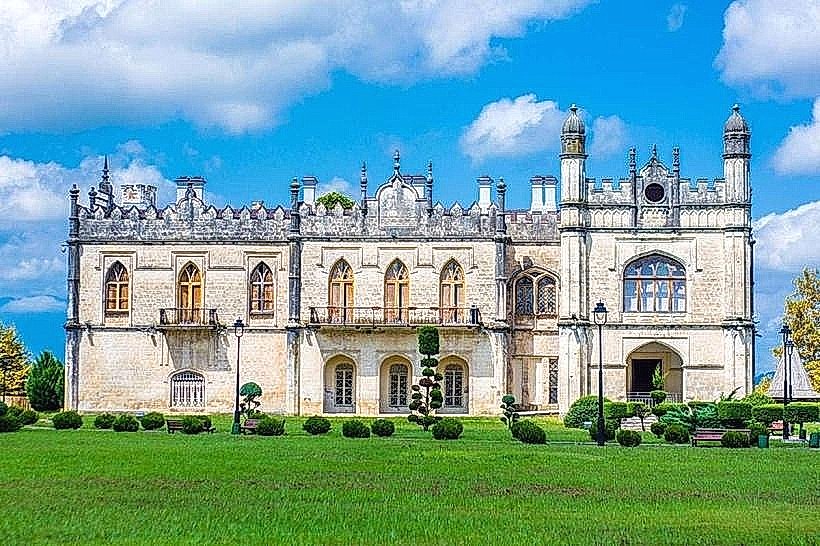
Dadiani Palace Museum: A 19th-century European-style complex housing over 41,000 artifacts, including one of Napoleon Bonaparte’s three original death masks and the Holy Shroud of the Virgin Mary.
Zugdidi Botanical Garden: A 26-hectare garden established in 1840 by Princess Ekaterine Dadiani, featuring over 80 species of exotic plants from India, Japan, and the Americas.
Rukhi Fortress: (10 km north); a 17th-century fortification on the banks of the Enguri River, currently serving as a symbolic point near the administrative boundary with Abkhazia.
Blachernae Icon of the Mother of God Cathedral: The spiritual center of the city, which hosts the annual Vlakernoba festival on July 15th.
Shalva Dadiani Drama Theater: One of the oldest theatrical institutions in Georgia, founded in the late 19th century.
Transportation Network
Zugdidi is 318 km west of Tbilisi.
Rail: The Tbilisi–Zugdidi Night Train and daytime express are the most reliable links to the capital.
Road: The city is the southern terminus for the spectacular mountain road to Mestia (Svaneti).
Air: Travelers use Kutaisi International (KUT), located approximately 1.5 hours away.
New 2026 Regulations: As of January 1, all intercity transport on routes exceeding 150 km must use Category M3 buses, phasing out smaller marshrutkas for increased safety.
Safety & Health
The city is safe, but its proximity to the Enguri Bridge (the primary crossing to occupied Abkhazia) means there is a notable military and police presence. As of January 1, 2026, all foreign tourists must possess mandatory health and accident insurance with a minimum coverage of 30,000 GEL. Tap water is generally safe but often has high mineral content.
Digital & Financial Infrastructure
4G and 5G connectivity are excellent via Magti and Silknet. The Lari (GEL) is the currency. ATMs are numerous in the city center. Most modern cafes and the Dadiani Museum accept card and contactless payments.
Climate & Ecology
Cfa (Humid subtropical). Characterized by high humidity, snowless winters, and hot summers. The proximity of the Black Sea ensures lush, year-round greenery. In 2026, portions of the Kolkheti National Park within the Zugdidi district are being expanded to protect the unique swamp forests and migratory bird paths.
Culture & Social Norms
The culture is famously defined by Megrelian hospitality and a fierce pride in local linguistics. Cuisine is the spiciest in Georgia, centered on Elarji (cornmeal with large amounts of cheese), Gebzhalia (cheese rolls in mint sauce), and Megrelian Khachapuri (topped with an extra layer of cheese).
Local Cost Index
1 Standard Meal: $7.00–$14.00 USD.
Dadiani Museum Entry: Approx. $5.00 USD.
Mid-range Hotel Night: $40.00–$80.00 USD.
Facts & Legends
The Dadiani family had direct blood ties to the Bonapartes; Salome Dadiani married Achille Murat, the nephew of Napoleon Bonaparte. A local legend claims that the Virgin Mary’s Robe was brought to Zugdidi to protect it from invaders and has since rendered the city spiritually invincible. Another fact: the city's botanical garden was designed by a gardener specifically invited from Versailles. In 2026, Zugdidi remains the indispensable cultural anchor of western Georgia.