Information
Landmark: Acueducto de los MilagrosCity: Seville
Country: Spain
Continent: Europe
Acueducto de los Milagros, Seville, Spain, Europe
The Acueducto de los Milagros (Miraculous Aqueduct) is located in Mérida (Badajoz), not Seville. It is situated 190 kilometers north of Seville and served as one of the primary water conveyance systems for the Roman colony of Emerita Augusta.
Visual Characteristics
The structure is famous for its "chromatic" design, featuring alternating layers of red brick and grey granite ashlar. This aesthetic influenced later Islamic architecture in Spain, including the Mosque of Córdoba. The surviving section spans 830 meters, with some pillars reaching heights of 25 meters. It consists of three tiers of semi-circular arches designed to maintain a constant water gradient across the Albarregas river valley.
Location & Access Logistics
Address: Av. Vía de la Plata, S/N, 06800 Mérida, Badajoz.
Transport from Seville: Approximately 1 hour and 45 minutes via the A-66 (Autovía de la Plata). Direct bus and train services are available.
Access: The monument is located in a public park. Admission is free and open 24 hours a day.
Parking: Ample free street parking and a dedicated lot are available on the northern side of the park near the Albarregas river.
Historical & Ecological Origin
Built during the 1st century AD, the aqueduct transported water from the Proserpina Dam (5km away). The name "Los Milagros" refers to the local inhabitants' belief that it was a miracle the slender pillars remained standing throughout the centuries. Today, the aqueduct is a major nesting site for white storks, whose large nests are a permanent feature atop the pillars.
Key Highlights & Activities
Stork Watching: The site is one of the best locations in Spain to observe storks, particularly during the nesting season from February to July.
Roman Bridge over the Albarregas: Located adjacent to the aqueduct, this smaller four-arched bridge carried the original Vía de la Plata (Silver Way).
The Green Corridor: A landscaped park surrounding the ruins, ideal for walking and cycling with unobstructed views of the masonry.
Infrastructure & Amenities
As an outdoor public site, there is no visitor center, but multilingual information plaques are positioned throughout the park. The entire area is wheelchair accessible due to the flat, paved paths. 5G signal is excellent. Public restrooms and cafes are available in the urban streets bordering the park.
Best Time to Visit
Sunset provides the best lighting for photography, emphasizing the contrast between the red brick and granite. Spring is the most scenic time due to the blooming greenery and active birdlife.
Facts & Legends
The engineering is notable for the use of "isodomum" masonry and the precision of its hydraulic incline. Legend holds that the water from this aqueduct was the purest in the city, reserved specifically for the Roman elite and public fountains.
Nearby Landmarks
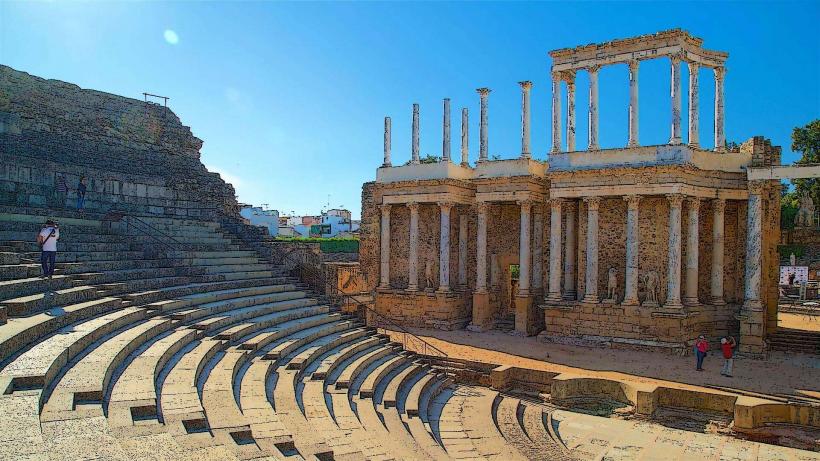
Teatro y Anfiteatro Romano: 1.5km Southeast
Temple of Diana: 1.2km South
Proserpina Dam: 5km North
National Museum of Roman Art: 1.4km Southeast
Roman Bridge (over the Guadiana): 1.8km South