Information
Landmark: Bates Mill ComplexCity: Lewiston ME
Country: USA Maine
Continent: North America
Bates Mill Complex, Lewiston ME, USA Maine, North America
The Bates Mill Complex is a former industrial site located in Lewiston, Maine, USA.
This complex comprises multiple brick buildings that once housed textile manufacturing operations.
Visual Characteristics
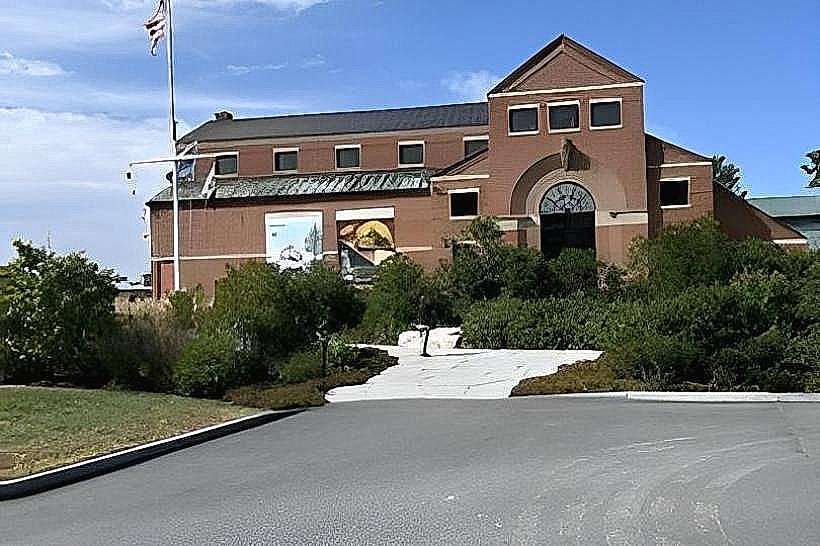
The Bates Mill Complex consists of several large, multi-story brick structures. The primary construction material is red brick, with granite lintels and sills. The buildings feature numerous multi-paned windows, many of which are now boarded or replaced. Rooflines are generally flat or low-pitched, with some sections exhibiting parapet walls. The overall architectural style reflects late 19th and early 20th-century industrial design.
Location & Access Logistics
The Bates Mill Complex is situated in downtown Lewiston, Maine. It is located approximately 0.5km west of the Lewiston City Hall. Access is primarily from Lisbon Street and Canal Street. Ample public parking is available in designated lots surrounding the complex, particularly on Canal Street. The Lewiston Auburn Transit Committee (LATC) bus routes, including Route 1 and Route 2, service stops within a 0.2km radius of the complex.
Historical & Ecological Origin
The Bates Manufacturing Company was founded in 1850. Construction of the initial mill buildings began in the 1850s and continued through subsequent decades, with significant expansion occurring in the late 19th and early 20th centuries. The original purpose was textile production, primarily cotton and woolen goods, utilizing water power from the Androscoggin River.
Key Highlights & Activities
Current activities within the complex include adaptive reuse for commercial and residential spaces. Guided historical tours focusing on the industrial past are sometimes available through local historical societies. Photography of the industrial architecture is permitted from public areas.
Infrastructure & Amenities
Restrooms are available within occupied commercial and residential units. Shade is limited to areas adjacent to buildings. Cell phone signal (4G/5G) is generally strong throughout the complex. Food vendors and restaurants are located on Lisbon Street, within a 0.3km walk.
Best Time to Visit
For architectural photography, early morning or late afternoon light provides optimal illumination of the brickwork. Weather is generally most favorable for outdoor exploration during the months of May through October. No specific tide requirements apply.
Facts & Legends
A notable historical fact is that the Bates Mill was once one of the largest textile manufacturers in New England, employing thousands of workers at its peak. A local legend suggests that the original mill owners had a secret tunnel connecting the main mill to the Androscoggin River for emergency egress, though this has never been definitively proven.
Nearby Landmarks
- 0.2km East: Lewiston City Hall
- 0.3km Northeast: Museum LA (Lewiston Auburn)
- 0.5km South: Kennedy Park
- 1.0km West: Androscoggin Riverwalk