Information
Landmark: Braila Public GardenCity: Braila
Country: Romania
Continent: Europe
Braila Public Garden, Braila, Romania, Europe
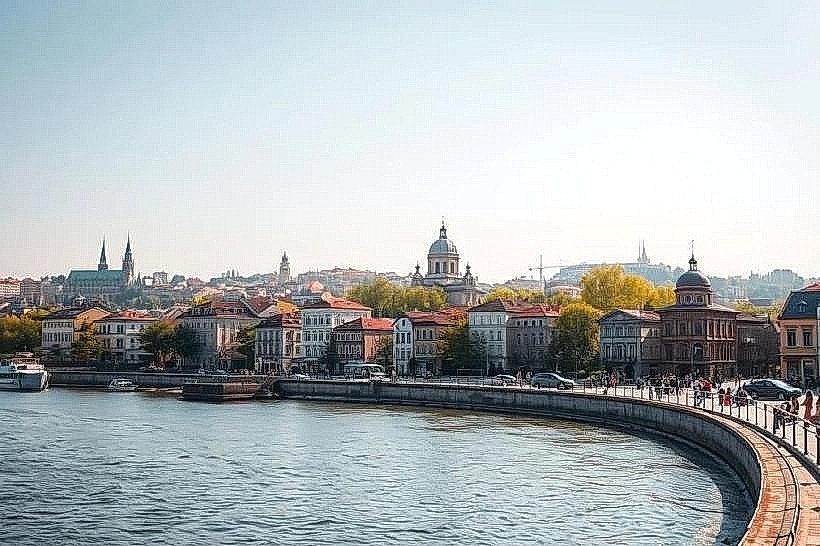
The Brăila Public Garden (Grădina Publică) is a historic park situated on the high plateau of the Danube’s left bank, offering one of the most significant vantage points over the river and the Măcin Mountains.
Visual Characteristics
The park is characterized by its late 19th-century landscape design, featuring wide promenades, centuries-old trees, and circular flower arrangements. The eastern edge consists of a steep embankment with a reinforced stone terrace that functions as a natural balcony overlooking the Danube. The architecture within the park is strictly classical, featuring wrought-iron kiosks and commemorative busts of prominent Romanian cultural figures.
Location & Access Logistics
The park is located at the northern end of Calea Galați, where it meets the Danube cliff. It is approximately 0.8 kilometers north of Traian Square. Access is free and the park is open 24/7. Public transport is available via bus lines 2, 4, and 10. Parking is available along the perimeter streets (Strada Grădinii Publice).
Historical & Ecological Origin
Established in 1833, it is one of the oldest public gardens in Romania. It was designed to provide the city's inhabitants with a space for socialization and "clean air" away from the industrial activity of the port. The park is home to several rare dendrological species and is a critical ecological site for migratory birds passing along the Danube corridor.
Key Highlights & Activities
The Kiosk: A central wrought-iron structure where military brass bands historically performed.
The Belvedere: The terrace area providing a 180-degree view of the Danube loop and the vast plains of Northern Dobruja.
The Clock of the Park: A floral clock that is replanted seasonally to maintain its functionality.
The "Hrube" (Catacombs): Portions of the park sit atop the famous Brăila tunnels, which were massive 18th-century underground warehouses used by the Ottoman administration.
Infrastructure & Amenities
The park features paved walkways, a modern children's playground, and public seating. Several restaurants and terraces are located at the entrance and along the cliff edge. 5G mobile coverage is excellent throughout the garden. Public restrooms are located near the main administrative building of the park.
Best Time to Visit
Sunset is the primary time for visiting the Belvedere to observe the sun descending behind the Măcin Mountains across the river. During the summer, the park offers significant natural shade, making it a preferred location for mid-day cooling.
Facts & Legends
Local legends claim that the underground "hrube" beneath the park were so vast that a horse and carriage could turn around inside them. These tunnels were used for smuggling and grain storage during the city's time as a "porto-franco" (free port). In the interwar period, the park was the site of high-society "corsos" (promenades) where strict dress codes were often informally observed.
Nearby Landmarks
Panait Istrati Memorial House: 0.1km South (located within the park perimeter)
The Water Tower: 0.5km South
Maria Filotti Theatre: 0.9km South
Danube Promenade: Accessible via the stairs at the eastern edge of the park.