Information
Landmark: Esztergom SynagogueCity: Esztergom
Country: Hungary
Continent: Europe
Esztergom Synagogue, Esztergom, Hungary, Europe
The Esztergom Synagogue is an important historical and architectural landmark in Esztergom, Hungary. It was one of the key places of worship for the Jewish community in the city and serves as a testament to the once-thriving Jewish presence in the region. While no longer functioning as a synagogue, it holds significant cultural and historical value today.
History of the Esztergom Synagogue
Construction and Early Years:
- The Esztergom Synagogue was built in the late 19th century, specifically in 1861, during a period of significant development and urbanization in Esztergom. At the time, the Jewish community in Esztergom was growing, and the synagogue was constructed to serve the needs of the local Jewish population.
- The synagogue was built in the Neoclassical style, which was popular at the time, and it included architectural features that were designed to accommodate the religious practices and needs of the Jewish community.
Jewish Community in Esztergom:
- The Jewish community in Esztergom dates back to the 18th century, and by the 19th century, it had grown substantially. Jewish families were involved in various businesses and trades, and they were an integral part of the social and economic fabric of the city.
- The synagogue became an important center of religious life and also a hub for the community’s cultural and social activities. It was also closely linked to the nearby Esztergom Jewish cemetery, which contains many graves of notable Jewish families.
Decline and Closure:
- In the early 20th century, the Jewish community in Esztergom, as in many parts of Hungary, began to face challenges due to increasing anti-Semitism, especially during the years leading up to and following World War II. The rise of Nazi Germany and Hungary’s involvement in the war led to the deportation of many Jews from Esztergom and other Hungarian cities to concentration camps, devastating the local community.
- Following the war, the Jewish population of Esztergom never fully recovered, and the synagogue was no longer needed as a place of worship for a vibrant community. In the subsequent decades, the building fell into disuse and neglect, and its religious functions ceased.
Recent Restoration and Current Use:
- After many years of disrepair, the Esztergom Synagogue was restored in the 1990s with efforts to preserve its historical value and architectural integrity. The restoration was part of broader efforts to commemorate Hungary’s Jewish heritage and restore historical Jewish sites that had been impacted by World War II and subsequent neglect.
- Today, the synagogue is no longer a functioning place of worship but is instead a historical monument. It serves as a reminder of the once-thriving Jewish community in Esztergom and is a site of cultural interest and heritage tourism.
Architectural Features
Neoclassical Design:
- The synagogue’s architecture is characterized by its Neoclassical style, which was common in many Hungarian synagogues built during the 19th century. The design features a large central hall with symmetrical proportions, high ceilings, and large windows that allow for plenty of natural light.
- The interior is simple yet elegant, with details that reflect both Jewish tradition and the architectural influences of the period.
Facade and Exterior:
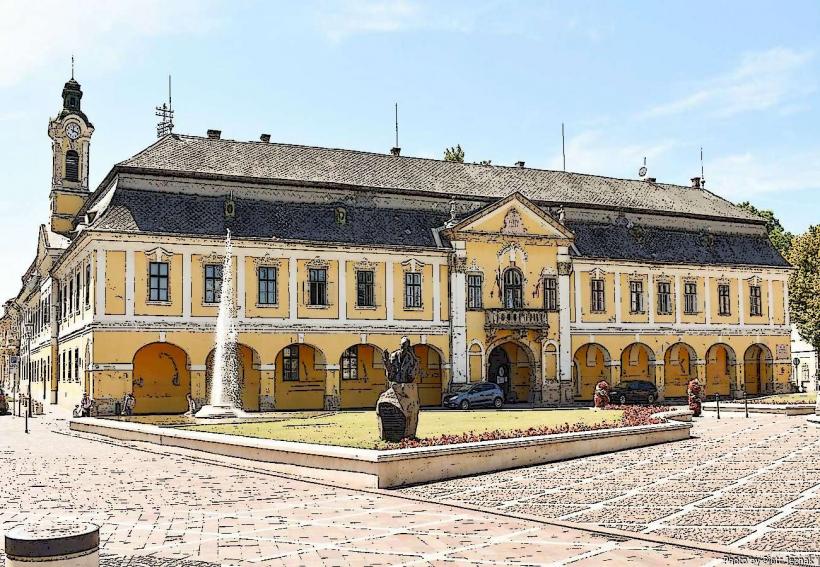
- The exterior of the synagogue is relatively modest, with a simple façade adorned with columns and decorative elements. The entrance is framed by an arch, typical of Neoclassical synagogue architecture, and there are symmetrical windows on either side.
- The building’s stone exterior is typical of synagogues from this period in Hungary, and its design reflects a blend of Jewish and secular architectural trends.
Interior:
- Inside, the synagogue is arranged in a way that accommodates traditional Jewish worship, with a bimah (central platform for prayer readings) and the ark (where the Torah scrolls are kept). Although much of the original interior has been altered over time, some architectural features still remain, providing insight into its original design.
Restoration Efforts:
- The restoration of the synagogue was focused on preserving the historical integrity of the building while adapting it for new uses. Some of the original decorations and architectural features have been restored, while others have been left to reflect the passage of time.
- The synagogue is now used for cultural events and exhibitions, providing an opportunity for visitors to learn more about the history of the Jewish community in Esztergom and Hungary in general.
Cultural and Historical Significance
Symbol of Esztergom’s Jewish Heritage:
- The Esztergom Synagogue serves as an important symbol of the Jewish community’s role in the history of the city. The synagogue itself is a reminder of the rich cultural heritage that the Jewish population contributed to Esztergom’s development in the 19th century.
- The Esztergom Jewish cemetery, located nearby, is also an important site that reflects the history of the city’s Jewish residents and serves as a memorial to those who were lost during the Holocaust.
Holocaust Remembrance:
- As part of the larger context of Jewish heritage sites in Hungary, the Esztergom Synagogue is an important place of remembrance for the Holocaust and the tragic events that affected Hungary’s Jewish population during World War II. Efforts to preserve the synagogue contribute to raising awareness of this part of Hungary’s history.
Tourism and Education:
- The Esztergom Synagogue is part of a broader effort to promote Jewish heritage tourism in Hungary. It is often included in tours of Esztergom, alongside the nearby Esztergom Basilica and other historical sites.
- Visitors to the synagogue can learn about the history of the Jewish community in the city and its significance in the broader context of Hungary’s Jewish history.
Conclusion
The Esztergom Synagogue is a historically significant building that reflects the once-thriving Jewish community of the city. Although it no longer serves as an active place of worship, the synagogue remains an important symbol of Esztergom’s cultural and religious diversity. Through its architectural beauty, historical significance, and restoration efforts, the synagogue is an integral part of the city’s heritage, providing a window into the past and a reminder of the resilience and contributions of Hungary’s Jewish community. Today, the Esztergom Synagogue serves as a place of reflection, education, and cultural appreciation, allowing visitors to learn about the important history of Jewish life in the city and Hungary.