Information
Landmark: Mbunza Living MuseumCity: Rundu
Country: Namibia
Continent: Africa
Mbunza Living Museum, Rundu, Namibia, Africa
The Mbunza Living Museum is an interactive cultural school and communal enterprise located on the banks of Samsitu Lake, 14km west of Rundu. It functions as a pre-colonial living history site dedicated to the preservation and demonstration of the traditional Mbunza Kavango culture.
Visual Characteristics
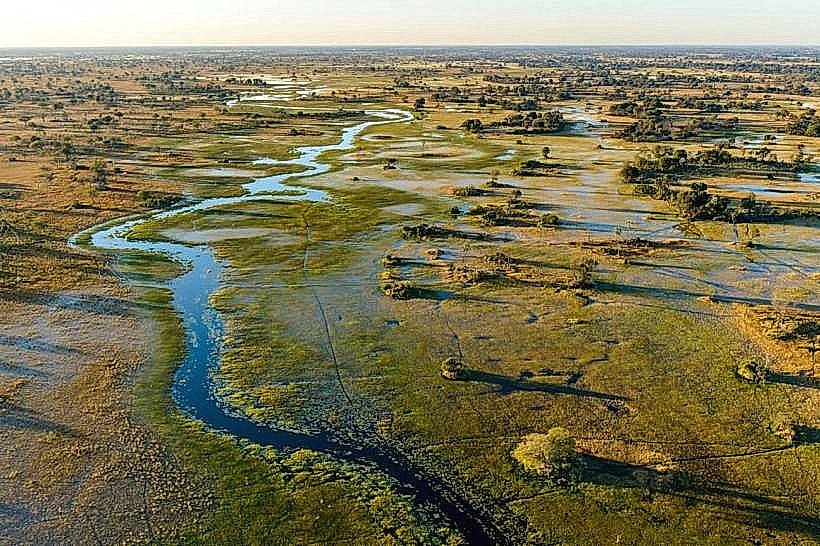
The museum is constructed as a traditional homestead using entirely natural materials, including mopane wood, reeds, and grass thatch for the conical huts. The central courtyard is enclosed by a reed fence, featuring designated areas for blacksmithing, pottery, and cooking. The participants wear historical garments made of self-tanned leather, refined with Mangetti nut oil, while the surrounding landscape is dominated by the silver-leafed vegetation and riparian wetlands of the Okavango River basin.
Location & Access Logistics
The site is situated approximately 14km west of Rundu. From Rundu, travelers take the B10 highway toward Nkurenkuru for 10km before turning onto a signposted gravel road (D2924) for the final 4km. During the high-water months of January to March, flooding may isolate the museum, at which point the final kilometer is bridged by a boat service provided by the museum staff. Ample gravel parking is available at the reception area.
Historical & Ecological Origin
The Mbunza Living Museum was inaugurated on October 22, 2011, in collaboration with the Living Culture Foundation Namibia (LCFN). It was established to serve as a sustainable business for the Mbunza community, transitioning their ancestral knowledge into an educational product. Geographically, it occupies a strategic position on the northern edge of the Kalahari basin, adjacent to the perennial water systems of the Okavango River, which has supported the matrilineal Mbunza clans for centuries.
Key Highlights & Activities
Programs range from short 1.5-hour introductions to full-day immersive workshops. Specific activities include demonstrations of blacksmithing (forging iron tools), traditional pottery molding, and weaving mats and baskets. Visitors can participate in bushwalks focusing on medicinal plant identification and traditional fishing techniques using reed traps. Each program concludes with traditional songs, dances, and games.
Infrastructure & Amenities
The facility was upgraded in September 2024 to include a small campsite with integrated sanitary facilities, including a solar-powered water pump, shower, and toilet house. There is no grid electricity on-site, and visitors should rely on 4G cellular signal, which is generally stable due to the proximity to Rundu. No food vendors are on-site, though basic snacks and crafts are available at the reception kiosk; full services are located 14km away in Rundu.
Best Time to Visit
The dry season from May to October offers the best accessibility and comfortable daytime temperatures for outdoor demonstrations. For photography, the late afternoon provides the best light to capture the textures of the thatched huts and the leather garments without the harsh glare from the lake. Visitors during the wet season (January–March) should be prepared for the aforementioned boat transfer if the access road is submerged.
Facts & Legends
The Mbunza people follow a matrilineal inheritance system where the mother's brother (the maternal uncle) often holds more social significance for a child than the biological father. A local legend centers on Karunga, the supreme being who is believed to manifest in the wind; hunters historically viewed shifting winds as a sign that Karunga was acting on behalf of the ancestors to protect the game.
Nearby Landmarks
Samsitu Campsite – 0.5km South
Rundu Beach – 11.7km East
Rundu Open Market – 12.8km East
Sarusungu River Lodge – 12.3km East