Information
Landmark: Peterhof PalaceCity: Saint Petersburg
Country: Russia
Continent: Europe
Peterhof Palace, Saint Petersburg, Russia, Europe
Overview
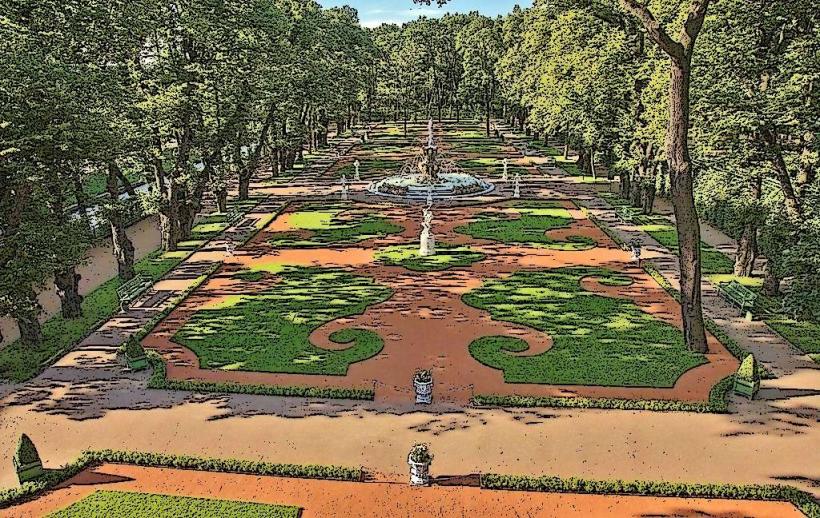
Frankly, Peterhof Palace, or Petergof, often called the Russian Versailles, stands as one of Saint Petersburg’s most iconic landmarks, with golden fountains that catch the sunlight like sparks, besides the palace, with its soaring arches, intricate gardens, and fountains that catch the sunlight in silver spray, stands as a vivid symbol of the Russian imperial era’s grandeur and opulence.Tsar Peter the Great built it as his summer retreat and the heart of the Russian court, crafting it to match the glittering grandeur of Western Europe’s palaces, as a result first, partially Peterhof sits on the edge of the Gulf of Finland, about 29 kilometers-roughly an easy half-hour drive-west of Saint Petersburg, alternatively the spot sits at 59.8872° north, 29.9728° east, where the air smells faintly of salt from the sea.Peterhof stays open all year, but it draws the biggest crowds in spring and summer, when the gardens burst with color and the fountains spill in glittering arcs, in turn hours can shift with the season-summer might run later into the warm, gold-lit evenings.Number two stood alone, a tiny black mark on the page like a pebble on white sand, moreover in 1714, Tsar Peter the Great ordered the building of Peterhof Palace as his country retreat just outside Saint Petersburg, where the air smelled of pine and sea.The palace was built to proclaim Russia’s imperial might, a stone-and-gold echo of Peter the Great’s drive to drag the nation into a modern age, not only that peter designed the palace himself, taking cues from the sweeping halls and gilded rooms he’d admired in Western Europe-most of all, the splendor of Versailles in France.Architectural Design: German architect Bartolomeo Rastrelli designed the palace, later going on to create many of Russia’s grand Baroque landmarks, their gilded domes gleaming in the sun, furthermore jean-Baptiste Le Masson, a French architect, played a key role in shaping its design, focusing on the lower garden and the cascading fountains that spill like silver threads into the pool below.The palace’s construction started in 1714 and wrapped up in 1725, though modern wings, gardens, and fountains-like one that spilled cool water into a marble basin-were added in the years that followed, on top of that imperial Residence: Over the centuries, Peterhof Palace grew into the Russian royal family’s beloved summer retreat, where sea breezes drifted in through gilded windows.Catherine the Great, Alexander I, and other Romanovs escaped here, wandering gilded halls and resting in quiet gardens far from Saint Petersburg’s noisy streets, what’s more after the 1917 Russian Revolution toppled the Romanov monarchy, the state seized Peterhof Palace and turned it into a museum, its gilded halls suddenly open to the public.German forces left the palace in ruins during World War II, shattering windows and scorching its once-shining walls, besides thieves carried off many of its statues, fountains, and artworks, while others lay shattered in the dust, not entirely But after the war, crews worked for years to restore the palace, polishing its marble floors until they gleamed and bringing back its original splendor, at the same time three.Architecture and Design: Peterhof Palace showcases the grandeur of Russian Baroque and the elegance of Neoclassical style, with gilded facades that catch the afternoon sun, not only that the palace and its gardens dazzle with ornate carvings, sweeping grandeur, and a seamless blend of art, nature, and precise engineering, maybe As you can see, Key Features: Grand Palace - At the heart of the Peterhof complex, the Grand Palace rises in gleaming gold and white, drawing every eye, along with the building blends baroque and classical styles, with curling stucco patterns, gold-leafed walls, and decorations that dazzle the eye.Golden domes catch the sunlight, while tall windows and cool marble columns give the palace a glance that’s both strong and graceful, also inside the Grand Palace, you’ll find a maze of chambers-the glittering State Rooms, the ornate Throne Room, and the Romanovs’ private apartments, where velvet curtains still catch the light, for the most part Lower Gardens: Perhaps the most celebrated part of Peterhof Palace, the Lower Gardens dazzle with sweeping lawns, bursts of luminous flowers, and the splash of ornate fountains, moreover geometric paths wind between flower beds and straight rows of trees, framing the fountains and the palace in a scene as crisp as freshly cut stone.Mind you, Fountains and Waterworks: Among Peterhof’s most striking sights is its intricate network of fountains, their arcs of water catching the sunlight, often likened to the grandeur of Versailles’ gardens, furthermore with more than 150 fountains splashing into its pools, the complex holds the title of the largest fountain ensemble in the world.These fountains ran without pumps, relying instead on a clever network of gravity-fed channels and tumbling cascades to power the glittering arcs of water, meanwhile the Grand Cascade, Peterhof’s most celebrated fountain, spills down in glittering tiers right in front of the palace.Truthfully, It spills over a chain of terraces, weaving past more than 200 statues, gleaming gold figures, and sharp arcs of water, meanwhile at the center stands a statue of Samson prying open a lion’s jaws, a scene meant to evoke Russia’s triumph over Sweden in the Great Northern War (1700–1721).The Samson Fountain, set in the heart of the Grand Cascade, stands as one of Peterhof’s most famous sculptures, with water bursting from the lion’s jaws in a glittering arc, simultaneously it shows Samson wrestling a roaring lion, a vivid emblem of the Russian Empire’s might and unshakable strength, generally As it turns out, The fountain shoots towering streams of water into the air, sending up a fine mist that takes your breath away, as a result the Chesma Fountain, built in elegant Neoclassical style, shows off sculpted lions crouched in stone and dolphins frozen mid-leap.You’ll find it in the Upper Gardens, where it connects to a network of smaller fountains and quick, sparkling water jets, in addition the Lion Cascade features a chain of fountains tumbling from the upper terrace to the lower gardens, where golden lions glint in the sunlight beside carved mythic figures.Number four, in conjunction with the gardens around Peterhof Palace burst with fountains and manicured paths, forming the heart of the estate’s grandeur.The gardens, laid out in the formal French style, showcase neat rows of blooms, tall shade trees, and ornate stone details, subsequently upper Gardens: Set just a short meander from the palace, these gardens follow a formal, perfectly balanced design, with paths that seem to mirror each other, generally Honestly, Hedges, trimmed lawns, and precise flower beds line the space, giving it a crisp, orderly behold, likewise here, among trimmed hedges and the scent of wet stone, you’ll find some of the palace’s most treasured fountains and sculptures.Lower Gardens: Sloping gently toward the Gulf of Finland, the Lower Gardens are known for dozens of glittering fountains and wide sweeps of manicured lawns, therefore these gardens feel a bit looser in style, yet every path and planting still falls into spot with quiet precision.In the Lower Gardens, the fountains steal the show, and visitors wander along winding paths beside sprays that catch the sunlight, meanwhile orangeries: In the gardens, these glass-walled shelters kept fragile plants alive through the bitter winter and stood as shining displays of the Russian court’s wealth and prestige.Even now, visitors wander through the last of the antique greenhouses, pausing to take in the sparkling bursts of seasonal blooms, furthermore five.Interestingly, Today, Peterhof Palace draws crowds from around the world, its golden fountains still dazzling visitors, and it proudly holds a area on UNESCO’s World Heritage list, in turn this treasured cultural and historical landmark draws millions each year, eager to observe its graceful arches, hear the rush of its fountains, and marvel at the history etched into every stone.If you’re in Saint Petersburg, don’t miss Peterhof-the palace’s golden fountains alone are worth the trip, furthermore visitors can wander through the grand rooms, their footsteps echoing softly across polished marble floors.
Author: Tourist Landmarks
Date: 2025-09-21