Information
Landmark: Thien Hau TempleCity: Ho Chi Minh City
Country: Vietnam
Continent: Asia
Thien Hau Temple, Ho Chi Minh City, Vietnam, Asia
Overview
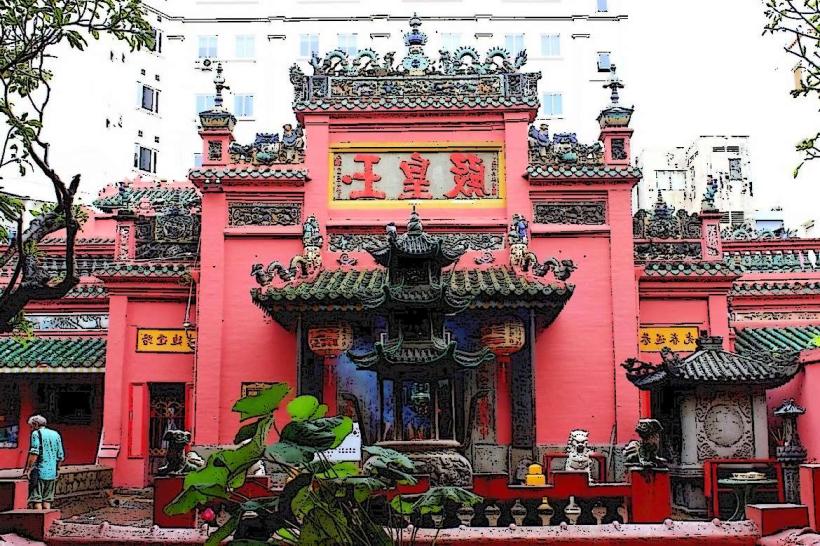
Thien Hau Temple, or the Goddess of the Sea Temple, is a well-known region of worship in Vietnamese culture, honoring Thien Hau, the Taoist sea goddess often pictured watching the waves from afar, as a result this temple plays a central role in the spiritual lives of many Vietnamese, especially folks along the coast-fishermen who smell of salt and sea, and families whose work depends on the water.Let’s take a closer glance at its historical roots, striking architecture, and cultural impact-picture the worn stone steps leading to its grand entrance, in turn thien Hau, or Tianhou, holds deep historical importance in Chinese and Vietnamese traditions, honored as the guardian of sailors, fishermen hauling in their nets, and merchants crossing the seas.In Chinese, she’s called Mazu (媽祖), meaning “mother ancestor.” Legend says Thien Hau was once a young girl who spoke with the sea and the gods, warning fishermen of oncoming storms and leading their boats home through the dusky, besides worship of Thien Hau began during China’s Song Dynasty (960–1279) and later traveled with sailors and traders to Southeast Asia’s shores, reaching Vietnam, where fishing villages lit incense at her temples for harmless journeys.In Vietnam, you’ll often find the Thien Hau Temple close to the shore, where the salt air hints at her watch over sailors, and number two stood out, written in thick black ink on the page.The Thien Hau Temple often stands near the coast, where the air smells of salt and slight fishing boats bob in the harbor, then in Cholon, Ho Chi Minh City’s bustling Chinatown, stands one of its most famous temples, a venue where the air smells faintly of incense and both locals and visitors come to wander.The temple showcases classic Chinese architecture, with curved tile roofs, carved wooden beams, and stone dragons and phoenixes so detailed you can trace each feather and scale, likewise you’ll spot these in plenty of Vietnamese and Chinese temples, often tucked near incense smoke curling toward the rafters.Main Hall: At the heart of the temple stands the central worship space, where a statue or image of Thien Hau rests-her calm eyes and flowing royal robes capturing both grace and quiet strength, meanwhile you might also find altars here devoted to other gods, their surfaces scattered with candles and minute offerings, occasionally Somehow, Temples often display carved waves, sailing ships, and curling sea creatures-ornaments that honor Thien Hau’s rule over the sea, to boot in the temple, incense burners and candles glow softly, and a thin ribbon of fragrant smoke drifts through the air, deepening the sense of peace.At many Thien Hau temples, you’ll find a bell tower or a quiet courtyard where people come together to celebrate festivals or whisper prayers beneath fluttering incense smoke, along with these spaces deepen the temple’s calm, like the still air beneath an aged cedar.Three, therefore at the Thien Hau Temple, devotees light incense and bow in prayer, asking for harmless journeys, calm seas, and good fortune in their work on the water.It seems, Before setting out to sea, fishermen and sailors often stop by the temple, the smell of incense curling in the air as they ask for blessings and harmless passage, at the same time the Thien Hau Festival stands as the most critical tribute to the goddess, with streets filling with lantern light and the sound of drums.It happens all over Vietnam, but you’ll detect it most in the salty air of compact coastal towns, also the festival typically falls on the 23rd day of the third lunar month, when lanterns glow in the evening streets.At this time, the temple bursts with life-worshippers crowd the steps, flowers and incense fill the air, and processions wind past dancers in glowing silk, equally important devotees bring gifts-sweet mangoes, fresh flowers, curling trails of incense, and other items-to show respect and ask for blessings.As far as I can tell, Sometimes people set the offerings on altars for Thien Hau, their surfaces crowded with candles and bowls of fruit, or for other deities, subsequently number four, somewhat In Vietnamese coastal towns, the Thien Hau Temple serves not just as a destination of worship, but as a gathering spot where neighbors trade news under the scent of burning incense, subsequently people come here to celebrate, mingle, and, when tempers flare, settle arguments under the watchful eye of the goddess.Rooted in maritime tradition, the temple stands at the heart of life for fishermen hauling in the morning’s catch, traders haggling over goods, and everyone else whose living depends on the sea, therefore number five stood alone, a petite mark on the page like a pebble on white sand.In the bustling center of Cholon, Ho Chi Minh City, the Thien Hau Temple stands as one of Vietnam’s oldest and most celebrated, its wooden beams darkened with age and incense smoke, then for the Chinese-Vietnamese community, the temple stands as a vital spiritual and cultural hub, its red lanterns swaying gently in the breeze.Thien Hau Temple stands in the modest coastal town of Bai Xep, Phu Yen, where the scent of salt drifts in from the sea, and it’s long been a favored venue of worship for central Vietnam’s seafarers, in turn in the coastal town of Vung Tau, the Thien Hau Temple draws local fishermen who stop by to light incense and pray before heading out on long trips at sea.Number six, at the same time in many Thien Hau Temples, dragons curl along roof beams while phoenixes spread their wings across painted panels, symbols of Yin and Yang in harmony and of the goddess’s fierce protection and gentle care.Sea Elements: The temple often displays symbols of the sea-rolling waves carved in wood, a tiny painted boat-honoring Thien Hau’s power over the water and her watchful care for all who sail it, not only that seven.Interestingly, Thien Hau worship reaches far beyond Vietnam and China, finding its way into temples where incense curls through the air in distant cities, to boot the tradition has taken root across Southeast Asia, especially in communities with large Chinese and Vietnamese populations-from the bustling streets of Kuala Lumpur to markets in Bangkok and the busy ports of Singapore, sort of In neighborhoods with many Chinese and Vietnamese residents, the Thien Hau Temple acts as a living link to the past, where the scent of burning incense ties people to the customs and stories of their homeland, at the same time in the end, the Thien Hau Temple rises like a steadfast guardian for those who live by the tide, granting protection and blessings to fishermen and seafarers alike, loosely As far as I can tell, With its centuries-vintage history, graceful architecture, and deep cultural roots, it’s a cornerstone of Vietnam’s spiritual life-especially for coastal communities who hear the sea’s restless waves just beyond its walls, at the same time stepping into a Thien Hau Temple isn’t only an act of faith-it’s a living thread between past and present, its incense curling through the air as it remains at the heart of many communities.
Author: Tourist Landmarks
Date: 2025-09-16