Information
City: MatolaCountry: Mozambique
Continent: Africa
Matola, Mozambique, Africa
Matola is the largest industrial center in Mozambique and the capital of Maputo Province. Located west of Maputo, it functions both as a satellite city to the capital and as a critical autonomous economic driver for the country, housing the nation’s primary manufacturing and smelting facilities.
Historical Timeline
Matola transitioned from a small settlement into a major industrial hub during the late colonial period (1950s–1970s) due to the expansion of the Port of Maputo and the railway link to South Africa. It was the site of the 1981 Matola Raid, a significant event during the Apartheid era when South African commandos attacked ANC residences. Following the 1992 peace accords, Matola received massive foreign direct investment, most notably the Mozal aluminum smelter, which transformed the national GDP.
Demographics & Population
The 2026 population is estimated at 1,850,000, having recently surpassed the city of Maputo in total residents. The population is a mix of urban professionals, industrial laborers, and migrants from across the southern provinces. Portuguese is the primary language, with Xichangana spoken widely.
Urban Layout & Key Districts
The city is sprawling and lacks a single concentrated "downtown," instead organized around industrial zones and residential blocks.
Matola 'A' through 'J': Sequential residential neighborhoods ranging from middle-class villas to dense housing.
Liberdade: A vibrant commercial and residential district.
Machava: Home to the national stadium and significant industrial infrastructure.
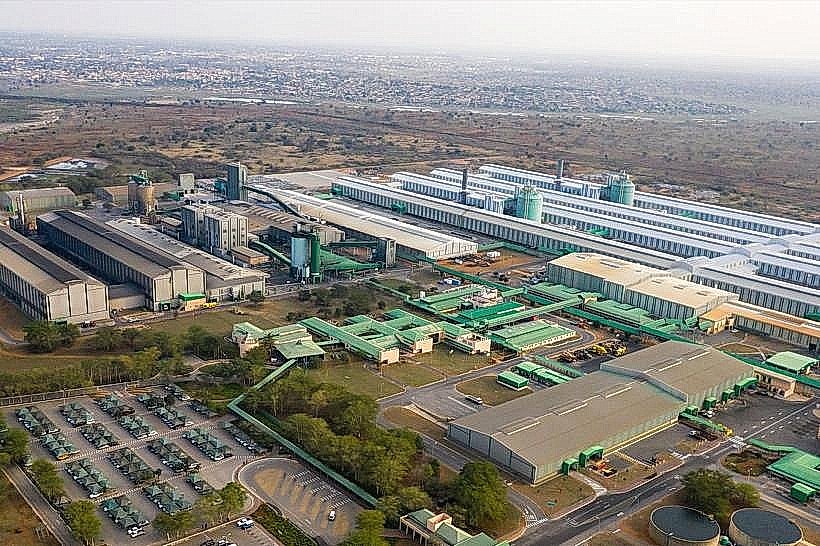
The Industrial Zone: A vast area containing the Mozal smelter, cement factories, and petroleum depots.
Matola Rio: A rapidly developing upscale residential area on the city's western edge.
Top City Landmarks
Mozal Aluminum Smelter: One of the largest industrial installations in Africa; a symbol of Mozambique's modern economy.
Matola Monument and Interpretive Centre: Dedicated to the victims of the 1981 raid and the liberation struggle.
Estádio da Machava: A historic 45,000-seat stadium where Mozambique's independence was officially proclaimed in 1975.
Matola River: A waterway used for industrial transport and local fishing.
Transportation Network
Matola is a primary node in the Maputo Development Corridor.
Roads: The N4 highway connects Matola directly to Pretoria/Johannesburg (South Africa) and Maputo.
Rail: A vital cargo and commuter rail line runs through Matola, linking the South African border (Ressano Garcia) to the Port of Maputo.
Public Transit: Movement is dominated by chapas and a growing fleet of municipal buses. The traffic between Matola and Maputo is among the most congested in Southern Africa.
Safety & "Red Zones"
Current Status: Exercise High Caution. Matola experiences significant levels of street crime and residential burglaries. Due to its industrial wealth, it has been a focal point for high-profile kidnappings for ransom. Avoid the industrial outskirts and poorly lit residential blocks after dark. High-traffic transit points like the Machava junction are hotspots for pickpocketing.
Digital & Financial Infrastructure
Internet: Fiber-to-the-home and 5G are available in primary residential zones. Average speeds: 30–60 Mbps.
Banking: The currency is the Metical (MZN). South African Rand (ZAR) is frequently used in business transactions due to the proximity to the border.
Finance: Matola has numerous shopping malls (e.g., Matola Mall) with high concentrations of ATMs and bank branches.
Climate & Air Quality
Matola has a tropical savanna climate. Temperatures range from 14°C to 33°C. Air quality is a significant concern; the concentration of heavy industry (smelters, cement, and refineries) results in higher levels of particulate matter compared to Maputo.
Culture & Social Norms
The culture is increasingly cosmopolitan and tied to the South African economy. Tipping is standard in the growing number of modern restaurants (10%). It is a city of "commuters" where social life is often centered around private residences or modern shopping centers.
Local Cost Index
1 Espresso: USD 1.30 (85 MZN)
1 Standard Lunch: USD 9.00 (570 MZN)
1 Liter of Petrol: USD 1.35 (86 MZN)
Nearby Day Trips
Ressano Garcia (80 km): The bustling border town with South Africa.
Maputo (15 km): The capital’s museums and nightlife are easily accessible (traffic permitting).
Facts & Legends
Matola is often called the "Engine Room of Mozambique." A local urban legend claims that the industrial heat from the smelters prevents rain from falling over certain neighborhoods, though this is a misconception of local microclimates. Historically, the city’s growth was so rapid that it officially became a city only in 1972, just three years before national independence.