Information
City: StepantsmindaCountry: Georgia
Continent: Asia
Stepantsminda, Georgia, Asia
Stepantsminda (formerly Kazbegi) is a highland town in northeastern Georgia, situated at an elevation of 1,740 meters. It is defined by its dramatic alpine scenery, its position on the Georgian Military Highway, and its status as the primary base for exploring the high Caucasus.
Historical Timeline
Historically the domain of the Chopikashvili clan, who served as regional toll collectors for the Russian Empire. A critical historical event occurred in 1925 when the town was renamed Kazbegi in honor of the local writer Alexander Kazbegi, a name that persists in popular usage despite the official reversion to Stepantsminda in 2006. In 2018–2019, the completion of the Kobi-Gudauri cable car revolutionized winter access. In 2026, the town is a focal point of Georgia's new Mandatory Travel Insurance enforcement for hikers and climbers entering the high-altitude zones.
Demographics & Population
The 2026 estimated population is approximately 1,400. The residents are predominantly Ethnic Georgians (Mokheves), a highlander group known for their distinct dialect and mountain traditions. The economy is almost exclusively driven by Tourism, Mountaineering, and Logistics related to the nearby Larsi border crossing with Russia.
Urban Layout & Key Districts
The town is split by the Terek (Tergi) River, with the main settlement on the eastern bank.
City Center: The hub for guesthouses, small markets, and the marshrutka terminal.
Gergeti: The village on the western bank, serving as the starting point for the climb to the Trinity Church.
Pansheti: A nearby village known for its mineral water springs and medieval defensive tower.
Top Landmarks
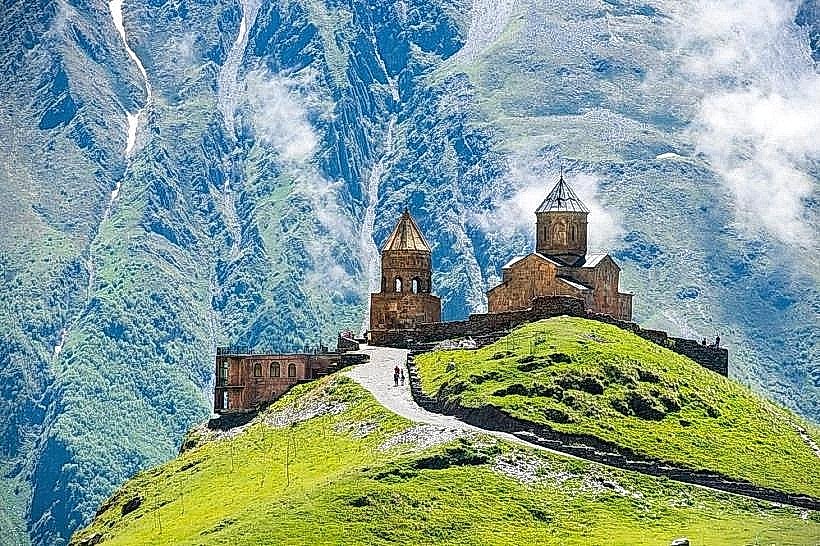
Gergeti Trinity Church (Tsminda Sameba): A 14th-century church perched at 2,170 meters; arguably the most iconic silhouette in Georgia.
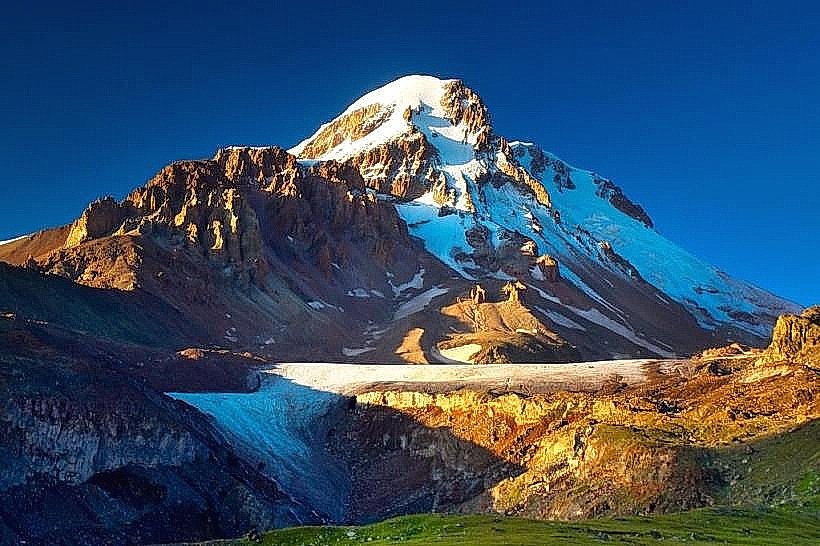
Mount Kazbek (Mkinvartsveri): A dormant stratovolcano (5,054m), Georgia's third-highest peak and a major mountaineering target.
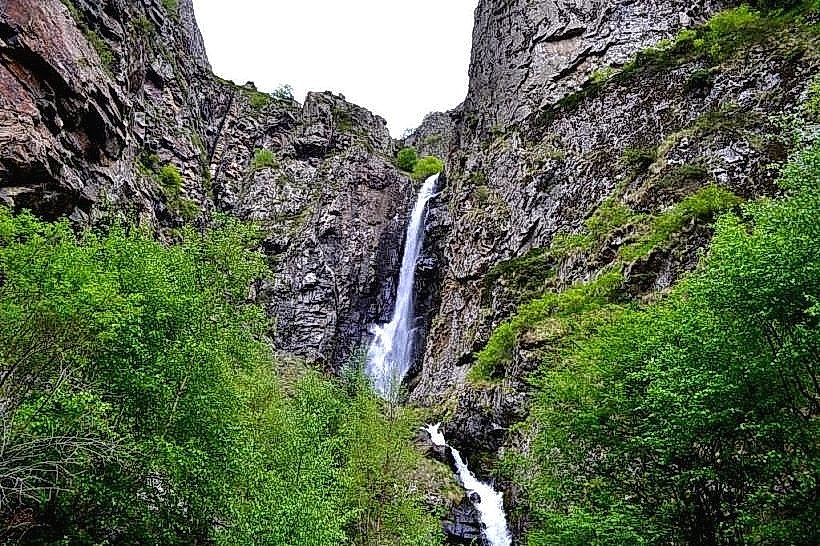
Gveleti Waterfalls: Two powerful cascades (Big and Small Gveleti) located in a narrow gorge north of town.
Alexander Kazbegi Museum: Housed in the writer's former family estate, detailing the history and ethnography of the Khevi region.
Darial Gorge: A dramatic canyon marking the border with Russia, historically known as the "Caucasian Gates."
Transportation Network
Stepantsminda is 157 km north of Tbilisi.
Marshrutka: Depart hourly from Tbilisi's Didube Station (approx. 3–3.5 hours, 15 GEL).
GoTrip: Private transfers are the preferred method for safety and photography stops (approx. 190 GEL per car).
Self-Drive: Requires a 4x4 or high-clearance vehicle, especially in winter. The Jvari Pass can close due to avalanches; in such cases, the Kobi Cable Car serves as the only link.
Internal: While a paved road now leads to Gergeti Trinity Church, many still opt for the 1.5-hour hike or local 4x4 Delica taxis (approx. 70 GEL).
Safety & Health
The town is safe, but the environment is high-risk. Mountain weather changes instantly; hikers should never attempt the Gergeti Glacier or Kazbek summit without a guide. In 2026, all foreign visitors must have Travel Insurance (minimum 30,000 GEL coverage) covering mountain activities. The Larsi Border is 10 km north; travelers should avoid the massive truck queues that frequently clog the main road.
Digital & Financial Infrastructure
4G connectivity is stable in the town center via Magti. The Lari (GEL) is the currency. ATMs are available in the center, though they frequently run out of cash during peak summer/winter weekends. Rooms Hotel Kazbegi serves as the digital nomad hub, offering high-speed Wi-Fi and co-working amenities.
Climate & Ecology
Dfc (Subarctic/Alpine). Summers are cool (average 14°C in July), and winters are harsh and long. In 2026, the Kazbegi National Park continues to focus on protecting the Caucasian Tur (mountain goat) and the Caucasian Black Grouse. The region is characterized by subalpine meadows and high-altitude birch forests.
Culture & Social Norms
The Mokheve people maintain a rugged, traditional lifestyle. Respect for the Gergeti Trinity Church is paramount; modest dress is required (wraps provided at the entrance). Cuisine is heavy and suited for the cold, featuring mountain Khinkali (traditionally made with lamb and wild herbs) and Mokheve Khachapuri (stuffed with local mountain cheese).
Local Cost Index
1 Standard Meal: $10.00–$20.00 USD.
4x4 Ride to Gergeti: $15.00–$25.00 USD.
Mid-range Guesthouse Night: $35.00–$70.00 USD.
Nearby Day Trips
Juta & Chaukhi Massif: A remote village known as the "Georgian Dolomites," ideal for trekking.
Truso Valley: A volcanic valley famous for travertines, mineral springs, and abandoned Ossetian villages.
Facts & Legends
According to Greek mythology, Prometheus (Amirani in Georgian) was chained to Mount Kazbek as punishment for stealing fire. A local legend says the Bethlemi Hut (a cave monastery at 4,100m) once housed the Holy Family's tent. Another fact: the road to Stepantsminda is the only functional land link between Georgia and Russia. In 2026, the town remains the undisputed "Crown Jewel" of the Georgian Caucasus.