Information
City: TunduruCountry: Tanzania
Continent: Africa
Tunduru, Tanzania, Africa
Tunduru is a strategic administrative town and the capital of the Tunduru District in the Ruvuma Region of southern Tanzania. It is situated on the A19 highway, approximately halfway between the cities of Masasi and Songea. The town is globally recognized as a major center for the colored gemstone trade and is a critical transit node for commerce between Tanzania and Mozambique.
Historical Timeline
Tunduru's name is derived from the Swahili words tundu (lion) and uru (land), reflecting its historical status as an untamed wilderness dominated by large predators. For centuries, the area was a crossroads for trade routes connecting the interior to the Swahili Coast. In 1994, the town's trajectory shifted when Swiss gem merchant Werner Spaltenstein discovered massive alluvial deposits of sapphires, chrysoberyl, and alexandrite in the nearby riverbeds, sparking a modern-day "gem rush."
Demographics & Population
The 2026 district population is approximately 460,000, with the town of Tunduru serving as the primary urban core. The predominant ethnic groups are the Yao and Makua. The population is largely rural, with the urban center hosting a diverse mix of gemstone brokers, international traders (primarily from Sri Lanka and Thailand), and agricultural entrepreneurs.
Urban Layout & Key Districts
Central Market Area: The commercial heart of the town, where agricultural produce and general goods are traded.
Gemstone Brokerage District: Located near the town center, characterized by small offices where local miners bring rough stones to be evaluated by licensed dealers.
The Ruvuma River Basin: The geographic boundary to the south, which defines much of the district's mining and agricultural activity.
Masasi-Songea Road (A19): The primary artery around which modern businesses and guesthouses are clustered.
Top Landmarks & Attractions
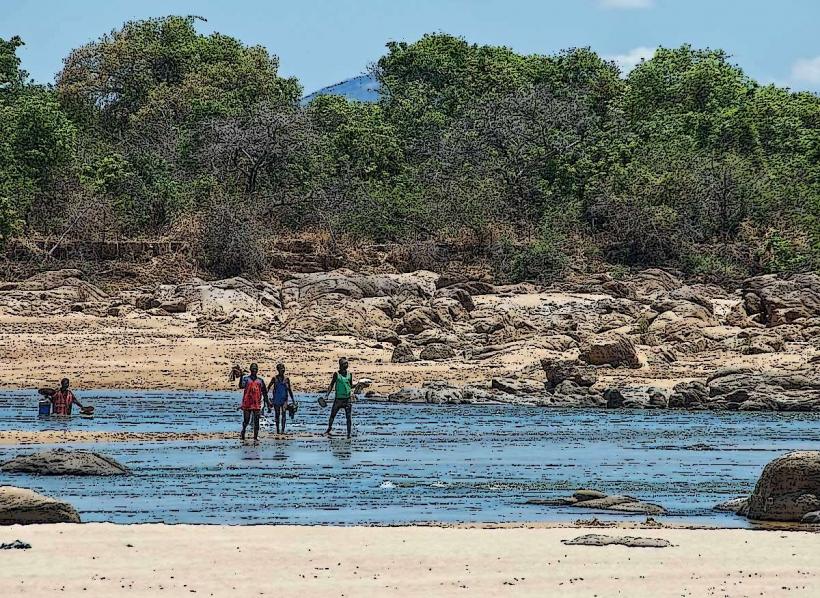
Alluvial Gem Mines: Located along the Muhuwesi, Lumesule, and Ruvuma rivers. While mostly small-scale artisanal pits, they represent the district's primary global claim to fame.
Selous Game Reserve (Nyerere National Park) Boundary: The northern part of the Tunduru district borders this massive wilderness, providing seasonal sightings of elephants and other large mammals.
The Unity Bridge (Daraja la Umoja): Located to the south; a 720-meter bridge across the Ruvuma River that connects Tanzania to Mozambique.
Rolling Granite Inselsbergs: The landscape is dotted with dramatic rock outcrops that rise sharply from the savanna, typical of the Mozambique Belt geology.
Transportation Network
Road: The Mtwara Development Corridor (A19) is the town’s lifeblood. The road is fully paved, significantly reducing travel time to Mtwara ($4$–$5$ hours) and Songea ($3$–$4$ hours).
Cross-Border: Tunduru is the final major stop before the Mtambaswala border crossing into Mozambique via the Unity Bridge.
Air: There is a small unpaved airstrip used for charter flights, though most travelers utilize Mtwara Airport (MYW) or Songea Airport (SGX).
Economy & Resource Extraction
Gemstones: Tunduru is one of the world's most diverse sources of colored stones. It produces blue, pink, and yellow sapphires, as well as rubies, spinels, topaz, and garnets. Most mining is artisanal, involving hundreds of miners working in riverbeds.
Cashew Nuts: Outside of mining, the district is a major producer of cashews, which are processed locally or transported to Mtwara for export.
Timber: The district's vast forests provide hardwood for domestic construction and export markets.
Safety & Health
Mining Hazards: Visiting the gem pits requires local permission; unsecured pits and riverbank erosion present physical risks.
Malaria: Highly prevalent due to the district's extensive river systems and tropical climate.
Wildlife: Due to the "Land of Lions" legacy and proximity to Nyerere NP, human-wildlife conflict (elephants and predators) occurs in rural wards bordering the park.
Digital & Financial Infrastructure
4G connectivity is stable within Tunduru town but disappears quickly in the mining bush. The currency is the Tanzanian Shilling (TZS). Due to the high-value nature of the gem trade, the town has a higher-than-expected concentration of bank branches (CRDB, NMB) and mobile money agents to facilitate large transactions.
Climate & Ecology
Tropical savanna climate ($Aw$).
Weather: High temperatures ($24^\circ\text{C}$–$31^\circ\text{C}$) with a distinct dry season from June to October.
Environmental Impact: Illegal mining in riverbeds has led to significant siltation of the Ruvuma River, prompting strict environmental laws that forbid mining within 60 meters of water sources.
Local Cost Index (TZS)
1 Shared Taxi (Tunduru to Masasi): 15,000–25,000 TZS
1 kg of Raw Cashews (Farmgate): 2,000–3,500 TZS
1 Night in a standard guesthouse: 25,000–45,000 TZS
Facts & Legends
Legend says that the finest "Padparadscha" (pink-orange) sapphires in the world are hidden in the deepest silts of the Tunduru riverbeds, only revealed after catastrophic flooding. A geographic fact: Tunduru is part of the Mozambique Belt, a massive geological formation that contains the world's largest unexploited deposits of colored gemstones. Historically, Tunduru remained one of the most isolated parts of Tanzania until the 2010s, when the completion of the paved road finally connected the "Gem Capital" to the rest of the country's economy.