Information
City: ZuzemberkCountry: Slovenia
Continent: Europe
Zuzemberk, Slovenia, Europe
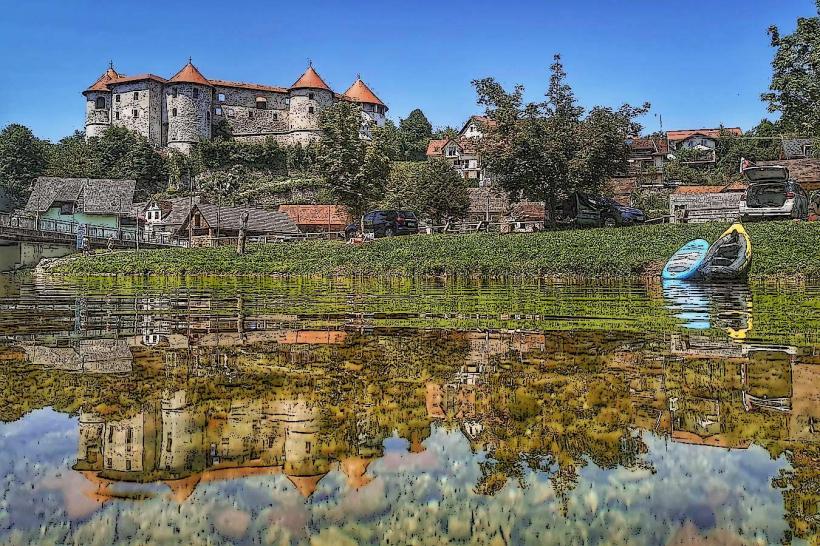
Žužemberk is the administrative and historical center of the Suha Krajina region in southeastern Slovenia. It is situated on a steep cliff above the Krka River, serving as a critical geographic link between the Ljubljana basin and the Lower Carniola (Dolenjska) region.
Historical Timeline
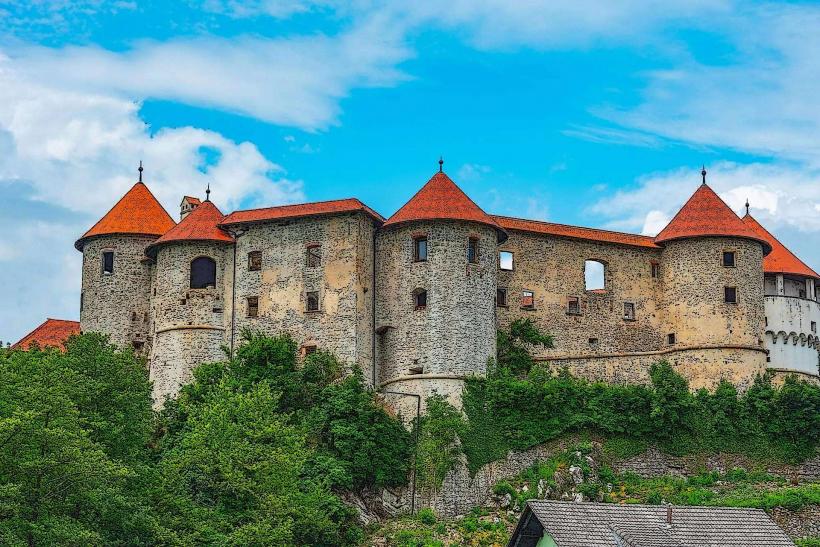
The settlement was first documented in 1246, though the dominant castle was constructed in the early 13th century. It was primarily governed by the Counts of Gorizia and later the Auersperg family, one of the most influential noble houses in the Habsburg Empire. The most significant architectural reconstruction occurred following World War II, as the town and its castle were nearly destroyed by Allied bombing in February 1945 due to the presence of a German garrison. The primary event shaping the current urban form was the decades-long restoration of the castle ruins, which restored the town’s medieval silhouette.
Demographics & Population
The municipality of Žužemberk has a population of approximately 4,710 residents, with the town center hosting roughly 1,100 people. The demographic is predominantly ethnic Slovene (over 95%). The median age of the population is 41.9 years.
Urban Layout & Key Districts
The town is organized around a central square (Trg) and the massive castle complex overlooking the river. The Castle District is the historical and cultural core. The residential sectors extend northward along the main road toward Ljubljana and southward toward the Grajska Planina. The Krka River forms the southern boundary of the town, featuring several tufa cascades and historic mills.
Top City Landmarks
Žužemberk Castle (One of the most picturesque medieval fortresses in Slovenia)
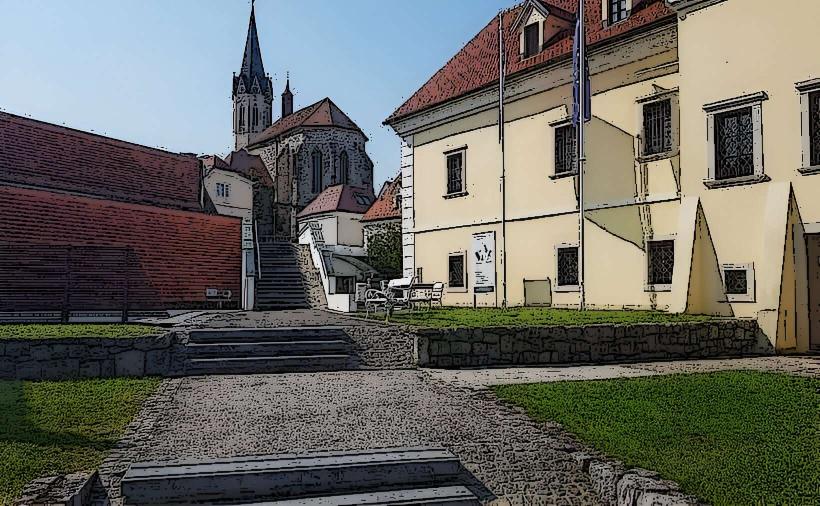
Church of Saints Hermagoras and Fortunatus (Baroque landmark)
The Iron Foundry Museum (Commemorating the Dvor ironworks)
The Tufa Cascades on the Krka River
Roman Tombstones (Integrated into the parish church walls)
Transportation Network
Movement within the town is conducted on foot or via private vehicle. Regional bus lines (Nomago) connect Žužemberk with Novo Mesto and Ljubljana. There is no metro, tram, or railway service. Ride-sharing apps are not available; local taxis must be dispatched from Novo Mesto. Traffic density is low, though the regional road through the town center sees moderate transit traffic.
Safety & "Red Zones"
The safety level is absolute. There are no neighborhoods or "red zones" to avoid. Common scams are non-existent. Standard caution is recommended only for those swimming in the Krka River due to current variations near the cascades.
Digital & Financial Infrastructure
Average internet speeds are 60-80 Mbps. Main mobile carriers are Telekom Slovenije and A1. Card acceptance is high in the local supermarket and established inns, but cash is preferred in smaller cafes. There is one ATM located in the central square near the municipal building.
Climate & Air Quality
Temperatures range from -4°C to 4°C in January and 14°C to 27°C in July. The region is part of the "Dry Karst" (Suha Krajina), meaning surface water is scarce despite the presence of the Krka. Air quality is exceptionally high due to the vast surrounding forests and lack of heavy industry.
Culture & Social Norms
Tipping is not mandatory; 10% is standard for restaurant service. The greeting is a firm handshake. Social life is centered on municipal festivals and heritage preservation. Smoking is prohibited in all indoor public spaces. Local alcohol culture is dominated by the production of Cviček, a unique low-alcohol red and white wine blend.
Accommodation Zones
Stay in the Town Center for immediate access to the castle and historic square. Stay in a Tourist Farm in the nearby village of Dvor for a rural experience near the historic ironworks site.
Local Cost Index
1 Espresso: €1.50 (1.50 EUR)
1 Standard Lunch: €12.00 (12.00 EUR)
1 Bus Ticket (to Novo Mesto): €2.50 (2.50 EUR)
Nearby Day Trips
Dvor (Site of a 19th-century iron foundry): 5 km
Stična Cistercian Abbey: 22 km
Novo Mesto (Regional center): 20 km
Baza 20 (Secret partisan hospital site): 25 km
Facts & Legends
Local legend tells of a secret tunnel that leads from the castle well down to the Krka River, allegedly used by the Auersperg family to escape sieges. A verified historical oddity is the "Iron Rose of Dvor"; during the 19th century, the local foundry was so technically advanced it produced intricate artistic cast-iron products that were exported across the entire Austro-Hungarian Empire, many of which still decorate the town and castle today.