Information
Landmark: Da Dia ReefCity: Phu Yen
Country: Vietnam
Continent: Asia
Da Dia Reef, Phu Yen, Vietnam, Asia
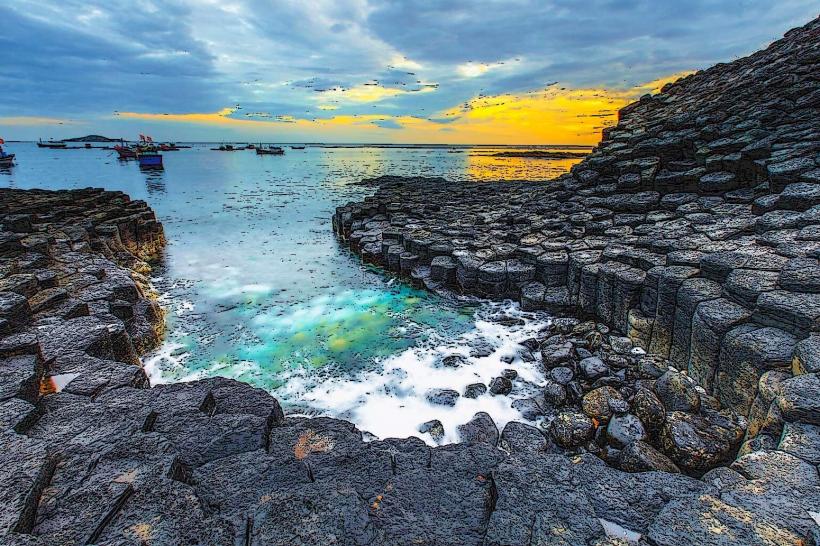
Da Dia Reef is a geological formation located off the coast of Phu Yen province, Vietnam. It is characterized by its unique hexagonal rock columns.
Visual Characteristics
The reef consists of thousands of basalt columns, primarily hexagonal, arranged in a dense, honeycomb-like pattern. The rocks are dark grey to black, formed from volcanic lava. The columns vary in size, with some reaching heights of up to 2 meters. The surrounding water is typically clear, with a blue-green hue.
Location & Access Logistics
Da Dia Reef is situated approximately 25 kilometers north of Tuy Hoa city. Access is via National Highway 1A, turning onto Provincial Road DT641 towards An Ninh Dong commune. The final approach involves a short walk from the parking area. Parking is available at designated points near the reef entrance. Public transport options are limited; local buses may reach nearby villages, but a taxi or private vehicle is recommended for direct access.
Historical & Ecological Origin
Da Dia Reef is a result of volcanic activity that occurred millions of years ago. Molten lava flowed into the sea, and rapid cooling caused the lava to contract and fracture into polygonal shapes, predominantly hexagonal columns. This process is a form of columnar jointing, a common geological phenomenon in basaltic lava flows.
Key Highlights & Activities
Observation of the geological formations is the primary activity. Visitors can walk along the designated paths to view the columns from various angles. Photography is a common pursuit. Swimming is not recommended directly around the reef due to the uneven rock surfaces and currents.
Infrastructure & Amenities
Basic amenities are available at the entrance to the site, including restrooms and small food stalls selling local snacks and beverages. Shade is limited, with natural shade provided by sparse vegetation. Cell phone signal (4G) is generally available in the vicinity.
Best Time to Visit
The best time of day for photography is during the early morning or late afternoon when the sunlight creates distinct shadows on the rock formations. The dry season, from January to August, offers the most favorable weather conditions with less rainfall. High tide can obscure some of the lower columns.
Facts & Legends
Local legend suggests the reef was formed by a giant who broke apart a large rock to create stepping stones across the sea. A verified geological fact is that the precise hexagonal shape is due to the uniform cooling and contraction of the basaltic lava.
Nearby Landmarks
- Mang Lang Church (1.5km Southwest)
- Nhan Tower (22km South)
- Bai Xep Beach (24km South)
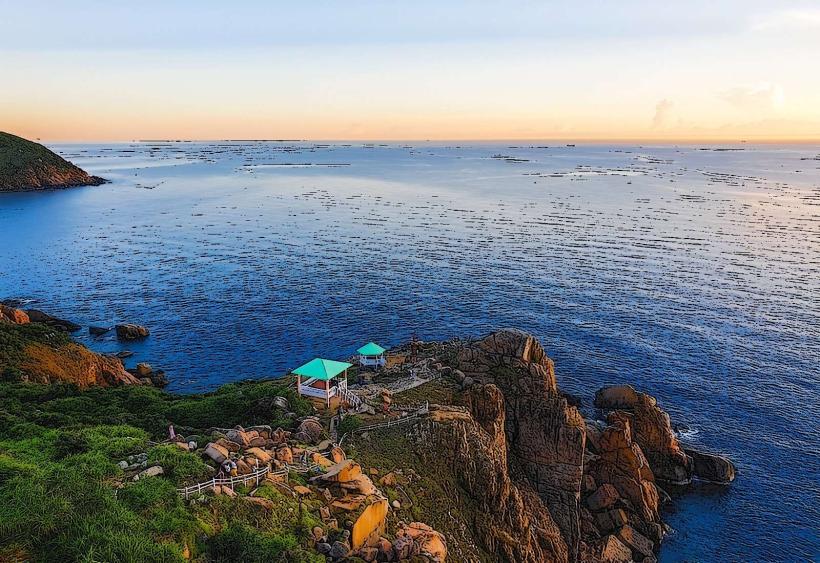
- Ganh Da Dia Lighthouse (0.8km North)