Information
Landmark: DowthCity: Meath
Country: Ireland
Continent: Europe
Dowth, Meath, Ireland, Europe
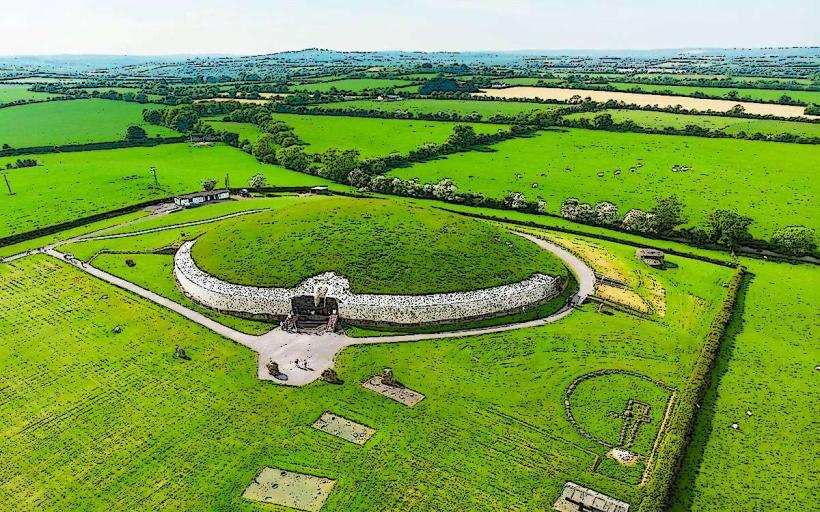
Dowth is a Neolithic passage tomb located in the Boyne Valley in County Meath, Ireland. It is one of the three principal monuments of the Brú na Bóinne UNESCO World Heritage site, situated approximately 2km northeast of Newgrange.
Visual Characteristics
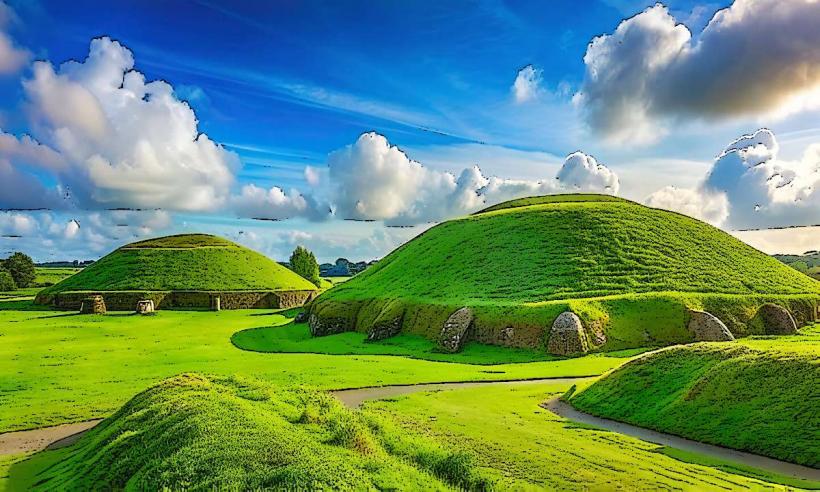
The monument consists of a circular earthen mound approximately 85 meters in diameter and 15 meters high. It is surrounded by a kerb of 115 large stones, though many are currently obscured by earth and vegetation. The mound contains two separate stone-lined passages located on its western side, known as Dowth North and Dowth South, leading to cruciform and circular burial chambers respectively.
Location & Access Logistics
The site is located on a minor road off the N51, approximately 7km west of Drogheda. Unlike Newgrange and Knowth, there is no shuttle bus service; visitors access the site directly via a small roadside parking area at coordinates 53.7038, -6.4504. Pedestrian access to the mound is available through a gate in the perimeter fence. There is no public transport directly to the site; the nearest regional hub is Drogheda.
Historical & Ecological Origin
Dowth was constructed circa 3,200–2,900 BC during the Neolithic period. It was built using locally sourced greywacke stones and river silt. The site was extensively damaged in 1847 during an unscientific excavation by the Royal Irish Academy, which resulted in a large crater at the summit that remains visible today. Geologically, it sits on a glacial terrace composed of carboniferous limestone and shale.
Key Highlights & Activities
Visitors can walk the perimeter of the mound to view exposed megalithic art on the kerbstones, notably Curbstone 51 (the "Stone of the Seven Suns"). The southern passage is aligned with the setting sun of the Winter Solstice. Public access to the interior chambers is strictly prohibited for safety and conservation reasons, though the entrance to the passages can be viewed from the exterior.
Infrastructure & Amenities
Infrastructure at the site is minimal. There are no public restrooms, visitor centers, or indoor facilities. Shade is provided only by a few mature trees at the base of the mound. 4G cell signal is stable due to the site's proximity to Drogheda. Visitors requiring amenities must travel to the Brú na Bóinne Visitor Centre (4km drive) or the town of Slane.
Best Time to Visit
The site is most significant at sunset during the Winter Solstice (December 21st), when the setting sun illuminates the southern passage. For general viewing, the late afternoon provides optimal light for observing the carvings on the western stones. The site is open 24 hours a day, year-round, as it is an unenclosed national monument.
Facts & Legends
According to the medieval "Dindsenchas," the mound was built in a single day by the men of Ireland for King Bresal, who wanted a tower to reach heaven; the project halted when the sun went down prematurely because his sister broke a taboo. The name "Dowth" is derived from the Irish word Dubhadh, meaning "darkness."
Nearby Landmarks
Newgrange – 2.1km Southwest
Knowth – 3.3km West
Brú na Bóinne Visitor Centre – 2.0km South
Battle of the Boyne Site (Oldbridge) – 3.5km East
Netterville Institute – 0.6km North