Information
Landmark: NewgrangeCity: Meath
Country: Ireland
Continent: Europe
Newgrange, Meath, Ireland, Europe
Newgrange is a prehistoric passage tomb located in the Boyne Valley in County Meath, Ireland. It is situated on a ridge overlooking the River Boyne, approximately 8km west of Drogheda.
Visual Characteristics
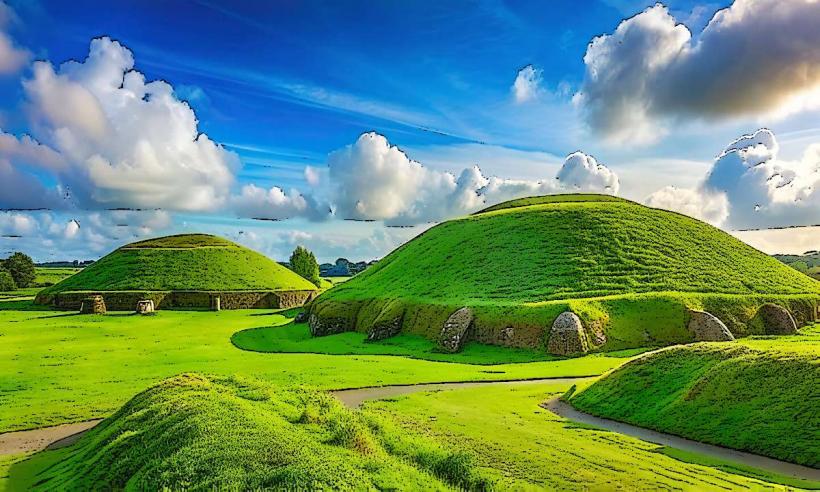
The structure is a large circular mound 85 meters in diameter and 13 meters high, constructed from 200,000 tonnes of earth and stone. The retaining wall at the front is composed of white quartz cobblestones interspersed with dark grey granite boulders. A 19-meter stone passage leads to a central cruciform chamber with a 6-meter-high corbelled roof. The exterior is encircled by 97 large curbstones, many featuring megalithic carvings such as triskeles and spirals.
Location & Access Logistics
Access is strictly managed through the Brú na Bóinne Visitor Centre, located on the south side of the River Boyne near Donore (Latitude: 53.6945, Longitude: -6.4463). From Dublin, it is 55km via the M1 motorway, exiting at Junction 9. Visitors must park at the Visitor Centre and use the official shuttle bus service to reach the monument; there is no direct vehicular access to the site for the public. Public transport is available via the 163 bus from Drogheda bus station to the Visitor Centre.
Historical & Ecological Origin
The monument was constructed approximately 3,200 BC during the Neolithic period, making it older than Stonehenge and the Great Pyramid of Giza. It was built by a settled farming community as a ritual center and burial chamber. The stones were sourced from various locations: the quartz from the Wicklow Mountains (80km south) and the granite from Dundalk Bay (50km north), likely transported via sea and the River Boyne.
Key Highlights & Activities
The primary activity is a guided tour of the inner passage and chamber, which includes a simulation of the Winter Solstice light alignment. Visitors can examine the K1 curbstone, located at the entrance, which displays the most famous examples of Neolithic spiral art. Walking the perimeter of the mound allows for viewing the Great Stone Circle, of which 12 of the original 36 standing stones remain.
Infrastructure & Amenities
The monument site has no facilities to preserve the archaeological landscape. All infrastructure is located at the Brú na Bóinne Visitor Centre, which includes restrooms, a restaurant, a gift shop, and an extensive exhibition area. There is no shade or indoor shelter at the mound itself. 4G cell signal is generally available across the site.
Best Time to Visit
The site is open year-round, but the months of May through September offer the longest visiting hours and best lighting for viewing exterior stone carvings. The Winter Solstice (December 21st) is the most significant astronomical event, though entry to the chamber on this date is restricted to a lottery system. Photography is permitted outside but strictly prohibited inside the passage and chamber.
Facts & Legends
A roof box located above the entrance is precisely aligned so that at dawn on the Winter Solstice, a beam of sunlight enters the opening and travels the length of the passage to illuminate the floor of the inner chamber. Local folklore previously identified the mound as the "Brugh na Bóinne," the home of the Tuatha Dé Danann and the god Dagda.
Nearby Landmarks
Knowth Passage Tomb – 1.2km Northwest
Dowth Passage Tomb – 2.1km Northeast
Battle of the Boyne Visitor Centre – 4.5km East
Old Mellifont Abbey – 4.8km North
Townley Hall Woods – 3.2km East