Information
Landmark: KnowthCity: Meath
Country: Ireland
Continent: Europe
Knowth, Meath, Ireland, Europe
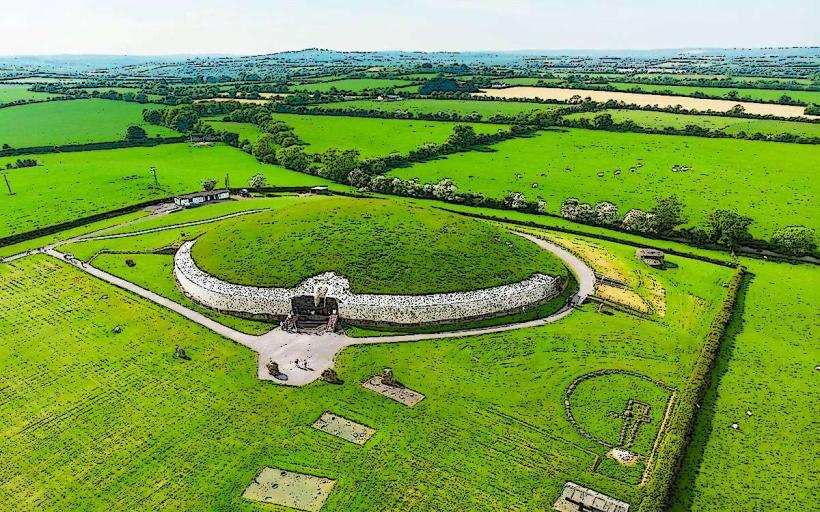
Knowth is a Neolithic passage tomb complex and the largest monument within the Brú na Bóinne UNESCO World Heritage site in County Meath, Ireland. It is situated on the northern bank of the River Boyne, approximately 1km northwest of the Newgrange monument.
Visual Characteristics
The site consists of one large central mound (Site 1) surrounded by 18 smaller satellite tombs. The main mound is approximately 95 meters in diameter and 12 meters high, featuring a flat-topped surface covered in grass. It is encircled by 127 massive structural curbstones, nearly all of which are decorated with megalithic art. Unlike Newgrange, Knowth contains two separate passages located on opposite sides (East and West), ending in distinct burial chambers.
Location & Access Logistics
Access is managed exclusively through the Brú na Bóinne Visitor Centre near Donore (Latitude: 53.6945, Longitude: -6.4463). Visitors must park at the center and board a dedicated shuttle bus. From Dublin, the center is 55km north via the M1 and N2 roads. Direct vehicular access to the monument is prohibited. Pedestrian access involves a bridge crossing over the River Boyne followed by a 10-minute shuttle ride.
Historical & Ecological Origin
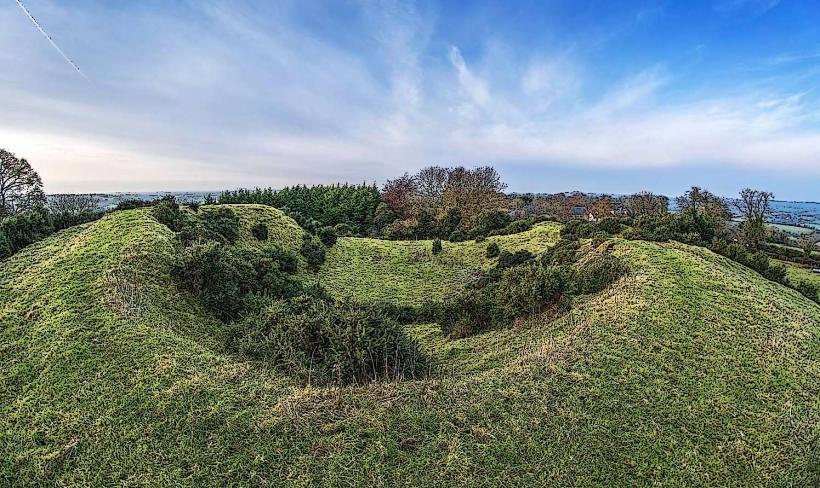
The complex was constructed circa 3,200 BC during the Neolithic period as a burial and ritual site. The site shows evidence of continuous human activity over 5,000 years, including use as a hillfort in the Iron Age and a settlement by Cistercian monks in the 12th century. The geological materials include local greywacke stones and quartz sourced from the Wicklow Mountains.
Key Highlights & Activities
Visitors can walk the perimeter to view the largest collection of megalithic art in Europe, including the famous "Lunar Stone" (Curbstone 52), which appears to depict a lunar calendar. Unlike Newgrange, visitors can climb a modern staircase to the top of the main mound for a panoramic view of the Boyne Valley. Access to the passages is restricted, but the eastern chamber can be viewed from a protected internal viewing area.
Infrastructure & Amenities
All primary infrastructure is located at the Brú na Bóinne Visitor Centre, including restrooms, a café, and an interpretive museum. The Knowth site itself has no toilets, shops, or permanent indoor shelter. 4G/5G cell signal is stable across the ridge. Benches are provided near the shuttle drop-off point for rest.
Best Time to Visit
The site is open seasonally, typically from April through October. Mid-afternoon provides the best oblique lighting for photographing the relief carvings on the western curbstones. Due to its elevated position, the site is highly exposed to wind; waterproof and wind-resistant clothing is necessary regardless of the season.
Facts & Legends
Knowth contains over 25% of all known Neolithic art in Western Europe. Archaeological excavations revealed that in the 10th century, the Kings of Northern Brega established a royal residence on top of the mound, digging deep defensive ditches into the prehistoric structure. A unique tip: Examine Curbstone 15 (the "Sundial Stone") to see one of the earliest known depictions of a solar/equinox tracking device.
Nearby Landmarks
Newgrange Passage Tomb – 1.2km Southeast
Dowth Passage Tomb – 3.3km East
Old Mellifont Abbey – 5.5km Northeast
Battle of the Boyne Site – 5.2km Southeast
Hill of Slane – 4.1km Northwest