Information
Landmark: Hisingsbron BridgeCity: Gothenburg
Country: Sweden
Continent: Europe
Hisingsbron Bridge, Gothenburg, Sweden, Europe
Hisingsbron is a bascule bridge spanning the Göta älv river in Gothenburg, Sweden. It connects the mainland district of Gullbergsvass with Hisingen island, facilitating vehicular, tram, pedestrian, and bicycle traffic.
Visual Characteristics
The bridge is constructed primarily from steel and concrete, featuring a modern architectural design. It has a total length of 440 meters and a width of 28 meters. The structure includes four prominent towers, each approximately 12 meters tall, which house the counterweights for the two movable bascule sections. The main deck is grey, with white accents on the towers and structural elements. Pedestrian and bicycle paths are integrated on both sides of the roadway.
Location & Access Logistics
Hisingsbron is centrally located within Gothenburg, connecting the city center with the southern part of Hisingen. It is directly accessible via local roads leading from the E45 highway. Limited direct parking is available; visitors typically use public parking garages in central Gothenburg, such as those near Nordstan or Lilla Bommen. Numerous public transport options cross the bridge or have stops nearby. Tram lines 4, 5, 6, 10, and 13 utilize the bridge, with key stops at Stenpiren and Lilla Bommen on the mainland side, and Lindholmen on the Hisingen side. Several bus lines also serve these areas.
Historical & Ecological Origin
Construction of Hisingsbron commenced in 2014, with the bridge opening for traffic in May 2021. The design was a collaboration between Dissing+Weitling Architecture from Denmark and ELU Konsult from Sweden. Its primary purpose was to replace the aging Götaälvbron, which had served as the main river crossing since 1939, providing increased capacity and meeting contemporary infrastructure standards for all modes of transport.
Key Highlights & Activities
The bridge facilitates pedestrian and bicycle crossing between the city center and Hisingen. It is a primary route for Gothenburg's tram network and vehicular traffic. Observing the bridge's bascule mechanism in operation, allowing large vessels to pass through the Göta älv, is a notable activity. The elevated position offers panoramic views of the river and surrounding cityscapes.
Infrastructure & Amenities
Restrooms are not available directly on the bridge structure but can be found at nearby public transport hubs such as Stenpiren and Lilla Bommen. Shade on the bridge itself is minimal, primarily provided by the bridge's structural elements. Cell phone signal coverage is strong across the bridge, with reliable 4G and 5G services. Food vendors are not present on the bridge; however, numerous cafes, restaurants, and kiosks are located in the adjacent areas of Stenpiren, Lilla Bommen, and Lindholmen.
Best Time to Visit
For photography, sunrise or sunset provides optimal lighting conditions, highlighting the steel structure and reflecting off the Göta älv. The summer months, from June to August, offer the most favorable weather with milder temperatures and extended daylight hours. The bridge's operation for ship traffic is not tide-dependent, but schedules for large vessel passages can vary and are sometimes published by the Port of Gothenburg.
Facts & Legends
Hisingsbron is the third bridge to occupy this specific location across the Göta älv, succeeding the Götaälvbron and an even earlier pontoon bridge. When fully raised, the bascule sections create a 60-meter wide navigation channel, accommodating significant maritime traffic. A practical tip for visitors is to check the Port of Gothenburg's website for scheduled bridge openings if observing large ship passages is of interest.
Nearby Landmarks
- Lilla Bommen: 0.3km East
- Göteborgsoperan (Gothenburg Opera House): 0.5km Southeast
- Nordstan Shopping Center: 0.7km South
- Maritiman: 0.8km East
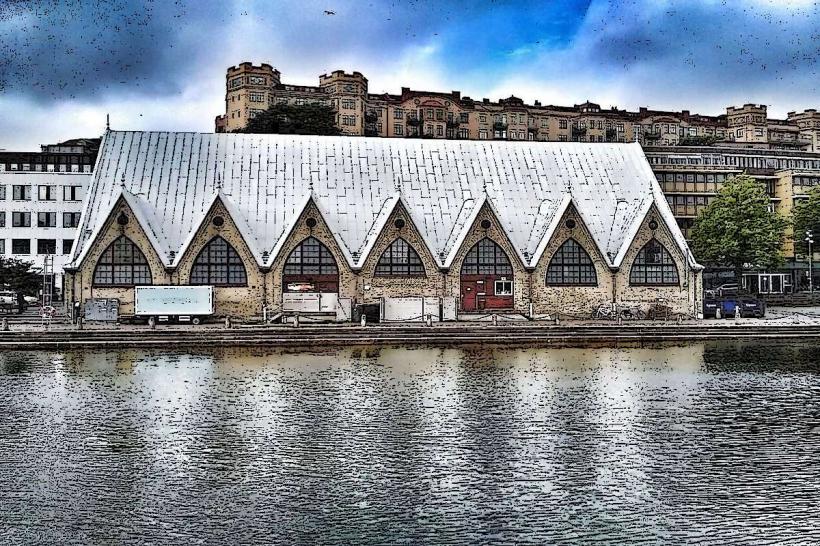
- Feskekôrka (Fish Church): 1.5km West