Information
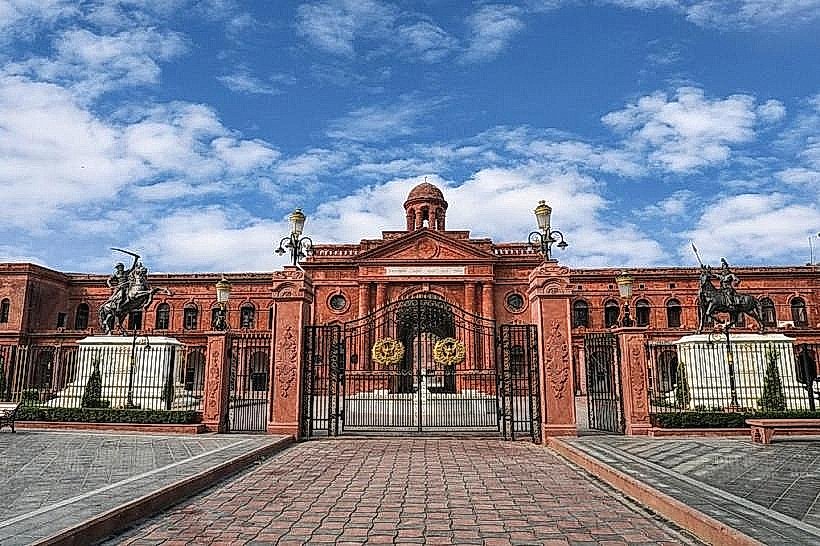
Landmark: Jallianwala BaghCity: Amritsar
Country: India
Continent: Asia
Jallianwala Bagh, Amritsar, India, Asia
The Newcastle Visitor Center is a public information facility located in Newcastle, Wyoming.
Visual Characteristics
The structure is a single-story building constructed primarily from locally sourced sandstone. Its exterior walls are a warm, earthy brown with visible mortar lines. The roof is a low-pitched gable design covered with dark grey asphalt shingles. Large, rectangular windows are present on the front facade, providing natural light to the interior. The building's footprint is approximately 1,500 square feet.
Location & Access Logistics
The Newcastle Visitor Center is situated at 16 East Main Street, directly in the downtown area of Newcastle. It is approximately 0.2 miles (0.3 km) east of the intersection of Main Street and Washington Boulevard. On-street parking is available along Main Street, with approximately 20 metered spaces directly in front of the building. Public transport is limited; the nearest bus stop for the regional transit service is located 0.5 miles (0.8 km) west on Washington Boulevard.
Historical & Ecological Origin
The building was constructed in 1958 as a municipal office building. It was repurposed into a visitor center in 1995. The sandstone used in its construction was quarried from the nearby Black Hills region, a geological formation primarily composed of Precambrian metamorphic and igneous rocks.
Key Highlights & Activities
Information on local attractions, including state parks and historical sites, is available. Maps of the surrounding area are distributed. Staff provide directional assistance and recommendations for dining and lodging. Brochures detailing regional events are accessible.
Infrastructure & Amenities
Restrooms are available for public use. Limited seating is provided within the main lobby area. Cell phone signal (4G) is generally reliable within the building. No food vendors are located on-site, but several cafes and restaurants are within a 1-block radius.
Best Time to Visit
The visitor center is open year-round. For optimal lighting conditions for photography of the building's exterior, late morning or early afternoon provides direct sunlight on the sandstone facade. The best months for visiting the surrounding region are typically May through September due to more favorable weather conditions.
Facts & Legends
A local anecdote suggests that the original blueprints for the building included a small, unbuilt observation deck on the roof, intended to offer views of the distant Black Hills. This feature was omitted due to budget constraints during construction.
Nearby Landmarks
- Newcastle Public Library - 0.1km West
- Weston County Historical Museum - 0.3km Southwest
- Town Square Park - 0.2km Northwest
- Newcastle Post Office - 0.1km West