Information
Landmark: La Mole di AnconaCity: Rimini
Country: Italy
Continent: Europe
La Mole di Ancona, Rimini, Italy, Europe
La Mole di Ancona (also known as the Lazzaretto of Ancona) is a massive pentagonal fortification located in the harbor of Ancona, approximately 95 km southeast of Rimini. It is a premier example of 18th-century military and civil engineering, now serving as the city's primary cultural and exhibition center.
Visual Characteristics
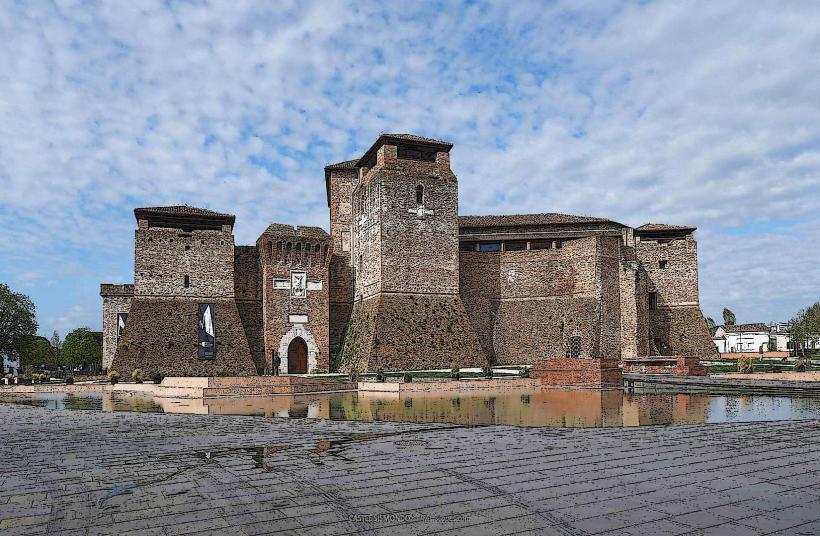
The structure is a monumental pentagon set on an artificial island within the port, connected to the mainland by a bridge. It is characterized by its stark, defensive brick walls and a central neoclassic temple dedicated to Saint Roch. The geometry of the building is its most striking feature, designed to be perfectly symmetrical for both functional and symbolic reasons.
Location & Access Logistics
From Rimini: Accessible via the A14 motorway (approx. 1 hour 10 minutes) or by direct Regional/Intercity train from Rimini to Ancona (approx. 50–70 minutes).
Local Access: The Mole is a 10-minute walk from Ancona Train Station and sits directly on the waterfront (Banchina Giovanni da Chio).
Entry: Access to the internal courtyard and the "Omero" Museum is generally free; specific art exhibitions and concerts require tickets.
Historical & Engineering Origin
Commissioned in 1732 by Pope Clement XII and designed by the celebrated architect Luigi Vanvitelli (who also designed the Royal Palace of Caserta). It was built as a multipurpose facility: a quarantine station for travelers and goods arriving from infected ports, a military fortification, and a massive warehouse. Its pentagonal shape was engineered to isolate different groups of people and goods to prevent the spread of disease while allowing for efficient surveillance from the central temple.
Key Highlights
Museo Tattile Statale Omero: One of the few museums in the world designed specifically for the blind and visually impaired, allowing visitors to touch life-sized plaster casts of world-famous sculptures (like the Pietà and David).
The Internal Courtyard: A vast open-air space used for high-profile summer concerts, film festivals, and contemporary art installations.
The Tempietto di San Rocco: A small, elegant circular temple in the center of the courtyard, which originally housed a freshwater cistern for the quarantined residents.
The Vanvitelli Arches: The internal corridors and vaults showcase the architect's mastery of brickwork and spatial perspective.
Infrastructure & Amenities
The site has excellent 5G coverage. It features a modern cafeteria/bar with outdoor seating overlooking the harbor. Public restrooms are available inside the museum area. The entire ground floor and courtyard are flat and fully accessible for wheelchairs and strollers.
Best Time to Visit
Open Tuesday to Sunday. The Mole is particularly atmospheric in the late afternoon when the sun sets over the Adriatic, illuminating the red brickwork. It is a primary venue for the Adriatico Mediterraneo Festival in late summer.
Facts & Legends
Despite being a quarantine station (a place of isolation), the Mole was designed to be beautiful to reflect the power and enlightened nature of the Papal States. Legend says that Giacomo Casanova was once quarantined here and wrote about his experiences in his memoirs, describing the facility as both a prison and a palace.
Nearby Landmarks
Arch of Trajan: 1.5 km (A well-preserved Roman arch at the port).
Ancona Cathedral (San Ciriaco): 2.0 km (Located on a hill overlooking the harbor).
Passetto Beach: 3.0 km (Famous for its white cliffs and "caves").
Rimini: 95 km Northwest.