Information
Landmark: Montjuic HillCity: Barcelona
Country: Spain
Continent: Europe
Montjuic Hill, Barcelona, Spain, Europe
Overview
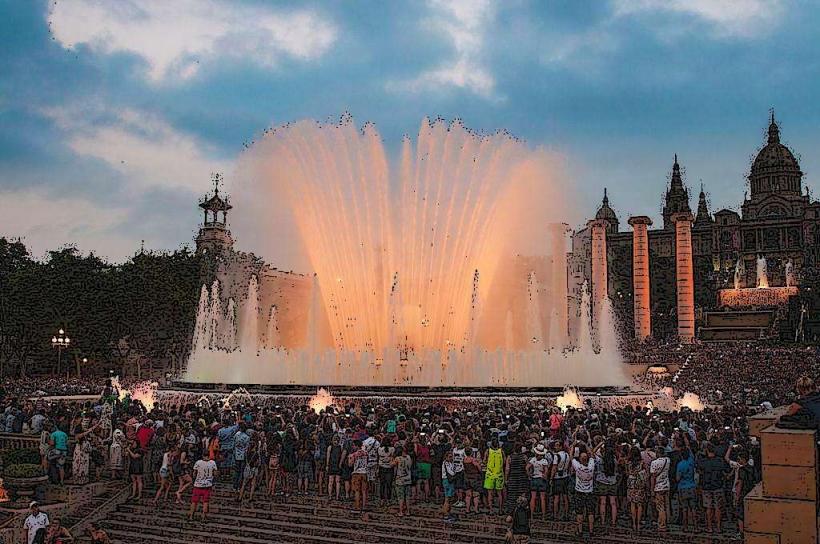
Rising above Barcelona, Montjuïc Hill stands as one of the city’s most loved landmarks, its slopes dotted with gardens and stone paths, consequently montjuïc towers 173 meters (568 feet) over the city, offering sweeping views of Barcelona, the glittering Mediterranean, and the hills that frame the horizon.The hill brims with history and culture, its slopes dotted with shady green parks, drawing both curious tourists and weekend locals, then it’s a region where forest trails, painted murals, centuries-heritage stone walls, and laughter from a nearby park all weave together effortlessly.Here’s what stands out on Montjuïc Hill-its must‑view sights and unique attractions, at the same time montjuïc’s name comes from Catalan, meaning “Jewish Mountain,” a nod to the Jewish cemetery that once crowned its summit in the Middle Ages, where weathered stones looked out over the city, to some extent Over the years, Montjuïc shifted from quiet farmland to a locale of strategic weight and cultural pride, its slopes once echoing with the thud of cannons and the march of soldiers, meanwhile in the 17th century, soldiers raised Montjuïc Castle high on the hill, its stone walls built to guard the city below.Over the centuries, it’s played many military roles, from the Spanish Civil War to the years under Franco’s regime, along with in the 20th century, the hill drew even more attention-first as a centerpiece of the 1929 International Exposition, then as a bustling venue during the 1992 Summer Olympics, when flags snapped in the warm summer breeze.These events spurred major changes to Montjuïc, turning it into a lively center for culture and leisure, with gardens where you can smell the pines, simultaneously montjuïc Castle, a 17th-century fortress, still stands guard on the hill as a reminder of its military past.From the castle walls, you can view the city sprawled below and the blue shimmer of the sea in the distance, likewise you can wander the castle grounds, trace the worn stone walls under your fingertips, and step inside to uncover its history through the exhibits.The fortress houses a museum filled with wartime relics-rusted helmets, faded maps-that reveal its role in the Spanish Civil War, and its courtyards now host open-air concerts, theater shows, and art exhibits, therefore decades later, Montjuïc saw one of its biggest changes when it was reshaped for the 1992 Summer Olympics, roughly The Olympic Ring, or Anella Olímpica, was built to host a range of sporting events, also at its heart stands the Estadi Olímpic Lluís Companys, the main stadium from the Games, where crowds still gather for championship matches, roaring concerts, and lively cultural festivals.Believe it or not, It’s named for Lluís Companys, who led Catalonia during the Spanish Civil War, and Palau Sant Jordi-an indoor arena where Olympic crowds once cheered basketball, handball, and gymnastics, meanwhile these days, it’s the stage for massive concerts and festivals.The Piscina Municipal de Montjuïc, where the 1992 Olympic water polo matches made waves, still shimmers in the sun, meanwhile nearby, the Olympic cauldron that once blazed with the Games’ flame stands tall, a proud marker of Barcelona’s Olympic past.Down the hill, Parc de Montjuïc stretches wide with leafy trails, quiet gardens, and open lawns perfect for a measured afternoon meander, equally important the park’s perfect for a measured, easy amble, with quiet paths where you can hear leaves rustle and forget the city’s noise.The park’s highlights range from the Jardins de Laribal, where fountains trickle beside shaded stone paths, to the formal Jardins de Joan Maragall, wrapped around the Palau de les Comunicacions with lawns, sculptures, and deep green hedges, furthermore you’ll also find the tiny Bonsai Garden tucked away in Montjuïc Park, a colorful Cactus Garden bursting with shapes from around the world, and the Magic Fountain of Montjuïc at the hill’s base-best seen after obscure, when its lights shimmer against the night.The fountain bursts to life with lights and music, a dazzling show that draws both tourists and locals, who often pause to watch the water shimmer in time with the melody, and the fountain bursts into vivid color, dancing in time with the music until you can almost feel the rhythm in the air.Nearby, the Museu Nacional d'Art de Catalunya (MNAC) fills the grand Palau Nacional on Montjuïc with centuries of Catalan art, at the same time the museum boasts one of Spain’s richest collections of Romanesque, Gothic, and Renaissance art, with gilded panels that gleam in the light, and it also houses an outstanding array of modern works.The building is a true architectural gem, and from the museum’s wide windows you can discover the city stretch out beneath a sparkling Catalan sky, in addition fundació Joan Miró celebrates the life and work of the famed artist Joan Miró.The museum sits in a striking stone-and-glass building designed by architect Josep Lluís Sert, and inside, you’ll find a vast collection of Miró’s paintings, sculptures, and delicate line drawings, consequently the museum features rotating exhibits of modern and contemporary art, while the Museu Olímpic i de l’Esport brings the Olympic Games to life with stories, memorabilia, and the gleam of historic medals.It gives visitors a glimpse into the Olympics’ cultural influence, with game-day jerseys, interactive stations, and rich multimedia displays, then whisks them uphill on the Montjuïc Funicular-a cable railway that links the city streets to the hill’s summit, on top of that the funicular whisks you uphill in minutes, with wide windows framing sparkling rooftops and winding streets along the way.Interestingly, The funicular connects directly to the metro, so you can hop on easily from Plaça d’Espanya, furthermore from there, the Montjuïc Cable Car glides up from the harbor to the hilltop, where sea air brushes your face and the skyline stretches toward the distant mountains.One of Montjuïc’s great treasures is that sweeping, all‑embracing view of Barcelona, what’s more from the hilltop, visitors scan out over the city, spotting the spires of the Sagrada Família, the bustle of La Rambla, the golden stretch of Barceloneta Beach, and far off, the rugged outline of Montserrat Mountain.Whether you’re walking the trails, standing by Montjuïc Castle, or riding the Teleférico or Funicular to the summit, the sweeping views-sea glittering in the distance-are unforgettable and perfect for photos, therefore in the end, Montjuïc Hill blends nature, culture, and history into one remarkable destination.From the historic stone fortress and the echoes of Olympic cheers to shady gardens, dazzling museums, and the splash of the Magic Fountain, Montjuïc has something for everyone, on top of that whether you’re wandering through art museums, hiking past sunlit gardens, or pausing to soak in the sweeping city views, Montjuïc belongs on every Barcelona itinerary., a little
Author: Tourist Landmarks
Date: 2025-08-18