Information
Landmark: Norrmalm DistrictCity: Stockholm
Country: Sweden
Continent: Europe
Norrmalm District, Stockholm, Sweden, Europe
Visual Characteristics
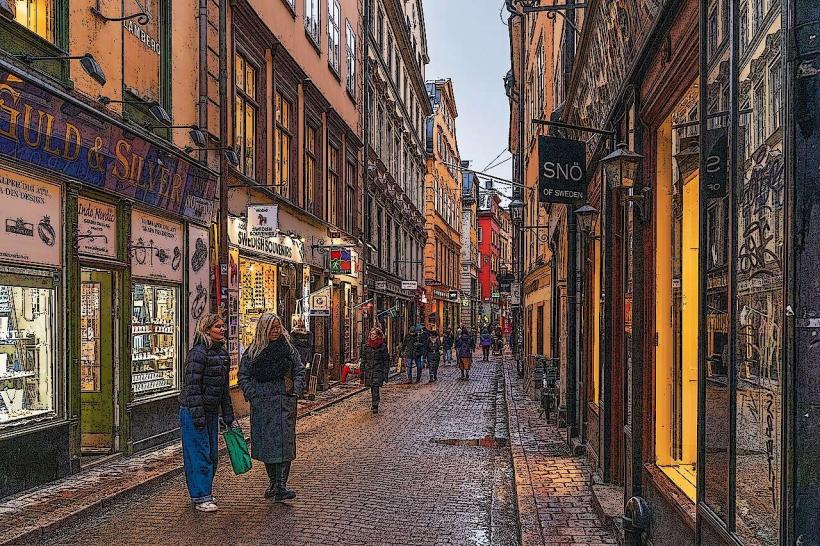
Norrmalm features a grid-like street plan in its central areas, characterized by large-scale commercial and office buildings constructed primarily from concrete, steel, and glass, particularly after the 1950s redevelopment. Older sections retain structures of brick and stone, often painted in muted earth tones. Building heights typically range from 5 to 10 stories.
Location & Access Logistics
Norrmalm is Stockholm's central district, directly accessible via numerous routes. Major thoroughfares include Sveavägen, Kungsgatan, and Hamngatan. Public transport is extensive, with multiple metro (T-bana) lines converging at T-Centralen, located within the district. Numerous bus lines serve the area, including routes 1, 2, 4, and 57. Parking is available in underground garages such as Gallerian P-hus and Parkaden, with metered street parking also present but limited.
Historical & Ecological Origin
Norrmalm's urban development dates back to the 13th century, though its current appearance is largely shaped by the "Norrmalmsregleringen" urban renewal project initiated in the 1950s and continuing into the 1970s. This extensive redevelopment aimed to modernize the city center, replacing older structures with contemporary commercial and administrative buildings. Key architects involved in the post-war reconstruction included Sven Markelius and David Helldén.
Key Highlights & Activities
Visitors can engage in retail shopping along Drottninggatan and in department stores like NK and Åhléns City. Cultural activities include attending performances at the Royal Swedish Opera or visiting the Nationalmuseum. Walking tours exploring the district's architecture are common.
Infrastructure & Amenities
Public restrooms are available in department stores, shopping centers, and at major transport hubs like T-Centralen. Shade is provided by building overhangs and occasional street trees, particularly in parks like Kungsträdgården. Cell phone signal (4G/5G) is consistently strong throughout the district. Numerous food vendors, restaurants, and cafes are widely distributed across Norrmalm.
Best Time to Visit
The best time to visit Norrmalm for general exploration is during the spring (April-May) and autumn (September-October) when temperatures are moderate and tourist crowds are less dense than in summer. For photography, early morning or late afternoon light can enhance architectural details. Winter offers a distinct atmosphere, especially during the holiday season, though daylight hours are significantly shorter.
Facts & Legends
A historical oddity of Norrmalm is the "Norrmalmsregleringen" itself, which involved the demolition of significant portions of the historic city center, a decision that remains a subject of debate regarding urban planning and heritage preservation in Sweden. A practical tip for visitors is to utilize the underground pedestrian tunnels connecting T-Centralen with various shopping centers, providing shelter during inclement weather.
Nearby Landmarks
- Gamla Stan: 0.5km South
- Kungsträdgården: 0.1km East
- Riksdagen (Parliament House): 0.4km South-West
- Nationalmuseum: 0.6km South-East
- Sergels Torg: 0.1km West