Information
Landmark: St. George's ChurchCity: Nitra
Country: Slovakia
Continent: Europe
St. George's Church, Nitra, Slovakia, Europe
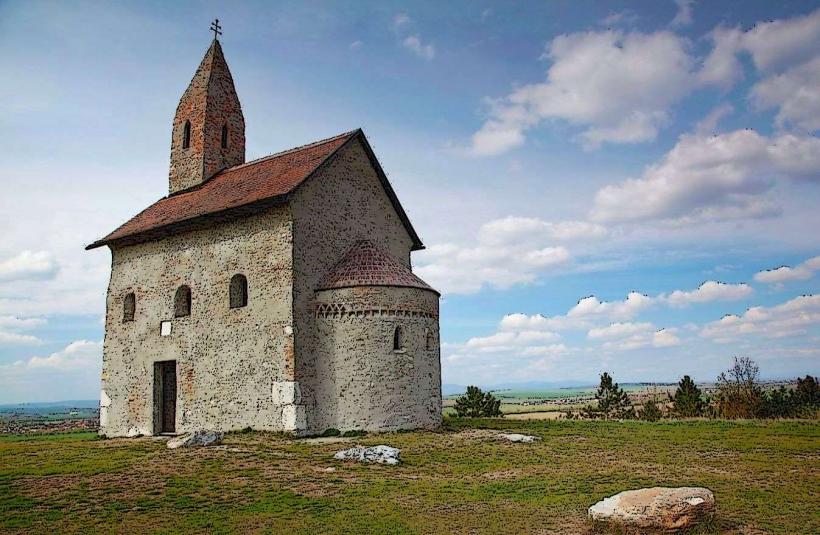
St. George's Church (Kostol svätého Juraja) is a pre-Romanesque sacral monument located in the village of Kostoľany pod Tribečom, approximately 15km northeast of Nitra. It is widely considered the oldest consistently used church in Slovakia and a primary site of the Great Moravian and early Hungarian heritage in the Ponitrie region.
Visual Characteristics
The church is a compact, archaic structure with a primitive, irregular floor plan. It is composed of four distinct sections, including a rectangular nave and a trapezoidal chancel. The exterior is characterized by thick, uneven stone walls of unplastered masonry and a small square tower with a shingled pyramidal roof. The interior is most famous for its 11th-century frescoes, which are the oldest surviving wall paintings in Slovakia, depicting biblical cycles and the lives of saints in a pre-Romanesque style.
Location & Access Logistics
The church is located at Kostoľany pod Tribečom 175, on a small hill in the northeastern part of the village.
Access: Visitors must climb a series of over 100 stone stairs leading from the village center across the Drevenica stream.
Public Transport: Accessible via regional bus from the Nitra central bus station (Autobusová stanica) toward Kostoľany pod Tribečom.
Entrance: The church is typically kept locked for preservation reasons. Interior viewing is usually possible only during Sunday mass or by prior arrangement with the local parish.
Historical & Ecological Origin
Origins: Archaeological research and radiocarbon dating of oak beams suggest foundations from the 9th or 10th century (Great Moravian or post-Great Moravian period).
Earliest Mention: It is officially recorded in the Zobor Document of 1113 AD under the name "Custolen."
Materials: Constructed primarily from local quarry stone and river pebbles bonded with lime mortar. The building survived a major fire in the 16th century and was significantly renovated in the Baroque style in 1721.
Key Highlights & Activities
The Frescoes: Fragments of original Romanesque and Gothic layers, discovered only in 1960, featuring unique iconography compared to later European Gothic art.
Romanesque Baptistery: A stone baptismal font that has remained in the church for centuries.
Cemetery: The surrounding grounds contain the remains of a medieval row cemetery with graves dating back to the 11th century.
Infrastructure & Amenities
Connectivity: 4G cellular coverage is available, though signal strength may be weaker near the thickest stone walls.
Amenities: No public restrooms or food vendors are at the church site; basic services are available in the village center at the bottom of the hill.
Environment: The site offers natural shade from the surrounding Tribeč forest and high stone walls.
Best Time to Visit
The church is best visited on clear mornings when natural light enters through the small southern windows, illuminating the interior masonry. Late April (around the feast of St. George) often features local pilgrimage events and cultural programs.
Facts & Legends
The church is part of the European Cultural Heritage list. Local lore suggests the church was once part of a larger monastery complex or a fortified settlement serving as a refuge for local elites during the Mongol invasion of 1241. A unique technical fact: the church was originally mistaken for a late-Baroque building until the 1960 discovery of the hidden medieval frescoes beneath layers of plaster.
Nearby Landmarks
Gýmeš Castle Ruins – 2.0km Northwest (via forest trail)
Nitra Castle – 16km Southwest
Oponice Manor House & Library – 10km West
Zobor Hill – 12km Southwest
Studený hrad (Castle ruins) – 1.8km Northwest