Information
Landmark: Templo de DebodCity: Madrid
Country: Spain
Continent: Europe
Templo de Debod, Madrid, Spain, Europe
The Temple of Debod is an authentic 2nd-century BCE Egyptian temple located in the Cuartel de la Montaña Park, near Plaza de España. It was gifted to Spain by the Egyptian government in 1968 as a gesture of gratitude for Spanish assistance in saving the Abu Simbel temples during the construction of the Aswan High Dam.
Visual Characteristics
The complex consists of three stone gateways (pylons) leading to the main temple building, surrounded by shallow reflecting pools. The structure is built primarily from sandstone and granite, featuring original reliefs inside depicting King Adikhalamani of Meroe. Its distinct Nubian architecture provides a stark contrast to the surrounding Mediterranean parkland.
Location & Access Logistics
The temple is located at Calle de Ferraz, 1.
Metro: Plaza de España (Lines 2, 3, and 10) and Ventura Rodríguez (Line 3).
Bus: Lines 1, 2, 44, 74, 133, 138, C1, and C2.
Vehicle: Street parking is extremely limited; nearest public garages are at Plaza de España and Calle de la Princesa.
Historical & Ecological Origin
Construction began around 200 BCE under King Adikhalamani, originally as a small chapel dedicated to the gods Amun and Isis. The temple was expanded during the Ptolemaic and Roman periods (under Augustus, Tiberius, and Hadrian). It was dismantled and transported stone-by-stone to Madrid in 1972, where it was reconstructed with its original East-West solar orientation.
Key Highlights & Activities
The interior serves as a museum containing scale models, videos, and panels explaining the history of the Nubian region. Key areas include the Chapel of Adikhalamani and the Vestibule. The surrounding park is a premier spot for picnics, leisure walks, and photography.
Infrastructure & Amenities
Entrance is free, though visitor capacity is strictly limited; checking availability online is recommended. Public restrooms are available in the park area. The interior has restricted accessibility for those with reduced mobility due to narrow ancient corridors. 5G signal is excellent throughout the exterior grounds.
Best Time to Visit
The site is widely considered the best location in Madrid to view the sunset, as the stones glow orange and reflect in the water. It is open Tuesday through Sunday (closed Mondays). Evening hours generally end at 20:00 in winter and 19:00 or later in summer depending on current regulations.
Facts & Legends
The temple sits on the Príncipe Pío hill, the site of the May 3, 1808 executions depicted in Goya’s famous paintings. A verified curiosity is that the reflecting pools were designed to simulate the temple's original proximity to the Nile River. Local folklore occasionally attributes spiritual energy to the stones due to their centuries-long role as a site of pilgrimage in ancient Egypt.
Nearby Landmarks
Plaza de España: 0.4km East
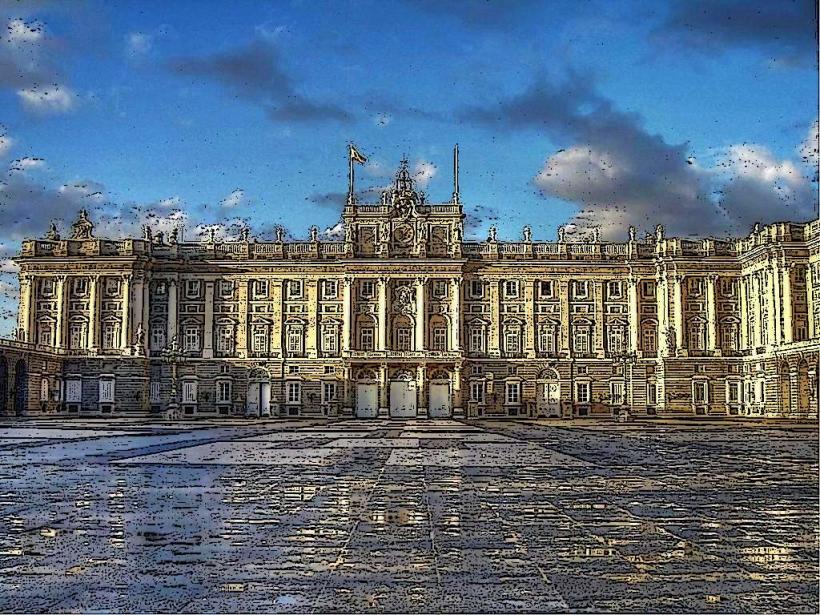
Royal Palace of Madrid: 0.8km South
Sabatini Gardens: 0.6km South
Parque del Oeste: Adjacent North
Cerralbo Museum: 0.3km Southeast