Information
Landmark: Three Hierarchs MonasteryCity: Iasi
Country: Romania
Continent: Europe
Three Hierarchs Monastery, Iasi, Romania, Europe
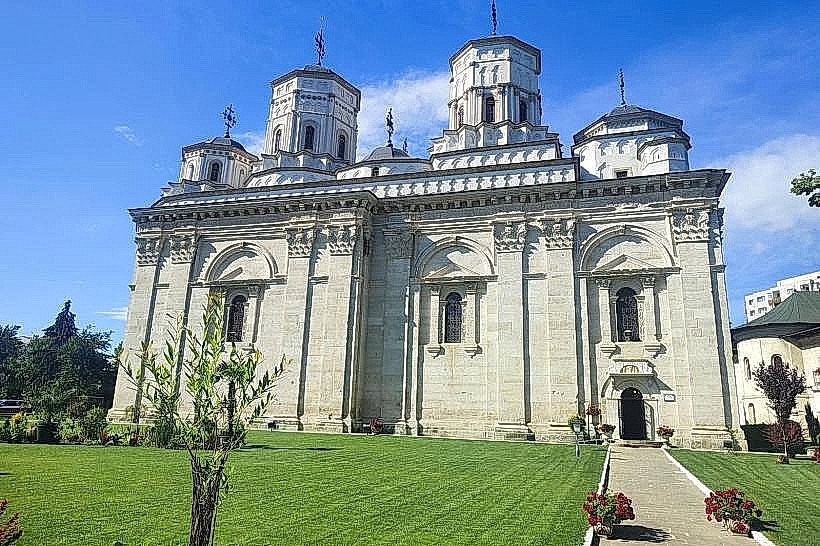
The Three Hierarchs Monastery is a 17th-century Orthodox Christian monastery located in the city of Iasi, Romania.
It is recognized for its intricate exterior decoration and historical significance within Romanian Orthodoxy.
Visual Characteristics
The monastery church is constructed primarily from stone and features extensive exterior ornamentation. The facade is covered in a complex network of carved stone reliefs, depicting various religious figures and geometric patterns. The dominant colors are the natural stone tones, with accents of glazed ceramic tiles in shades of blue, yellow, and green. The church has a single nave with a large, octagonal tower above the crossing and smaller bell towers at the western end. The roof is covered in tin.
Location & Access Logistics
The monastery is situated in the central area of Iasi, at 4 Strada Sărărie. It is approximately 1.5 kilometers from the city center. Access is via paved city streets. Limited street parking is available in the vicinity, often requiring payment. Public transport options include bus lines 3, 29, and 41, which stop within a 5-minute walk of the monastery entrance.
Historical & Ecological Origin
Construction of the Three Hierarchs Monastery began in 1634 and was completed in 1639 under the patronage of Prince Vasile Lupu. The architect was Ioan Gherasim. The monastery was built to commemorate the three great Church Fathers: Basil the Great, Gregory the Theologian, and John Chrysostom. It served as a significant religious and cultural center during the Moldavian period.
Key Highlights & Activities
Visitors can observe the detailed exterior stone carvings. The interior houses a significant collection of religious icons and frescoes. The monastery museum displays historical artifacts related to its construction and history. Photography is permitted inside the church and on the grounds, though flash is prohibited.
Infrastructure & Amenities
Restrooms are available within the monastery complex. Limited shaded areas are present on the grounds. Cell phone signal (4G/5G) is generally good. There are no on-site food vendors, but numerous cafes and restaurants are located within a 500-meter radius.
Best Time to Visit
For optimal lighting on the exterior carvings, visit between 10:00 AM and 2:00 PM. The best months for weather are May through September, with average temperatures ranging from 18°C to 25°C. The monastery is open year-round, with specific visiting hours for the church and museum.
Facts & Legends
A unique aspect of the monastery's construction is the extensive use of gilded elements in the original exterior decoration, which have largely deteriorated over time. Local lore suggests that the intricate carvings were so detailed they were believed to be the work of angels.
Nearby Landmarks
- Palace of Culture (0.8km West)
- Metropolitan Cathedral of Moldavia and Bukovina (0.6km Southwest)
- Golia Monastery (1.2km North)
- Union Museum (0.9km West)
- Botanical Garden "Anastasie Fătu" (2.5km South)