Information
Landmark: Tournai's Old City GatesCity: Tournai
Country: Belgium
Continent: Europe
Tournai's Old City Gates, Tournai, Belgium, Europe
Tournai's old city gates are the primary remaining structures of the city’s two medieval defensive perimeters. While the inner wall (11th century) has mostly vanished, several significant gates from the second wall (13th century) remain.
Visual Characteristics
The gates are constructed from local Tournai blue limestone. They typically feature massive twin towers flanking a central arched passage. The architecture is characterized by thick masonry, narrow arrow slits, and corbels that once supported wooden defensive galleries (hoards).
Principal Gates
Pont des Trous
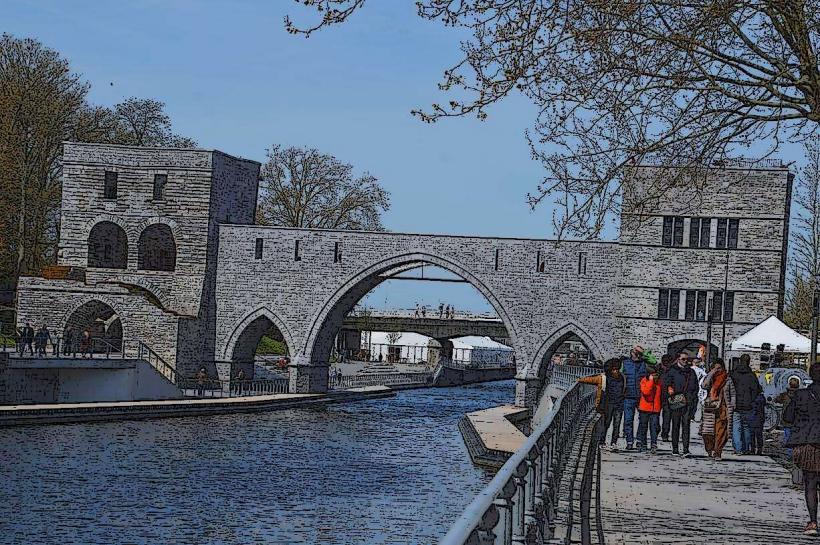
The most famous "water gate" in Europe. It consists of two defensive towers connected by three arches over the Escaut river.
Status: Recently reconstructed (2023) to allow larger ship passage while preserving the medieval towers.
Porte de Marvis
Located on the eastern side of the city, this gate is composed of two imposing circular towers.
Visuals: It retains its medieval ruggedness and is surrounded by a small park area where the old moats once were.
Porte de Valenciennes
Also known as the "Porte de Lille" depending on historical context, this gate served the southern entry.
Architecture: It features a complex defensive arrangement with a vaulted passage and remains of the curtain walls.
Location & Access Logistics
The gates are distributed along the "Boulevards" which follow the path of the former ramparts.
Access: Most gates are public monuments visible from the street. Entry to the interior of the towers is generally restricted except during Heritage Days.
Public Transport: All are within a 15-minute walk of the Grand Place or the Railway Station.
Mobility: The exterior sites are fully accessible via flat pedestrian sidewalks.
Historical Origin
The second city wall was built between 1281 and 1304 during a period of significant economic growth. Tournai was then a French royal city, and the fortifications were designed to withstand sieges during the 100 Years' War. Most of the walls were demolished in the 19th century to allow for urban expansion, leaving only the gates as "islands" of history.
Infrastructure & Amenities
The areas surrounding the gates have been converted into green spaces and promenades. Information panels in French, Dutch, and English are typically located near each structure. 5G signal is robust at all locations.
Best Time to Visit
Accessible 24/7. The gates are best viewed during the golden hour (shortly before sunset) when the blue limestone takes on a deep grey-gold hue.
Facts & Legends
A verified historical detail is that Tournai's fortifications were considered so formidable that Henry VIII of England personally oversaw the construction of a massive citadel (the Henry VIII Tower) after capturing the city in 1513. Legend states that the Porte de Marvis was haunted by a "Watchman of the Walls" who would signal the approach of the plague, though this is likely a folk memory of the real guards who enforced quarantines at the city gates.
Nearby Landmarks
Belfry of Tournai – 0.8km Central
Henry VIII Tower – 0.6km North
The Railway Station – 0.5km from Porte de Marvis