Information
Landmark: Waikapu ValleyCity: Wailuku
Country: USA Hawaii
Continent: North America
Waikapu Valley, Wailuku, USA Hawaii, North America
Waikapu Valley is a geological formation located in Wailuku, Maui, Hawaii, USA.
This valley is characterized by its steep, eroded walls and the Waikapu Stream that flows through its base.
Visual Characteristics
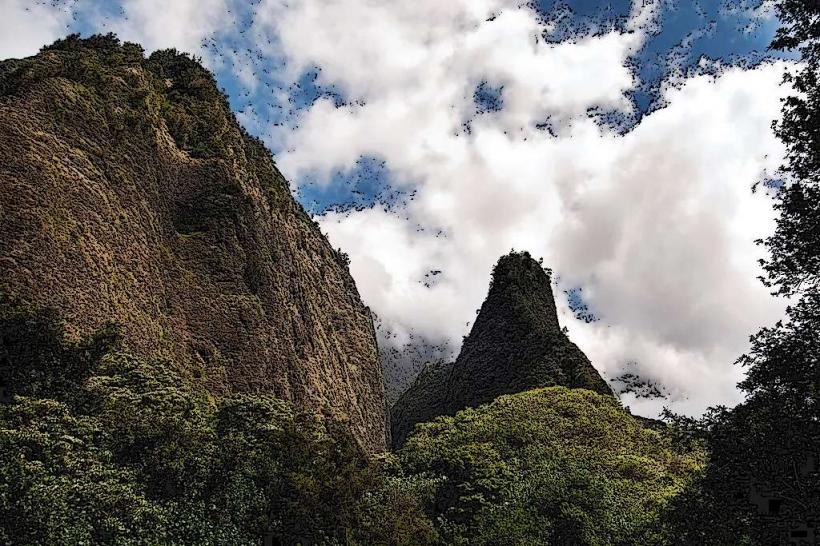
The valley walls are composed of dark, weathered basalt rock, exhibiting distinct layering from ancient lava flows. Vegetation is dense, primarily consisting of tropical foliage including various species of ferns, grasses, and scattered trees. The Waikapu Stream appears as a brown or green ribbon depending on recent rainfall and sediment load.
Location & Access Logistics
Waikapu Valley is situated approximately 5 kilometers southeast of Wailuku town center. Access is primarily via Waiale Road, which transitions into a rougher track suitable for 4WD vehicles. Public transport does not directly serve the valley entrance. Parking is limited to informal pull-offs along Waiale Road.
Historical & Ecological Origin
Waikapu Valley is an erosional feature formed over millennia by the persistent action of the Waikapu Stream and weathering. It is part of the eroded landscape of the West Maui Mountains, which are ancient shield volcanoes.
Key Highlights & Activities
Hiking is possible along the Waikapu Stream bed, though this requires careful navigation due to uneven terrain and water flow. Observation of the valley's geological stratification is a primary activity. Birdwatching is also feasible due to the dense vegetation.
Infrastructure & Amenities
No formal infrastructure or amenities are present within Waikapu Valley. Restrooms, shade structures, and food vendors are not available. Cell phone signal is intermittent to non-existent within the valley itself.
Best Time to Visit
The best time for visiting is during the dry season, typically from April to October, to minimize stream flow and improve trail conditions. Mid-morning offers moderate lighting for viewing rock formations.
Facts & Legends
Local lore suggests that the valley was once a significant agricultural area for ancient Hawaiians, utilizing the stream for irrigation. A specific geological feature, a large, solitary rock formation near the valley entrance, is sometimes referred to as the "Guardian Stone."
Nearby Landmarks
- Iao Valley State Monument (1.5km Northwest)
- Maui Tropical Plantation (2.0km West)
- Kepaniwai Park & Heritage Gardens (2.5km Northwest)
- Wailuku Town (5.0km West)