Information
City: CorfuCountry: Greece
Continent: Europe
Corfu, Greece, Europe
Corfu (Kerkyra) is the northernmost of the major Ionian Islands, situated at the entrance of the Adriatic Sea. Unlike the rest of Greece, Corfu was never occupied by the Ottoman Empire; instead, it remained a possession of the Republic of Venice for four centuries (1386–1797), followed by periods of French and British rule. This history creates a unique cultural and architectural identity that is more Italianate and Central European than Aegean.
Historical Timeline
In antiquity, Corcyra was a major naval power whose dispute with Corinth helped trigger the Peloponnesian War. During the Venetian era, it served as a crucial bastion against Ottoman expansion. In 1815, it became the capital of the United States of the Ionian Islands, a British protectorate, before being ceded to Greece in 1864. The island was a favored retreat for European royalty, including Empress Elisabeth (Sisi) of Austria and the Greek Royal Family.
Demographics & Population
As of 2026, the permanent population is approximately 105,000, with nearly 30,000 residing in Corfu Town. The demographic includes a significant community of British expatriates and seasonal residents from across the EU. The median age is 44.1 years.
Urban Layout & Key Districts
Old Town (Campiello): A UNESCO World Heritage site characterized by multi-story Venetian-style tenements, narrow alleys (kantounia), and laundry lines strung across streets.
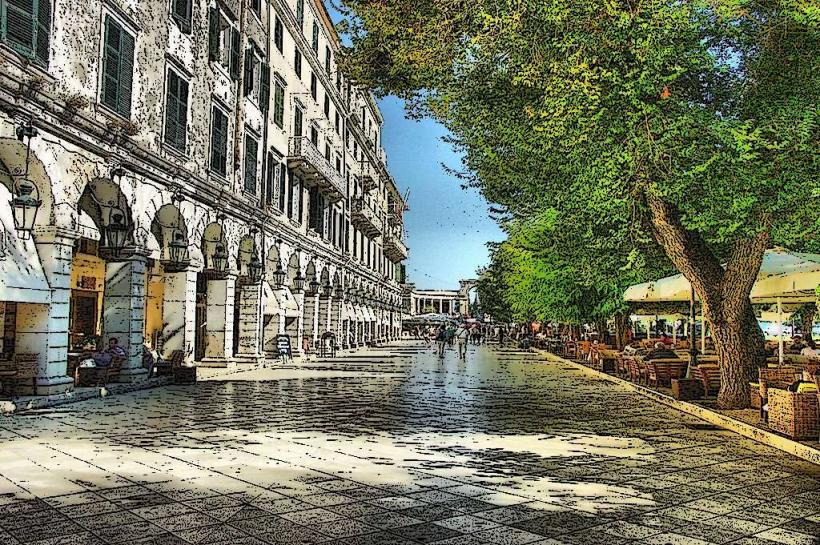
The Liston: A neoclassical arched gallery and promenade in Corfu Town, modeled after the Rue de Rivoli in Paris.
Spianada (Esplanade): One of the largest town squares in Southeast Europe, located between the city and the Old Fortress; it features a cricket pitch, a legacy of British rule.
Paleokastritsa: A scenic district on the west coast known for its six bays, dramatic cliffs, and turquoise waters.
Kavos: A southern coastal village known exclusively for high-density youth tourism and nightlife.
Top Landmarks
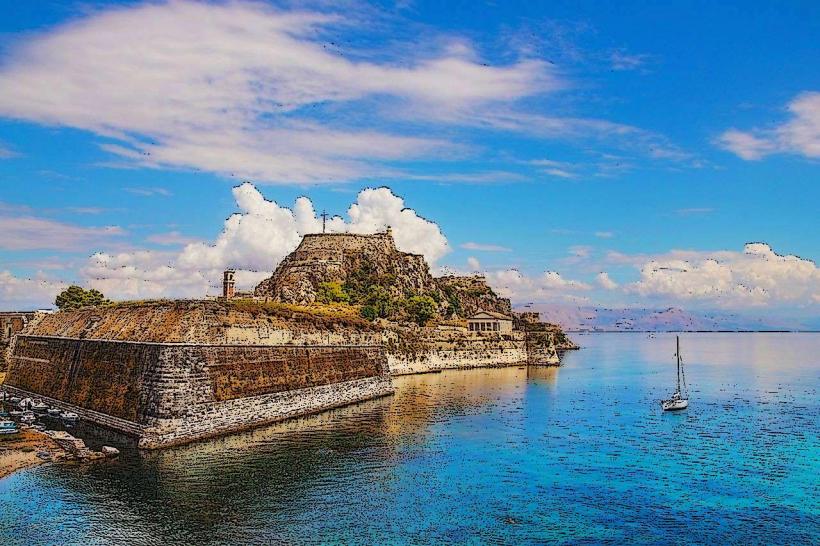
Old Fortress (Palaio Frourio): A 15th-century Venetian fortress separated from the town by a sea moat.
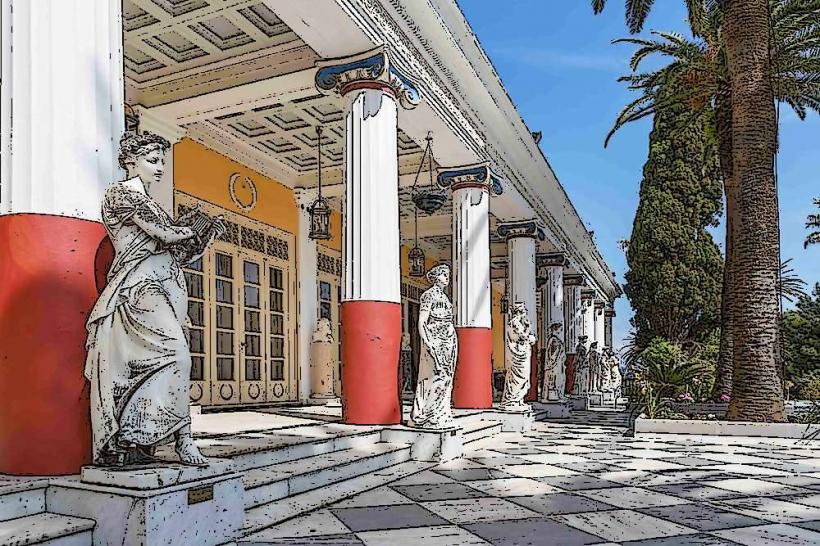
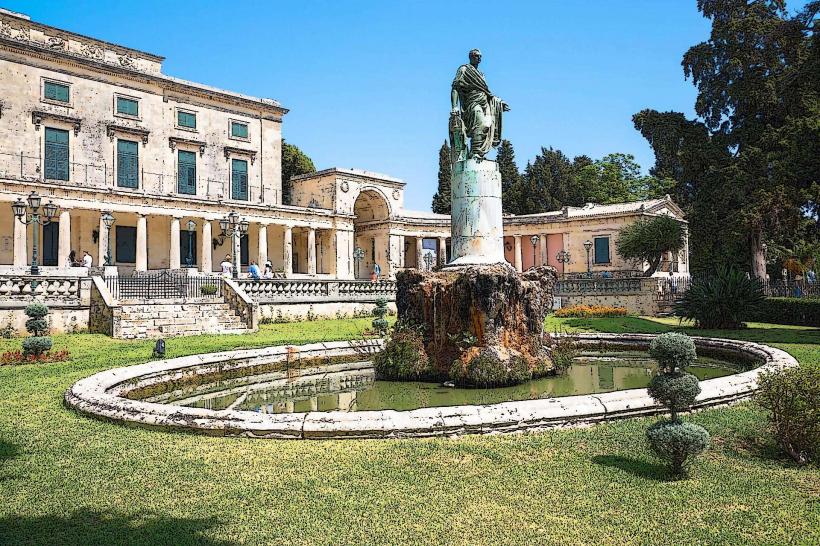
Achilleion Palace: A neoclassical palace built by Empress Sisi of Austria, dedicated to the hero Achilles.
Canal d'Amour (Sidari): Unique sandstone rock formations creating natural tunnels and inlets on the northern coast.
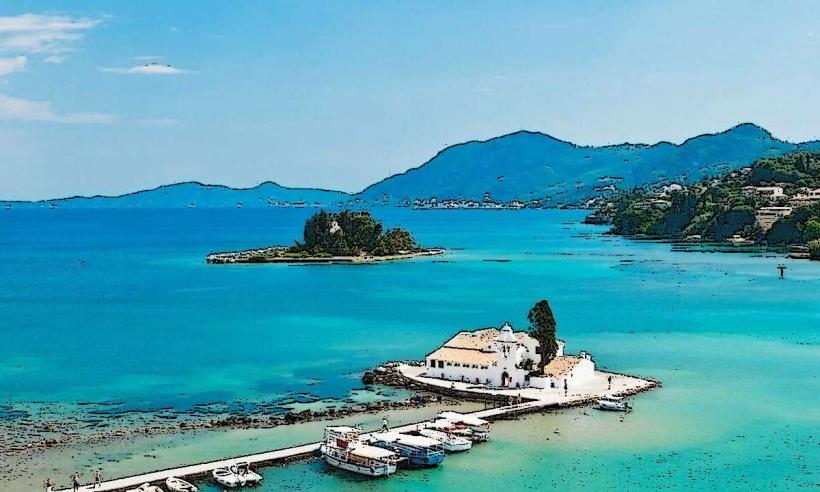
Vlacherna Monastery & Mouse Island (Pontikonisi): The iconic 17th-century white chapel situated on a tiny islet near the airport.
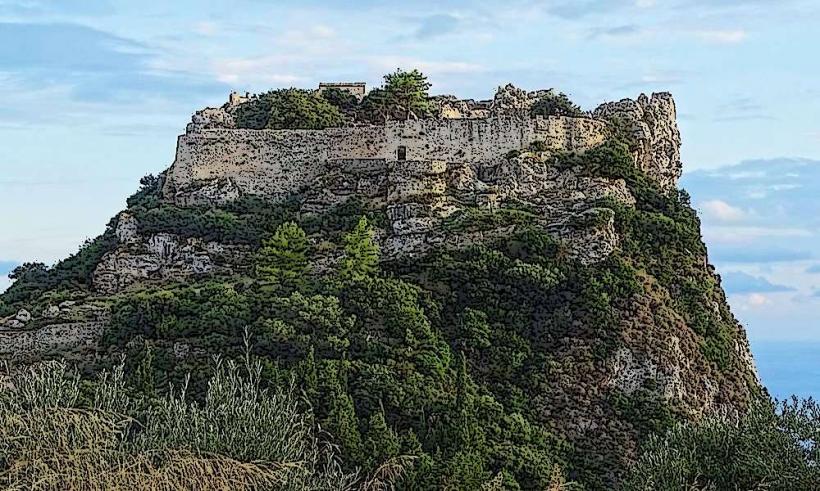
Angelokastro: A 13th-century Byzantine castle perched on a 305m cliff overlooking the Adriatic.
Transportation Network
Air: Corfu International Airport "Ioannis Kapodistrias" (CFU) is located 3 km from the town; it is famous for its short runway and proximity to the sea.
Sea: The Port of Corfu handles daily ferries from Igoumenitsa (mainland) and international routes from Brindisi, Bari, and Ancona (Italy), as well as Saranda (Albania).
Bus: Two networks: Blue Buses (urban/suburban) and Green Buses (long-distance/intercity).
Road: The interior roads are notoriously narrow and winding; scooter and car rentals are the primary tourist transport.
Safety & Social Infrastructure
Corfu is highly safe. The primary safety concerns are related to nightlife-related incidents in Kavos and road safety on poorly lit rural paths. The island has a stable 5G network via Cosmote and Vodafone. Card acceptance is 100%. The currency is the Euro (€).
Climate & Environment
The climate is Mediterranean but significantly more humid and rainy than the Aegean islands. This rainfall results in dense vegetation, including over 4 million olive trees, many of which are hundreds of years old and were planted during the Venetian period.
Culture & Gastronomy
Language: Greek. The local dialect contains numerous Italian loanwords.
Music: The island has a strong Western classical tradition, with 18 active marching bands (Philharmonics) that perform during festivals.
Food: Distinct from mainland Greece. Signature dishes include Pastitsada (pasta with spicy rooster or beef) and Sofrito (veal in a garlic-parsley-vinegar sauce).
Kumquat: A small citrus fruit originally from China, now a PDO product of Corfu used in liqueurs and sweets.
Local Cost Index
1 Espresso (Freddo): €3.00–€4.50
1 Kumquat Liqueur (Bottle): €8.00–€15.00
1 Standard Lunch: €16.00–€25.00
1 Car Rental (Daily): €30.00–€55.00
Facts & Legends
Legend identifies Corfu as Scheria, the island of the Phaeacians where Odysseus was washed ashore and found by Nausicaa. A verified historical fact: Corfu is the only place in Greece where cricket is played regularly, with the first match recorded in 1823 during the British administration.