Information
City: RouenCountry: France
Continent: Europe
Rouen, France, Europe
Rouen is the capital of the Normandy region in northwestern France, situated on the Seine River. It is a major river port and historical center known for its high concentration of medieval timber-framed architecture and its status as a primary site of the Hundred Years' War.
Visual Characteristics
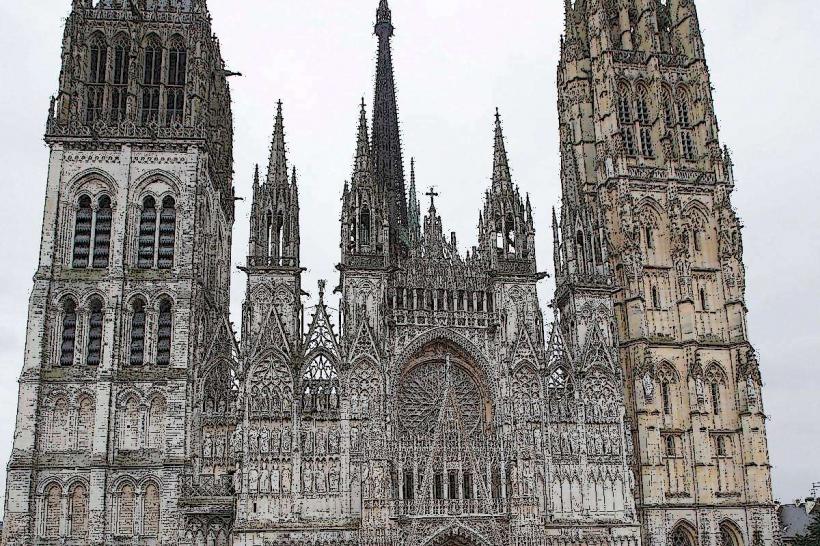
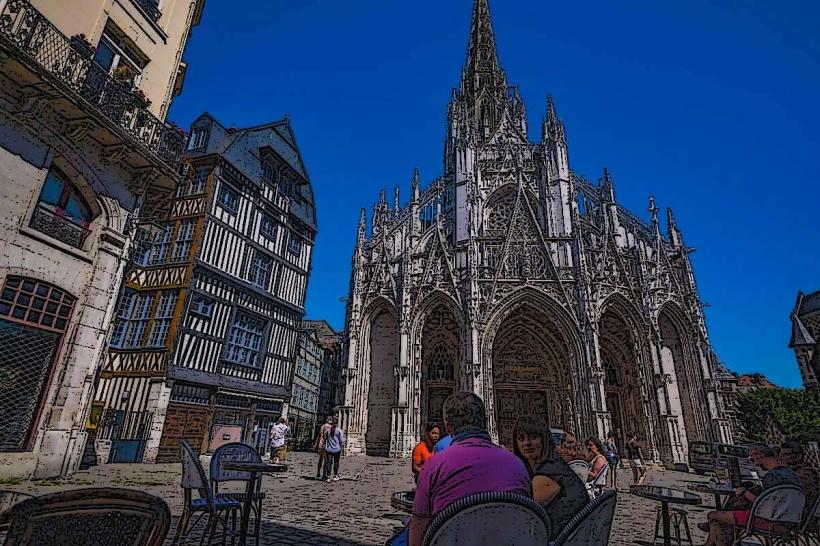
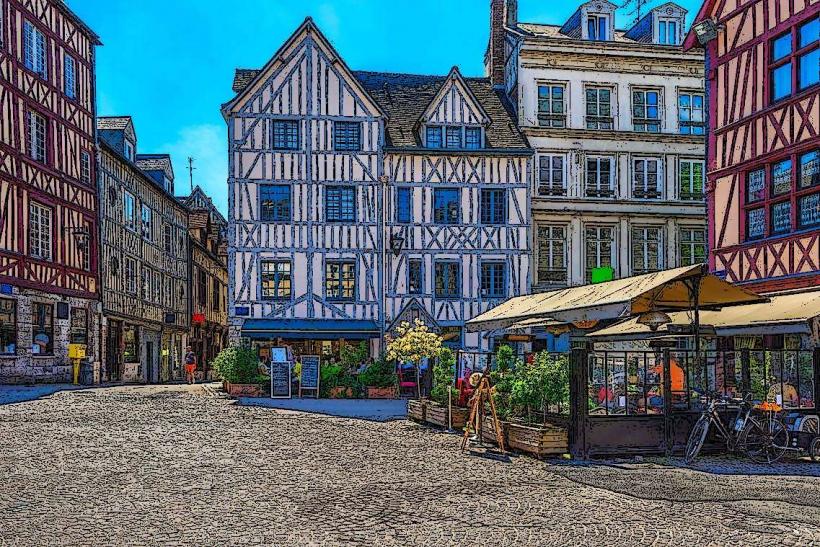
The urban core is defined by narrow cobblestone streets and approximately 2,000 half-timbered houses (maisons à pans de bois) dating from the 14th to 18th centuries. The skyline is dominated by the Cathédrale Notre-Dame, a Gothic structure featuring a 151-meter cast-iron spire-the tallest in France. Stone construction primarily utilizes light-colored Caen limestone, contrasted by the dark wood beams of secular buildings and the modern, sweeping curves of the Church of Saint Joan of Arc.
Location & Access Logistics
The city is located approximately 135 kilometers northwest of Paris. It is accessible via the A13 motorway and by SNCF Intercités trains from Paris Gare Saint-Lazare, with a travel time of 75 to 90 minutes. Within the city, the "Metropole" network operates two tram lines (Technopôle and Georges Braque) and several "TEOR" rapid transit bus lines. Public parking is available in large underground garages such as Espace du Palais and Place du Vieux-Marché.
Historical & Ecological Origin
Founded by the Romans as Rotomagus, the city became the capital of the Duchy of Normandy in the 10th century. It served as a major center for the medieval textile industry due to its proximity to the Seine. Historically, it is significant as the location of the trial and execution of Joan of Arc in 1431. Geologically, the city occupies a valley carved by the Seine, surrounded by chalk cliffs and the Roumare and Verte forests.
Key Highlights & Activities
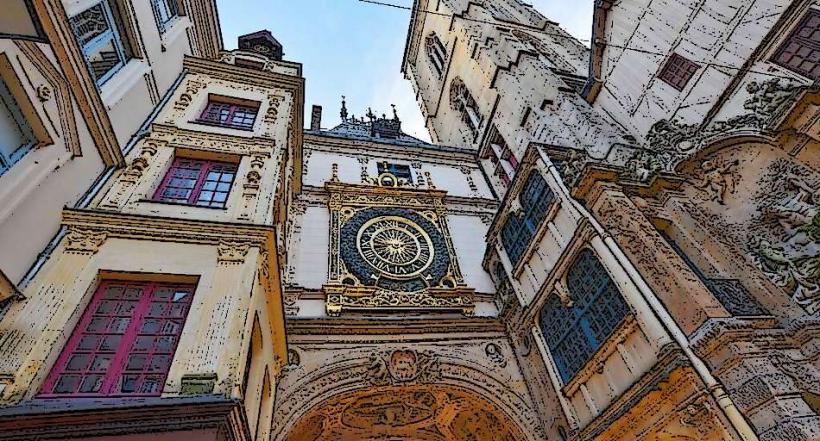
Walking the pedestrian-only Rue du Gros-Horloge allows for viewing of the 14th-century astronomical clock and its Renaissance arch. The Musée des Beaux-Arts contains a significant collection of Impressionist paintings, including works by Claude Monet. Visitors can access the interior of the Rouen Cathedral to view the tombs of Richard the Lionheart and the early Dukes of Normandy. The Panorama XXL on the riverfront offers 360-degree immersive historical displays.
Infrastructure & Amenities
The historic center is largely pedestrianized and equipped with public restrooms near the Place du Vieux-Marché and the Cathedral. Reliable 5G cellular signal is available across the metropolitan area. The city operates a bike-sharing system called "Cy'clic" with stations located at major plazas. Food and retail services are highly concentrated in the city center, particularly around the Saint-Maclou and Old Market districts.
Best Time to Visit
The best months for weather and outdoor exploration are May through September, when average highs range from 18°C to 23°C. Photography of the Cathedral's facade is optimal in the late afternoon or during the "Cathédrale de Lumière" light show held on summer evenings. Rainfall is frequent throughout the year due to the maritime climate, making waterproof footwear advisable for cobblestone navigation.
Facts & Legends
Rouen is often called the "City of a Hundred Spires" (la ville aux cent clochers), a term coined by Victor Hugo. A historical oddity involves the "Gros-Horloge" clock mechanism, which is one of the oldest in France and has functioned almost continuously since 1389. The Place du Vieux-Marché contains a 20-meter high cross marking the exact spot where Joan of Arc was burned at the stake, now integrated into the site of a modern memorial church.
Nearby Landmarks
Rouen Cathedral: 0.1km East of center
Church of Saint Joan of Arc: 0.5km West
Musée des Beaux-Arts de Rouen: 0.4km North
Saint-Maclou Church: 0.3km East
Jardin des Plantes de Rouen: 2.2km South