Information
City: SchwerinCountry: Germany
Continent: Europe
Schwerin, Germany, Europe
Schwerin is the capital of the state of Mecklenburg-Vorpommern in northern Germany, situated within the Schweriner See (Lake Schwerin) district. It is the smallest state capital in Germany and is characterized by its high density of freshwater lakes and Prussian architectural heritage.
Visual Characteristics
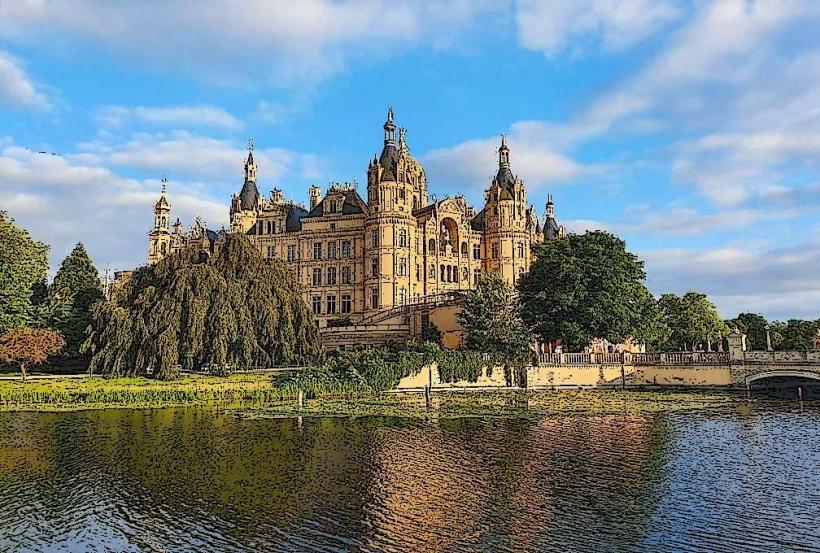
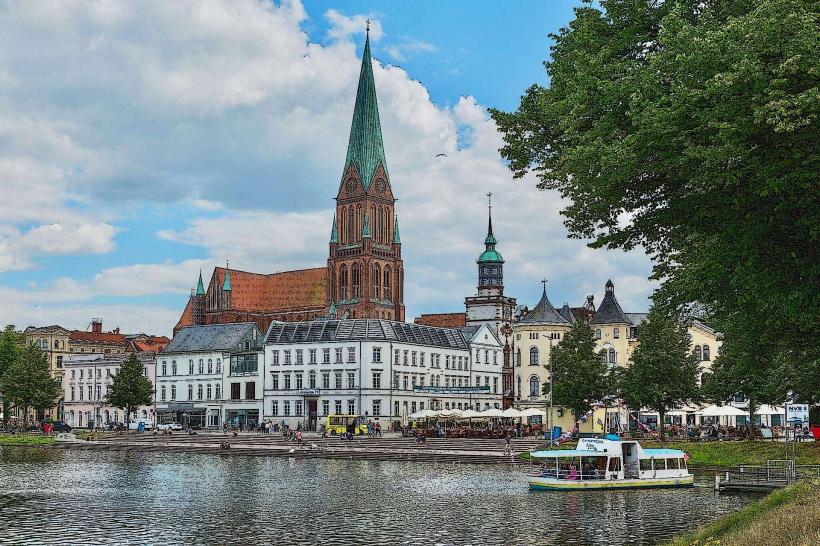
The urban landscape is dominated by the Schwerin Castle (Schweriner Schloss), a neo-Renaissance palace featuring over 600 rooms and numerous golden-domed towers, situated on an island in the lake. The city architecture is primarily historicist and neoclassical, with the Schwerin Cathedral (Schweriner Dom) serving as a significant example of Brick Gothic. The "Schelfstadt" district contains well-preserved 18th-century half-timbered houses and brick buildings.
Location & Access Logistics
Schwerin is located approximately 100 kilometers east of Hamburg and 200 kilometers northwest of Berlin. It is served by the Schwerin Hauptbahnhof, providing regional and InterCity rail connections to Hamburg (1 hour), Rostock, and Berlin. The nearest major international airport is Hamburg Airport (HAM). The NVS transit network operates four tram lines and an extensive bus system. Vehicle access is managed via the A14 and A24 motorways; parking is concentrated in lots near the castle and the Altstadt (Old Town).
Historical & Ecological Origin
First mentioned in 1018 as an Obotrite settlement, it was granted city rights in 1160 by Henry the Lion. It served for centuries as the residence of the Dukes and Grand Dukes of Mecklenburg. Geologically, the area is part of the Mecklenburg Lake District, formed during the last ice age. The city is surrounded by twelve lakes, with the Schweriner See covering 60 square kilometers, which significantly influences the local microclimate and urban drainage systems.
Key Highlights & Activities
The Schwerin Castle is accessible for tours of the throne room, ancestral galleries, and the State Museum (Staatliches Museum Schwerin), which holds a major collection of 17th-century Dutch and Flemish paintings. The Castle Garden (Schlossgarten) is an expansive Baroque park featuring a large orangery and canal system. Boat tours of the Schweriner See depart from the pier adjacent to the castle. The Open Air Museum Schwerin-Mueß displays regional rural architecture and historical farming techniques.
Infrastructure & Amenities
The city center is equipped with public restrooms near the Marienplatz and the Cathedral. 5G cellular coverage is universal. The city maintains a high-density network of cycling paths around the lakes. Drinking water fountains are available in the pedestrian zones of the Altstadt. Retail and dining are concentrated around the Marienplatz and Mecklenburgstraße, specializing in regional northern German cuisine and freshwater fish.
Best Time to Visit
The climate is temperate oceanic. June through August offers the most stable weather for lake activities, with temperatures between 18°C and 23°C. The "Schlossfestspiele" (Castle Festival), featuring open-air opera performances, occurs in summer. Photography of the castle is optimal at sunrise from the "Schwimmende Wiese" (Floating Meadow) or the Schlossgarten. Winters are cold and damp, featuring a traditional Christmas market ("Der Stern im Norden").
Facts & Legends
Schwerin is often referred to as the "City of Seven Lakes," though the number of lakes within the city limits has increased due to municipal expansion. A local historical oddity: the castle island is artificial in part, having been expanded over centuries to support the palace foundations. Legend holds that the "Petermännchen," a benevolent house spirit or kobold, guards the castle and protects the virtuous while punishing intruders and thieves.
Nearby Landmarks
Schwerin Castle: Central hub/Island
Schwerin Cathedral: 0.6km North of Castle
State Museum: 0.2km East of Castle
Marienplatz: 0.8km Northwest of Castle
Schelfkirche: 0.9km North of Castle