Information
Landmark: Banff National ParkCity: Calgary
Country: Canada
Continent: North America
Banff National Park, Calgary, Canada, North America
Banff National Park is Canada's oldest national park, situated in the province of Alberta. It is located approximately 110 kilometers west of Calgary.
Visual Characteristics
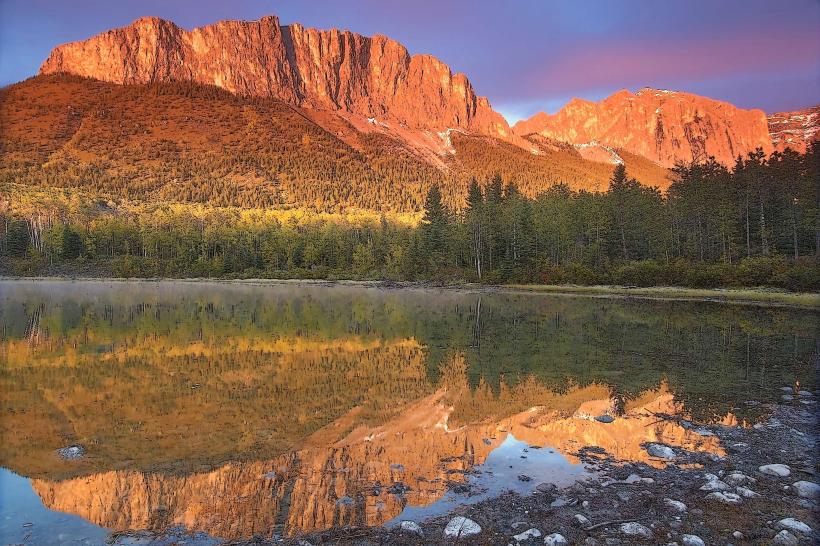
The park encompasses a significant portion of the Canadian Rocky Mountains. It features glaciated valleys, dense coniferous forests, and alpine meadows. Prominent geological features include jagged mountain peaks, turquoise-colored glacial lakes such as Lake Louise and Moraine Lake, and extensive ice fields. Elevations range from 1,300 meters (4,265 feet) at the townsite to over 3,000 meters (9,843 feet) in the mountain ranges.
Location & Access Logistics
Access to Banff National Park is primarily via the Trans-Canada Highway (Highway 1). From Calgary, take Highway 1 West for approximately 110 kilometers. The park has multiple entrances; the main one is near the town of Canmore. Parking is available at various trailheads, viewpoints, and within the town of Banff. Public transport options include bus services from Calgary to the town of Banff, operated by companies like Brewster Express and Sundog Tours. Within the park, the Roam Public Transit system provides bus service to key locations.
Historical & Ecological Origin
Banff National Park was established in 1885 following the discovery of hot springs near Sulphur Mountain. Its initial designation was as a 26 square kilometer reserve, later expanded to its current size. The park is part of the Canadian Rocky Mountain Parks UNESCO World Heritage Site, recognized for its outstanding universal value. Ecologically, it is characterized by montane, subalpine, and alpine ecosystems, supporting a diverse range of flora and fauna including grizzly bears, elk, and bighorn sheep.
Key Highlights & Activities
Activities include hiking on over 1,600 kilometers of trails, ranging from short interpretive walks to multi-day backcountry expeditions. Boating and canoeing are available on Lake Louise and Moraine Lake. Wildlife viewing opportunities are present throughout the park. Skiing and snowboarding are popular during winter months at resorts like Sunshine Village, Lake Louise Ski Resort, and Mt. Norquay. Scenic drives include the Icefields Parkway and the Bow Valley Parkway.
Infrastructure & Amenities
The town of Banff provides a full range of amenities, including hotels, restaurants, and retail stores. Restrooms are available at major viewpoints, trailheads, and picnic areas. Shade is provided by forest cover in many areas. Cell phone signal (4G/5G) is generally available in the town of Banff and along major parkways, but can be intermittent in remote areas. Food vendors and picnic facilities are located at designated sites.
Best Time to Visit
For hiking and general sightseeing, the best months are from June to September, when most trails are snow-free and weather is mild. For photography of the lakes, early morning or late afternoon light offers optimal conditions, particularly during the summer months when the glacial silt is most reflective. High tide is not a relevant factor for this park. Winter (November to April) is best for snow sports.
Facts & Legends
A unique geological feature is the presence of numerous hot springs, the discovery of which led to the park's establishment. The Banff Upper Hot Springs are still accessible to the public. A local legend speaks of the "Spirit Bears" of the Rockies, though these are more commonly associated with the coastal rainforests of British Columbia.
Nearby Landmarks
- Canmore Nordic Centre Provincial Park (5km Southeast)
- Kananaskis Country (20km Southwest)
- Lake Minnewanka (10km Northeast)
- Johnston Canyon (25km West)
- Sunshine Village Ski Resort (9km West)