Information
Landmark: Church of Saint IldefonsoCity: Porto
Country: Portugal
Continent: Europe
Church of Saint Ildefonso, Porto, Portugal, Europe
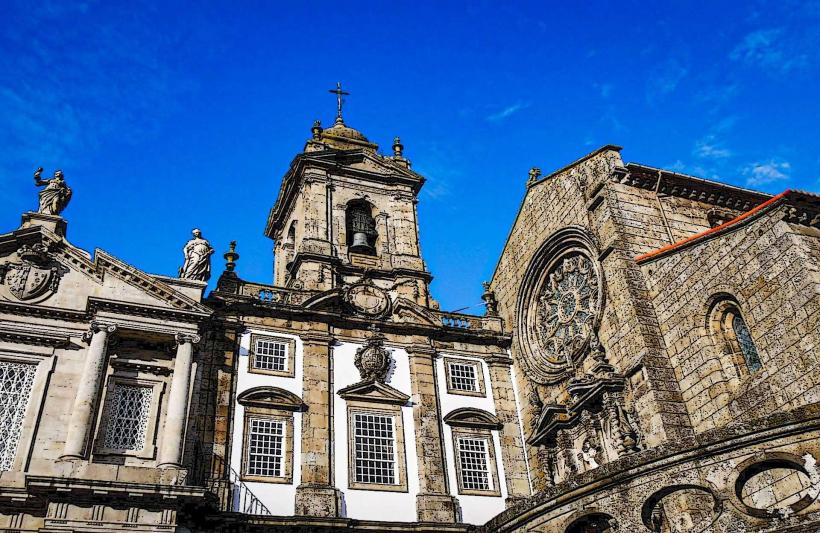
The Church of Saint Ildefonso is an 18th-century proto-Baroque religious building located near Praça da Batalha in Porto, Portugal. It stands on an elevated site, serving as a prominent architectural anchor for the city's upper district.
Visual Characteristics
The facade is distinguished by its covering of approximately 11,000 blue and white azulejo tiles, installed in 1932 by artist Jorge Colaço. The building features two symmetrical bell towers topped with masonry spires and decorative stone spheres. The structure is built primarily from granite, with a rectangular nave and a narthex characterized by high ceilings and ornate gilded woodcarvings (talha dourada) inside.
Location & Access Logistics
The site is situated at Rua de Santo Ildefonso, 11, at the top of the hill overlooking Rua de 31 de Janeiro. It is 400 meters from the São Bento Train Station and the São Bento Metro Station (Line D). Multiple STCP bus lines stop at the adjacent Batalha terminal. Pedestrian access involves climbing a stone staircase from the street level; there is no dedicated visitor parking on-site.
Historical & Ecological Origin
Construction of the current church began in 1709 to replace a dilapidated medieval chapel, reaching completion in 1730. The architect is unknown, though the style reflects the Baroque influence prevalent in 18th-century northern Portugal. The retable in the chancel was designed by the architect Nicolau Nasoni in 1745. The church is built upon a granite outcrop typical of the regional Hercynian Massif.
Key Highlights & Activities
Visitors can examine the exterior tile narratives depicting scenes from the life of Saint Ildefonso and allegories from the Eucharist. Interior access allows for the viewing of the Nasoni altarpiece and the pipe organ. Religious services are held daily, during which tourist sightseeing is restricted. Photography is permitted when mass is not in progress.
Infrastructure & Amenities
There are no public restrooms or food services within the church itself. 4G/5G cellular signal is strong throughout the exterior and interior. The surrounding Praça da Batalha contains numerous cafes, public benches, and commercial amenities. The church entrance is not wheelchair accessible due to the historical stone steps.
Best Time to Visit
The afternoon offers the best lighting for photographing the tiled facade as the sun moves to the west. Best months for visiting are May through September for optimal light clarity. The church is typically open to the public from 09:00 to 12:00 and 15:00 to 18:30, with closures on Monday mornings.
Facts & Legends
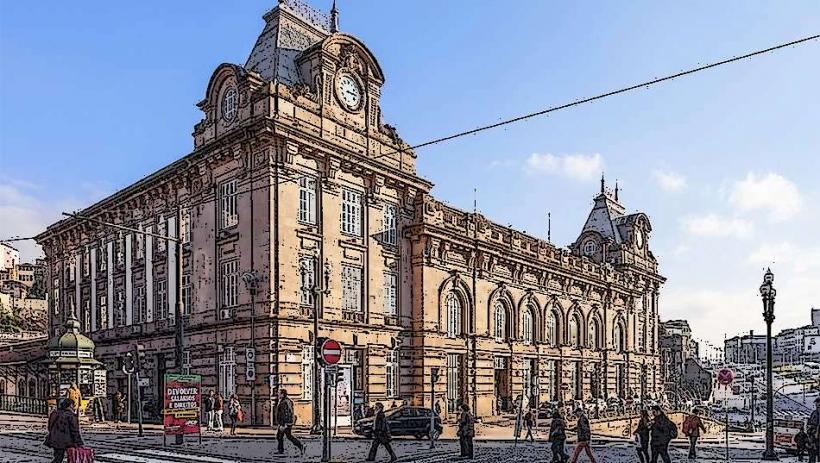
The church was severely damaged during the Siege of Porto in 1832-1833 and again during a massive storm in 1819, which caused the original stained glass to shatter. A local historical oddity is that the tiles were added nearly two centuries after the church's completion to match the aesthetic of other major landmarks in Porto, such as the São Bento Station.
Nearby Landmarks
Coliseu do Porto: 0.1km East
Rua de Santa Catarina: 0.2km North
São Bento Train Station: 0.4km West
Porto Cathedral (Sé do Porto): 0.6km Southwest
Clérigos Tower: 0.8km West