Information
Landmark: Gdynia ForestCity: Gdynia
Country: Poland
Continent: Europe
Gdynia Forest, Gdynia, Poland, Europe
Gdynia Forest (Lasy Gdyni) refers to the extensive woodland tracts within the city limits, primarily comprising the Tri-City Landscape Park (Trójmiejski Park Krajobrazowy). These forests cover approximately 45% of the city’s total area, creating a unique "forest-city" interface.
Visual Characteristics
The forest is dominated by the Kashubian Edge (Krawędź Kaszubska), a post-glacial geographical formation characterized by steep ravines, glacial erratic boulders, and high moraine hills. The tree stands consist primarily of old-growth beech and oak, interspersed with pine. Several streams, such as the Kacza and Potok Oliwski, cut through the terrain, creating miniature waterfalls and marshy valley floors.
Location & Access Logistics
The forest borders nearly every western district of Gdynia, including Witomino, Chwarzno-Wiczlino, and Redłowo.
Public Transit: Accessible via SKM commuter train (stations: Gdynia Główny, Gdynia Orłowo, Gdynia Redłowo) or numerous bus lines (e.g., 147, 160) to edge-of-forest stops.
Parking: Forest entrance parking lots are located at Marszewska Street (near the Botanical Garden), Witomińska Street, and the Kępa Redłowska entrance.
Historical & Ecological Origin
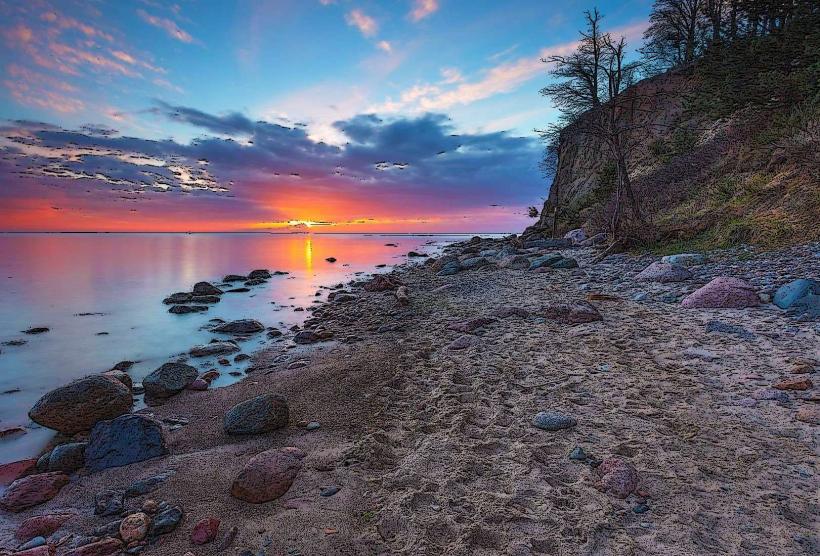
The forest is a remnant of the vast Primeval Pomeranian Forest. Most of the Gdynia section is protected within the Tri-City Landscape Park, established in 1979. It contains several nature reserves, most notably Kępa Redłowska, created in 1938 to protect the Swedish whitebeam tree and natural cliff erosion processes.
Key Highlights & Activities
Hiking and Cycling: Hundreds of kilometers of marked trails, including the "Tri-City Forest Marathon" route.
Marszewo Botanical Garden: A specialized forest education center on the western outskirts.
Military Relics: Numerous World War II bunkers and battery positions are scattered throughout the Kępa Redłowska and Witomino sections.
Viewpoints: Elevated points like Góra Donas (205m) feature an observation tower offering views of the entire Bay of Gdańsk.
Infrastructure & Amenities
The forest features "Forest Gates"-designated entry points with maps, benches, and shelters. 4G/5G cellular signal is generally stable but can drop in deep ravines. Educational paths (e.g., in Marszewo) are equipped with interactive boards. Public restrooms are absent within the forest interior; facilities are only available at major educational centers or adjacent urban districts.
Best Time to Visit
Autumn (October) provides the "Golden Polish Autumn" effect, as the massive beech canopy turns vibrant orange and red. Spring (May) is optimal for seeing the forest floor covered in wood anemones. Due to the hilly terrain, winter visits require footwear suitable for icy, steep slopes.
Facts & Legends
Local lore suggests the forests were used as hideouts for "Cursed Soldiers" (anti-communist resistance) after WWII. A geological curiosity is the "Large Stone" (Duży Kamień), one of the largest glacial erratics in the region, deposited here by the Scandinavian ice sheet approximately 13,000 years ago.
Nearby Landmarks
Marszewo Forest Botanical Garden – Western edge
Kępa Redłowska Nature Reserve – Eastern (coastal) edge
Adventure Park Gdynia – Southern edge (Kolibki)
Gdynia City Stadium – Central-South edge
Góra Donas Observation Tower – West