Information
Landmark: Holy Cross ChurchCity: Warsaw
Country: Poland
Continent: Europe
Holy Cross Church, Warsaw, Poland, Europe
Holy Cross Church (Bazylika Świętego Krzyża) is a late-Baroque minor basilica located on the Royal Route (Krakowskie Przedmieście). It is one of the most significant national shrines in Poland, functioning as both a religious site and a mausoleum for prominent Polish cultural figures.
Visual Characteristics
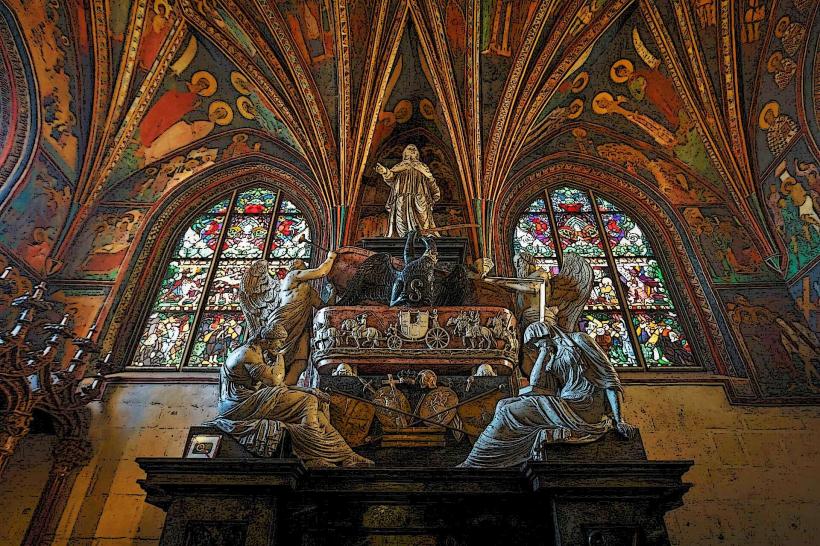
The church is defined by its late-Baroque facade featuring two symmetrical towers topped with ornamental spires. A grand, double-flight stone staircase leads to the main entrance, dominated by a 19th-century bronze statue of Christ carrying the cross under the inscription "Sursum Corda" (Lift up your hearts). The interior is a massive three-nave structure with white-washed walls, gilded altars, and large pillars containing urns and commemorative plaques.
Location & Access Logistics
The site is located at ul. Krakowskie Przedmieście 3, 00-047 Warsaw. It is situated directly opposite the main gate of the University of Warsaw. The nearest Metro station is Nowy Świat-Uniwersytet (Line M2), a 3-minute walk away. Numerous bus lines stop at "Uniwersytet" or "Ordynacka." Vehicle access is restricted to authorized traffic; public parking is available on nearby Świętokrzyska or Mazowiecka streets.
Historical & Ecological Origin
The current structure was built between 1679 and 1696, designed by Józef Szymon Bellotti. During the 1944 Warsaw Uprising, the church was a site of intense combat and was largely destroyed by German "Goliath" remote-controlled mines. It was meticulously reconstructed after the war, with the interior work continuing into the 1950s. Geologically, it sits on the Warsaw Escarpment, overlooking the lower-lying Powiśle district.
Key Highlights & Activities
Chopin’s Heart: The most visited site within the church is the second pillar on the left side of the nave, where the heart of composer Frédéric Chopin is immured.
Władysław Reymont’s Heart: The heart of the Nobel Prize-winning author of The Peasants is also preserved in a pillar here.
The Altar of the Fatherland: A central site for national commemorations.
Historical Plaques: The walls are lined with epitaphs for notable Poles, including Bolesław Prus and Ignacy Kraszewski.
Infrastructure & Amenities
The church is an active parish; tourist visits are discouraged during Sunday masses and religious services. Public restrooms are not provided for tourists within the basilica but are available in the adjacent University area. 5G cellular coverage is excellent. The main entrance requires climbing stairs, but wheelchair access is provided via a ramp at the side entrance on the southern facade.
Best Time to Visit
The church is open daily. Weekday mornings (09:00–11:00) provide the best opportunity to view the interior and the Chopin memorial without the crowds associated with services. The facade is best photographed in the late afternoon when the sun hits the western front.
Facts & Legends
During the 1944 Uprising, the "Sursum Corda" statue of Christ was blown off its pedestal and lay in the rubble with its hand pointing toward the inscription, which became a powerful symbol of hope for surviving residents. A verified detail: Chopin’s heart was smuggled into the church during the Nazi occupation to prevent it from being seized or destroyed.
Nearby Landmarks
University of Warsaw (Main Campus): 0.05km East
Nicolaus Copernicus Monument: 0.2km South
Presidential Palace: 0.4km North
Fryderyk Chopin Museum: 0.4km East
Zacheta National Gallery of Art: 0.5km West