Information
Landmark: Temple of DianaCity: Evora
Country: Portugal
Continent: Europe
Temple of Diana, Evora, Portugal, Europe
Overview
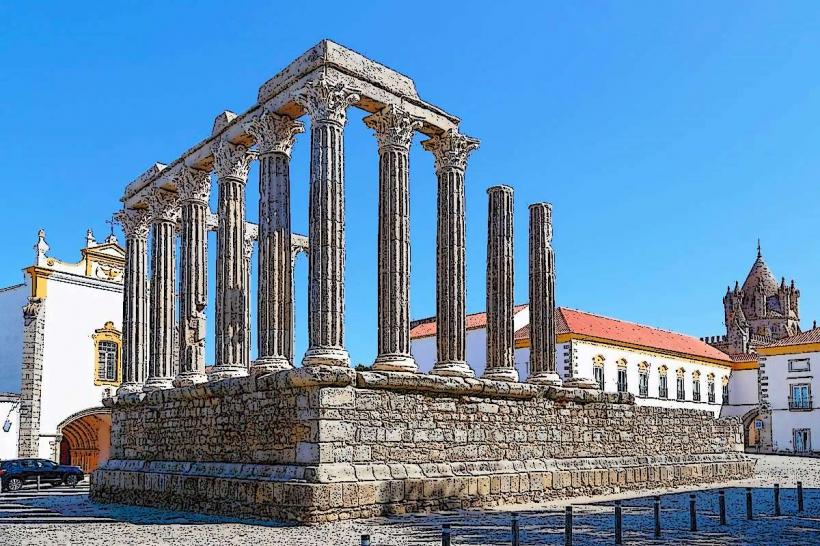
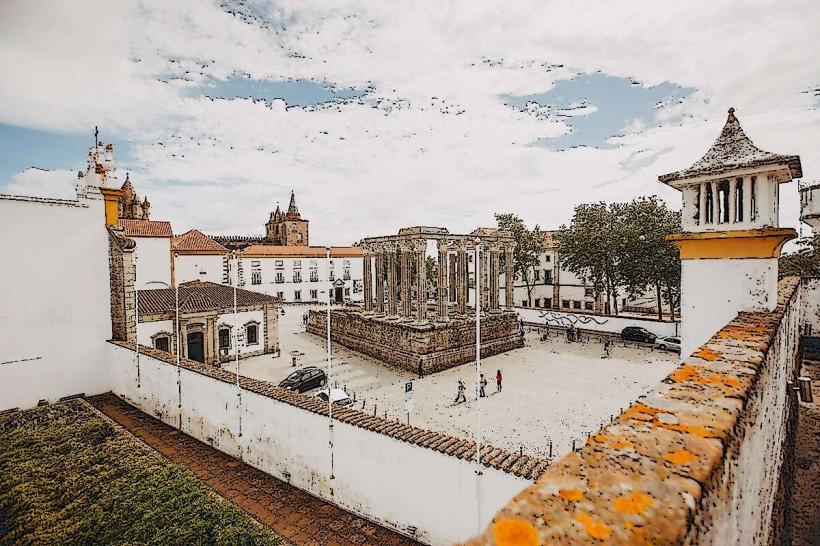
Rising from Évora’s aged stone square, the Temple of Diana (Templo de Diana) stands as one of the city’s most beloved sights and a striking reminder of its Roman roots, to boot in the heart of Évora’s classical town, it rises as a striking piece of Roman architecture, its worn stone columns still sharp against the dazzling sky after centuries.Built in the 1st century CE, the temple still stands with crisp stone carvings, making it one of the best-preserved Roman landmarks in Portugal, in addition though people still argue about its original purpose, most agree it was dedicated to Diana-the Roman goddess of the hunt, the moon, and the wild forests where deer slip between the trees.One tiny candle flickered in the corner, to boot back in Roman times, Évora-then called Ebora-stood as a key settlement in the province of Lusitania, its stone streets echoing with the sound of cart wheels.The city grew into an essential hub, perched on a key trade route, and bustled with life under Roman rule, equally important the Temple of Diana stood within a sprawling Roman forum that bustled with civic meetings, religious rites, and market stalls fragrant with spices.Historians usually date its construction to Emperor Augustus’s reign (27 BCE–14 CE) or the early 1st century CE, when the Roman Empire reached its peak, not only that no one knows the exact date it was built, though it’s often linked to local elites eager to show off their Roman identity and honor Roman gods.The temple bears Diana’s name-the huntress goddess of nature-but with no clear inscriptions to prove it, some scholars think it might have been meant for other deities too, and still, its closeness to other Roman sites devoted to Diana across the empire strengthens this view, and the Temple of Diana itself-its tall columns catching the afternoon light-stands as a classic example of Roman temple design.It’s a peripteral temple, ringed by a single row of columns that hold up the shaded portico, what’s more the temple rises on a stone stylobate, lifting it above the land around it so the first step feels like leaving the earth behind.It once held 16 tall Corinthian columns; 14 still stand, their fluted shafts catching the afternoon light, therefore the columns, carved from local limestone, are finely detailed, their smooth edges and crisp lines a quiet testament to the skill of Roman engineering and design.The Corinthian order, with its capitals carved in curling acanthus leaves, stood as the most lavish of the classical styles, a clear emblem of the empire’s wealth and grandeur, to boot the temple’s design follows a familiar Roman plan: a rectangular cella at its heart, surrounded by an airy, open structure.The balanced proportions echo the classical love of symmetry and harmony, much like the even rhythm of marble columns along a sunlit portico, showing the Romans’ mastery of architectural design, not only that the structure stands about 9.5 meters tall and stretches 18 meters wide, its design blending Greek and Hellenistic touches with a distinctly Roman flair-seen in the Corinthian columns and the balanced, orderly layout.Like other temples of its time, it was a setting where incense curled into the air during rituals for Diana and perhaps other gods, drawing the community together in worship, while in Roman Évora, it would’ve stood as a major religious hub-part sanctuary, part stone reminder of Rome’s grip on the region.The sheer size and marble columns declared the Empire’s power and cultural reach across Lusitania, as a result it probably showed the city’s wish to embrace Roman ideals, from civic pride to the firm grip of Roman religion, much like the marble statues in its forum, mildly In the centuries after the empire’s collapse, the Temple of Diana-like so many Roman monuments-slipped into neglect and slowly crumbled, after that by the Middle Ages, the temple’s splendor had faded; stones once carved with intricate patterns now stood weathered, and the building served all sorts of innovative purposes.The city’s medieval walls swallowed it up, and masons salvaged chunks of its stone to raise other buildings, after that in the 19th century, as streets widened and archaeologists sifted through the earth, they uncovered the temple’s remains and set about restoring part of it, slightly often Though parts of the original structure have vanished, most of the temple still rises in site, its granite columns catching the afternoon light and marking it as one of Évora’s finest historical landmarks, what’s more today, the Temple of Diana stands among the best-preserved Roman monuments in all of Portugal.Though time has worn it down, the weathered columns and scattered stones still paint a vivid picture of the temple’s former grandeur, along with the Temple now stands in the Jardim de Diana, a leafy public park where you can linger on a shaded bench and take in the ancient stone columns.Open to everyone, it’s one of Évora’s most beloved and visited landmarks, subsequently it’s part of Évora’s UNESCO World Heritage site, a venue where worn stone streets and centuries-aged walls tell the story of the city’s rich past.Visitors can wander among the temple’s weathered columns, trace a fingertip over the carved stone, and uncover its history through clear panels and knowledgeable guides, then today, it stands as a proud emblem of Évora’s ancient past.It captures the city’s Roman roots and living heritage, bridging centuries of history, and stands in the heart of town beside the quiet Jardim de Diana, where you can rest on a sun‑warmed bench and take in the temple’s graceful lines, then from its spot, you can snap a striking photo of the temple’s columns stretching toward the sky, framed by the modern streets of Évora; it also doubles as a hands-on classroom for anyone drawn to Roman architecture, history, or archaeology.It offers a window into the religious and cultural life of Roman Lusitania, showing the Romans’ skill in engineering and art, from sturdy granite columns to intricate carvings, simultaneously the Temple of Diana remains a cornerstone of Portugal’s Roman heritage and a lasting emblem of Évora’s deep history.With its soaring arches, intricate stonework, and rich history, it’s a region no visitor to Évora should miss, not only that no one’s quite sure what it was built for, but the temple still draws people in, its stone walls holding the hush of centuries in this ancient city.
Author: Tourist Landmarks
Date: 2025-08-26