Information
Landmark: Thun WaterfallsCity: Thun
Country: Switzerland
Continent: Europe
Thun Waterfalls, Thun, Switzerland, Europe
There are no major natural waterfalls located within the city limits of Thun. The primary hydrologic feature of the city is the Aare River and its regulated locks. The nearest significant natural cascades are the Giessbach Falls and the Staubbach Falls, located further east in the Bernese Oberland.
Visual Characteristics
The most prominent water features in Thun are the artificial cascades created by the Scherzligschleuse and Mühleschleuse wooden bridges. These structures regulate the flow of the Aare River through adjustable timber gates, creating white-water turbulence and vertical drops of approximately 1 to 2 meters. The water is typically transparent or turquoise, reflecting its glacial origins in the high Alps.
Location & Access Logistics
The sluice gates are located at the northern and southern ends of the Bälliz island. The Mühleschleuse is situated at the Mühleplatz, while the Scherzligschleuse is located near the Göttibachsteg. Both are within a 5-minute walk (approx. 400m) of the Thun railway station and are accessible via pedestrian-only bridges and riverbank promenades.
Historical & Ecological Origin
The wooden lock systems were constructed in 1724 (Scherzligschleuse) and 1726 (Mühleschleuse) as part of Bernese flood control and navigation management. These structures replaced earlier medieval systems used to power watermills. They are built of oak and larch timber supported by stone foundations, serving to maintain a consistent water level in Lake Thun and the Aare branches.
Key Highlights & Activities
Observing the mechanical operation of the sluice gates is possible when municipal workers adjust the timber needles. The Mühleschleuse is a primary site for river surfing, where the artificial cascade creates a standing wave utilized by local athletes. Walking across the interior of the covered wooden bridges allows for close-range photography of the water flow.
Infrastructure & Amenities
The areas surrounding the cascades are equipped with safety railings and public benches. High-density 5G cellular coverage is available. Since the sites are in the city center, public restrooms and food vendors are located in the adjacent Mühleplatz and Bälliz shopping districts.
Best Time to Visit
The cascades are most powerful in late spring and early summer (May–June) during the alpine snowmelt period, which increases the river's volume. Night photography is possible as both wooden bridges and the surrounding river embankments are illuminated by municipal street lighting.
Facts & Legends
Thun utilizes "needle dam" technology, a centuries-old method where individual wooden poles (needles) are manually inserted or removed to regulate water flow. This system remains functional and is considered a rare example of preserved pre-industrial engineering in Switzerland, still preferred over modern mechanical gates for its precision in fine-tuning water levels.
Nearby Landmarks
Mühleplatz - 0.05km East
Bälliz - 0.1km South
Thun Town Hall - 0.2km East
Kunstmuseum Thun - 0.3km East
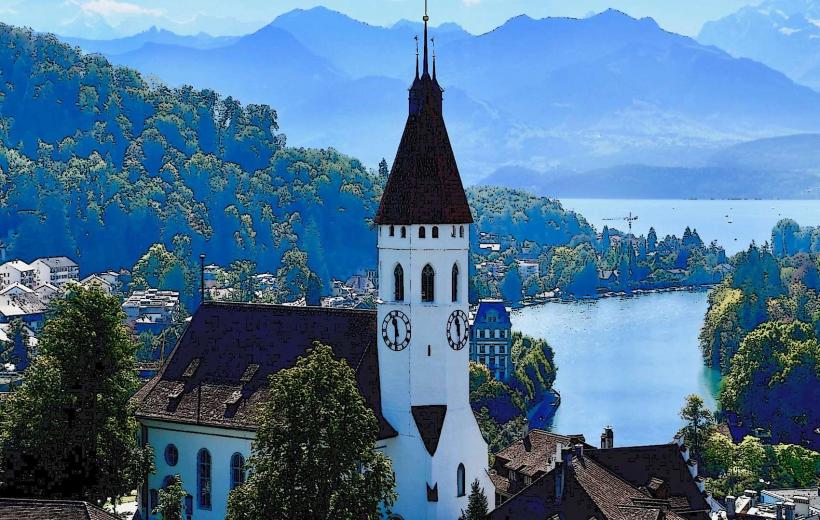
Stadtkirche Thun - 0.35km Northeast