Information
Landmark: Catherine’s GateCity: Brasov
Country: Romania
Continent: Europe
Catherine’s Gate, Brasov, Romania, Europe
Catherine's Gate, or Poarta Ecaterinei, is a 16th-century fortification located in the western part of the Brașov Old Town. It is the only original city gate from the medieval period that has survived to the present day.
Visual Characteristics
The structure is a three-story square tower built in the Saxon Renaissance style. It features a central spire flanked by four smaller corner turrets, symbolizing the city's medieval "Jus Gladii" (Right of the Sword), the authority to apply the death penalty. The exterior walls are rendered in white plaster with exposed stone accents around the pointed arch of the passage. Above the entrance, the city's coat of arms-a crown on a tree trunk-is carved in stone.
Location & Access Logistics
The gate is located at the intersection of Șirul Gheorghe Dima and Strada Poarta Șchei, approximately 0.5 kilometers southwest of Council Square. It is easily accessible on foot via the pedestrian paths along the city's western walls. For those using public transport, the closest bus stop is Livada Poștei, located 0.6 kilometers to the north. Vehicular parking is prohibited directly at the gate, but paid spots are available nearby at the Public Library or along Nicolae Bălcescu Street.
Historical & Ecological Origin
Commissioned by the Tailors’ Guild, the gate was constructed in 1559 to replace a previous structure destroyed by a flood in 1526. It was named after St. Catherine’s Monastery, which formerly stood on the site. Historically, it served as the only entry point into the fortified city for the ethnic Romanians living in the neighboring Șchei district, who were required to pay a toll to enter the Saxon-governed center.
Key Highlights & Activities
Visitors can walk through the central arch and examine the medieval stone carvings and architectural details of the turrets. The surrounding area includes a small landscaped park and sections of the restored fortification walls, suitable for walking. Photography is common, particularly from the western side where the turrets are most visible against the backdrop of the old city.
Infrastructure & Amenities
The gate is situated in a well-maintained public area with paved walkways and benches. There are no restrooms or food vendors within the structure itself, but several cafes and restaurants are located within a 100-meter radius on Poarta Șchei Street. 5G cellular coverage is excellent. The area is illuminated at night for visibility and safety.
Best Time to Visit
The western facade is best photographed in the late afternoon when the sun highlights the white masonry and the details of the turrets. The site is accessible 24 hours a day and does not require an admission fee. Winter months offer a high-contrast view when the roof tiles are covered in snow, while spring and summer provide lush greenery in the adjacent park.
Facts & Legends
While the gate looks like a complete defensive unit, the current tower was originally just the outer gateway of a much larger fortification complex that included a wooden bridge and a secondary inner gate. Most of that complex was demolished in 1827 to make way for Schei Gate. The four corner turrets served a grim purpose: they notified arriving travelers that the city had its own judicial court and could execute criminals.
Nearby Landmarks
Șchei Gate: 0.05km South
The Weavers' Bastion: 0.3km Southeast
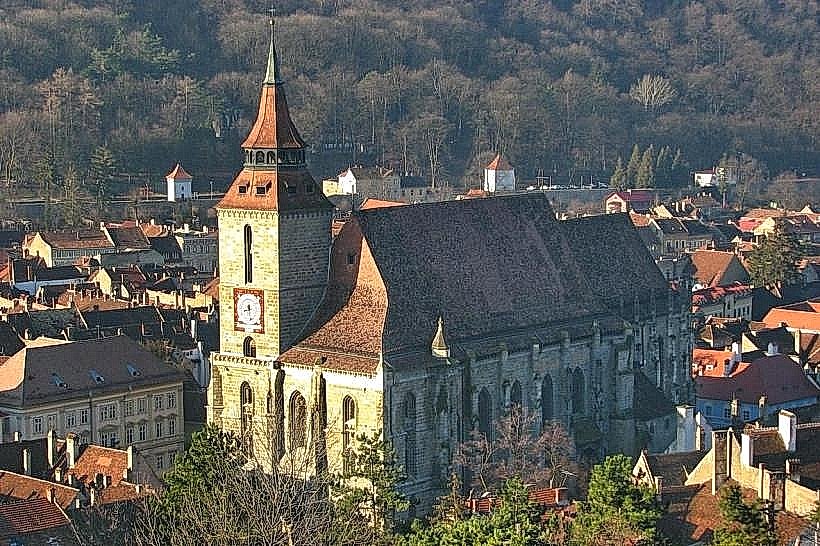
The Black Church: 0.4km Northeast