Information
Landmark: Minett Park Fond-de-GrasCity: Luxembourg City
Country: Luxembourg
Continent: Europe
Minett Park Fond-de-Gras, Luxembourg City, Luxembourg, Europe
Minett Park Fond-de-Gras is an open-air industrial museum and heritage site located in a valley between Differdange and Pétange, approximately 25 kilometers southwest of Luxembourg City. It preserves the infrastructure of a former iron ore transshipment center that was critical to the nation's steel industry until the 1960s.
Visual Characteristics
The site features a collection of industrial architecture, including corrugated metal warehouses, brick power stations, and timber-framed railway sheds. The landscape is dominated by a network of vintage rail tracks, antique steam locomotives, and heavy machinery, set against a backdrop of rewilded open-pit mines and dense broadleaf forests. Rust-colored earth and weathered iron equipment reflect the high iron content of the "Minette" soil.
Location & Access Logistics
The park is located at 2 Fond-de-Gras, L-4576 Niederkorn. It is accessible by car via the A4 and A13 motorways, followed by local roads leading to the valley floor. A unique logistical access point is the "Train 1900" vintage steam line, which runs from Pétange station on Sundays and public holidays. Additionally, the "Minièresbunn" narrow-gauge mining train connects the site to Lasauvage via a 4-kilometer tunnel. Free parking is available on-site near the main station building.
Historical & Ecological Origin
The site functioned as one of Luxembourg’s most important iron ore mining centers from the late 19th century until its closure in 1964. The "Minette" iron ore was formed during the Jurassic period as oolitic ironstone. Following the decline of the steel industry, the site was converted into a conservation area to protect both industrial heritage and the unique flora that colonized the abandoned calcareous mining slopes.
Key Highlights & Activities
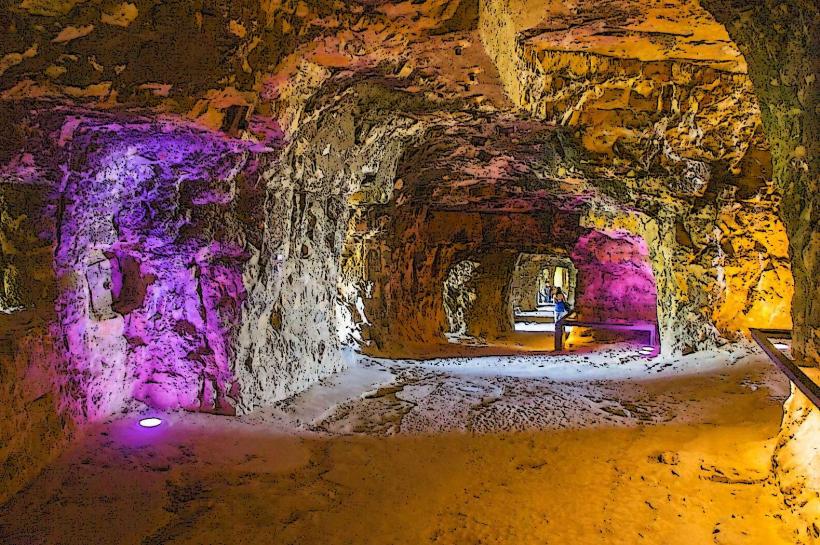
Visitors can ride the "Train 1900" steam railway or the "Minièresbunn" mining train, the latter of which descends into an actual mine gallery. The site includes the "Paul Wurth" hall, which houses historical machinery, and a grocery store from the early 20th century preserved in its original state. Hiking trails, such as the "Giele Botter" nature reserve circuit, allow for exploration of the former open-cast mining terraces.
Infrastructure & Amenities
The park features a traditional brasserie, "Bei der Giedel," and a seasonal buffet at the railway station. Public restrooms are located in the main visitor buildings. While 4G and 5G cellular signals are generally available on the higher ridges, signal strength can be inconsistent within the deep valley and is non-existent inside the mining tunnels. The main paths are flat and gravel-surfaced, though the vintage trains have limited accessibility for mobility-impaired visitors.
Best Time to Visit
The park is primarily active from May through September, with trains operating on Sundays and public holidays. The "Blues Express" festival in July is a peak activity period. For photography, the morning light is optimal for capturing the steam locomotives, while the late afternoon provides dramatic shadows across the industrial ruins of the nearby "Giele Botter" cliffs.
Facts & Legends
The "Minièresbunn" is one of the few places in Europe where a train crosses an international border underground, as the tunnel connects Luxembourg to the French border region. A local oddity is the "Victor Binck" grocery store, which remains stocked with period-accurate packaging and goods, providing a precise visual record of worker life in the 1920s.
Nearby Landmarks
Giele Botter Nature Reserve – 0.5km South
Lasauvage Village – 4.0km West (via mine train)
Titleberg Celtic Oppidum – 1.2km North
Luxembourg Science Center – 3.5km Northeast
Differdange Castle – 3.2km East