Information
Landmark: Palazzo AbatellisCity: Palermo
Country: Italy
Continent: Europe
Palazzo Abatellis, Palermo, Italy, Europe
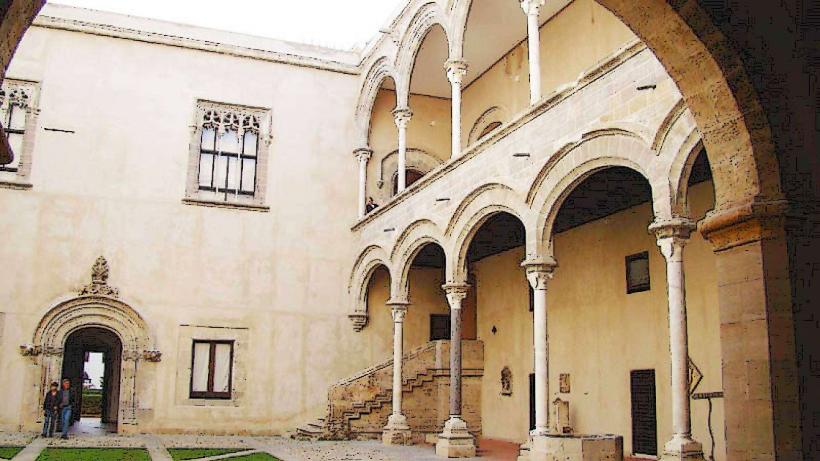
Palazzo Abatellis is a 15th-century fortified palace in the Kalsa district, functioning as the Galleria Regionale della Sicilia. It is internationally recognized for its combination of Catalan Gothic architecture and the 1954 modernist interior redesign by architect Carlo Scarpa.
Visual Characteristics
The exterior is characterized by square-cut stone blocks, a massive crenelated portal, and two corner towers, giving it the appearance of a noble fortress. Inside, the central courtyard features two levels of elegant loggias. The gallery spaces are world-renowned for Scarpa’s "museographic" style-using colored plaster panels, minimalist metal supports, and calculated natural light to isolate and dramatize individual masterpieces.
Location & Access Logistics
Located at Via Alloro, 4, in the historic Kalsa quarter. It is approximately 1.2 km from Palermo Centrale station (a 15-minute walk). Entrance requires a ticket. Opening hours are typically Tuesday–Saturday (09:00–19:00) and Sunday (09:00–13:00). The museum is closed on Mondays. Security protocols at the entrance are rigorous.
Historical & Engineering Origin
Commissioned in 1490 by Francesco Abatellis, Portulano Mayor of the Kingdom of Sicily. Following his death, it became a Benedictine convent. The building sustained heavy damage during the 1943 Allied bombings of Palermo. In the early 1950s, the Sicilian Region oversaw a restoration that culminated in Carlo Scarpa’s interior intervention, which transformed the ruin into a modern art gallery that respects the original Gothic-Renaissance volumes.
Key Highlights & Activities
The Triumph of Death (Trionfo della Morte): An enormous 15th-century fresco depicting Death as a skeletal horseman. Its placement in a dedicated room designed by Scarpa is a highlight of world art history.
The Virgin Annunciate (L'Annunziata): A 1476 oil-on-panel by Antonello da Messina. It is celebrated for its psychological intensity and the Virgin's direct gaze at the viewer.
Bust of Eleanor of Aragon: A marble sculpture by Francesco Laurana, noted for its ethereal, geometric purity.
The Malvagna Triptych: A high-detail early 16th-century Flemish work by Jean Gossaert (Mabuse).
Infrastructure & Amenities
5G cellular coverage is stable throughout the museum. The site includes a bookshop specializing in Sicilian art and architecture. The ground floor is largely accessible via ramps; however, the upper floors of the 15th-century structure have limited accessibility despite the presence of modern lifts. Climate control is maintained to protect the delicate wooden panels.
Best Time to Visit
Mid-week mornings provide the quietest environment. To experience the specific lighting effects intended by Carlo Scarpa, a morning visit during a sunny day is recommended, as the natural light interacts with the placement of the sculptures and panels.
Facts & Legends
The "Triumph of Death" fresco originally adorned the courtyard of the Sclafani Palace; it was detached and moved to Palazzo Abatellis for preservation. Its imagery-the indiscriminate nature of death-is said to have influenced Pablo Picasso’s Guernica. Architects frequently visit the palace not for the art, but specifically to study Scarpa’s joinery, hardware, and spatial layout, which are considered a "manifesto" of modern restoration.
Nearby Landmarks
Piazza Marina: 0.2km North
Church of Santa Maria dello Spasimo: 0.4km South
Palazzo Butera: 0.3km East
Foro Italico (Seafront): 0.5km East
Oratorio di San Lorenzo: 0.4km North