Information
Landmark: Villa GiuliaCity: Palermo
Country: Italy
Continent: Europe
Villa Giulia, Palermo, Italy, Europe
Villa Giulia is a historic public park located along the seafront in Palermo, adjacent to the Botanical Garden. Established in the late 18th century, it is recognized as Italy’s first public park specifically designed for leisure and aesthetic enjoyment.
Visual Characteristics
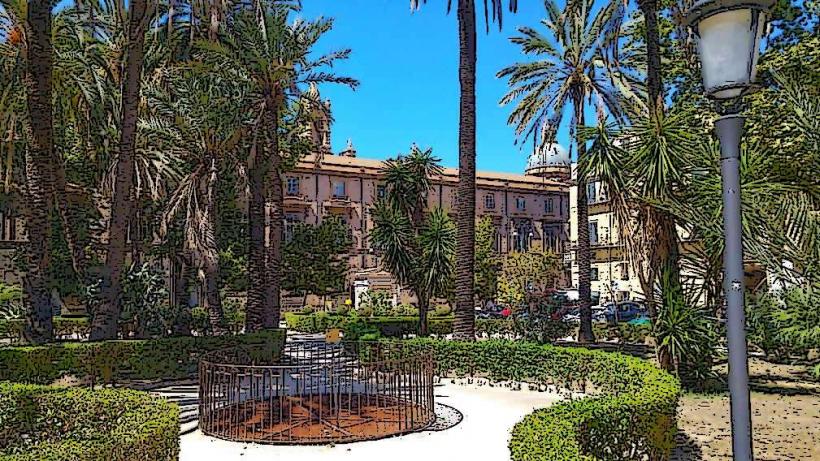
The park is designed with a rigorous geometric plan, forming a perfect square divided into four quadrants by intersecting paths. It features Neoclassical architecture, including fountains, pavilions, and marble sculptures. The central point is a circular space dominated by a monumental sundial. The greenery consists of lush Mediterranean flora, citrus groves, and towering exotic palms, creating a highly symmetrical and orderly environment.
Location & Access Logistics
Situated on Via Lincoln, bordering the Kalsa district and the Foro Italico seafront. It is approximately 1.2 km from Palermo Centrale station (a 15-minute walk). Access is free and the park is open daily from sunrise to sunset. The main entrance is a grand Neoclassical portal facing the sea. The park is entirely pedestrian and level, making it highly accessible.
Historical & Engineering Origin
Commissioned in 1777 by the Viceroy Marcantonio Colonna, Prince of Stigliano, and named in honor of his wife, Giulia Avalos. It was designed by architect Nicolò Palma and completed in 1778. The park was intended to provide a modern, enlightened public space for the aristocracy and the populace. The central sundial, a dodecahedron where each face serves as a gnomon, was designed by the mathematician Lorenzo Federici.
Key Highlights & Activities
The Dodecahedron Sundial: A unique 18th-century scientific instrument resting on the shoulders of a statue representing Atlas (or a young boy), located at the intersection of the park's main axes.
Genius of Palermo: One of the most important statues of the city’s secular patron, depicting an old crowned man with a snake, sculpted by Ignazio Marabitti in 1778.
Music Pavilions: Four circular Neoclassical pavilions located at the corners of the central square, originally used for live orchestral performances.
The Sea Connection: The park serves as a green transition between the historic city walls and the open expanse of the Foro Italico lawn.
Infrastructure & Amenities
The area has excellent 5G cellular coverage. Public benches are distributed throughout the shaded paths. While there are no dedicated cafes inside, numerous kiosks and bars are located just outside on Via Lincoln and the Foro Italico. Public restrooms are located near the entrance. The flat, paved, and gravel paths are well-suited for wheelchairs and strollers.
Best Time to Visit
Late afternoon is the optimal time to visit as the sun sets over the city, casting long shadows through the palm trees and illuminating the marble statues. It is a quiet alternative to the busier city center parks, ideal for reading or a peaceful walk.
Facts & Legends
In 1787, Johann Wolfgang von Goethe visited the park and described it as "the most wonderful place in the world" in his Italian Journey. Local tradition notes that the park was a favored spot for "conversazioni," where the elite would discuss politics and philosophy in the late 18th century. Unlike other Palermo parks, Villa Giulia has maintained its original Enlightenment-era layout without significant modern alterations.
Nearby Landmarks
Orto Botanico (Botanical Garden): 0.05km West (Adjacent)
Foro Italico: 0.1km East
Palazzo Abatellis: 0.6km North
Piazza Magione: 0.5km Northwest
Santa Maria dello Spasimo: 0.4km Northwest