Information
Landmark: Agios Titos ChurchCity: Crete
Country: Greece
Continent: Europe
Agios Titos Church, Crete, Greece, Europe
Overview
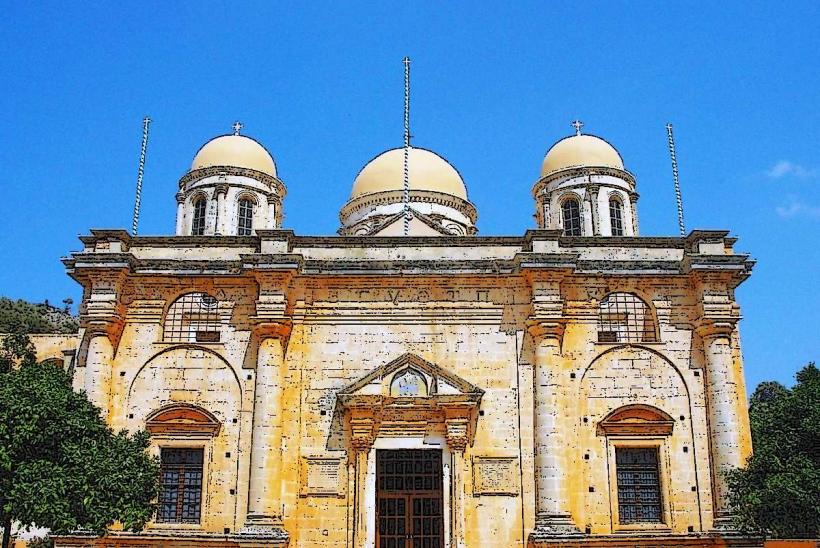
Believe it or not, In the bustling center of Heraklion, Crete, the Agios Titos Church (Άγιος Τίτος) stands as a striking relic of the Byzantine era, its stone walls warm under the Mediterranean sun, to boot it’s one of the city’s most treasured landmarks, valued for its deep spiritual meaning and the graceful arches that catch the afternoon light.The church stands in the heart of Heraklion, just steps from Plaza Agios Titos, a lively main square where café tables spill onto the pavement, in conjunction with right in the heart of Heraklion, it’s easy to spot and reach-whether you’re a local grabbing coffee nearby or a tourist with a map in hand.The church honors Saint Titus, the patron saint of Crete, whose name still echoes in the island’s narrow stone streets, as a result titus served as one of St. Paul’s apostles and later became Crete’s first bishop, guiding its early church like a steady hand on a weathered wooden helm, therefore he’s remembered for his missionary work and for pulling together the first Christian communities on the island, where tiny stone chapels still catch the morning light.People value the church as an essential location of worship because it’s tied to Saint Titus, whose name still echoes in the worn stone walls, at the same time the church of Agios Titos traces its roots to the Byzantine period, likely rising in the early Christian era around the 7th century AD, when its stone walls first caught the island sun.Over the centuries, different rulers on the island rebuilt and altered it, leaving their marks-an arch here, a carved emblem there, subsequently during the Venetian rule of Crete (1204–1669), the church grew in size and took on a novel behold, with tall arched windows and stonework that echoed the elegance of Venetian design.The Venetians built a larger portico and tweaked other parts of the design, adding details like carved stone columns, and the Ottomans later kept it all intact, moreover during the Ottoman conquest of Crete in 1669, they turned the church into a mosque, its bells falling silent beneath a contemporary minaret.They renamed it Kebir Mosque, stripping away or reworking the church’s Christian images-faded saints on the walls, halos scraped thin, not only that when the island won its freedom in the 19th century, the church once again rang its bells for Christian worship.In the 19th century, after Crete won its freedom from Ottoman rule, the church came alive again as a vital locale for Christian worship, its bells ringing over the town square, in conjunction with during the Ottoman era, the remains of Saint Titus vanished from sight.I think, They were later found again and carried back to the church, their marble reliquary cool to the touch, to boot they restored the church completely in the late 20th century, polishing its worn wooden pews until they shone, slightly The Agios Titos Church is a striking example of Byzantine and early Christian design, built in the classic cross-in-square layout you’ll find in many Byzantine churches, with arches that seem to gather the light, while at the heart of the building rises a central dome, resting on four sturdy pillars, while a gilded iconostasis-marking the line between sanctuary and nave-glows with painted Christian saints, kind of During the Venetian era, builders added to the church’s original design, giving it a modern stone facade and a sheltered narthex where visitors first stepped in from the street, equally important you can discover the Venetian touch in the carved stone arch above the doorway and the intricate details framing each window.You can still spot traces of the Ottoman era, especially from when the church served as a mosque-like the sturdy base of its minaret, left standing even after the building was restored to Christian worship, after that the church honors Saint Titus, a key figure in Crete’s Christian history, remembered much like a steadfast lighthouse guiding ships to shore.He traveled alongside the Apostle Paul, helping carry the message of Christianity across the island’s dusty roads and crowded marketplaces, consequently tradition says Saint Titus was laid to rest in Heraklion, and a church later rose on the spot where his tomb once stood, its stone floor cool even in summer.As you can see, In the church, a silver reliquary holds the bones of Saint Titus, uncovered long after the Ottoman era had passed, also the relics are held sacred, their worn edges and faint scent of incense woven deep into the church’s sense of the divine.Somehow, Every August 25, the church throws its annual feast for Saint Titus, a day the local Christian community treasures, with bells ringing and tables piled high with food, as well as visitor Experience: Opening Hours: You can usually step inside Agios Titos Church any day of the week, when sunlight spills through its tall arched windows.Step inside the church to take in its soaring arches and feel the quiet hush that fills the air, on top of that before you go, check if hours change for religious events or festivals-some places close early, like after sunset prayers, under certain circumstances You can step inside Agios Titos Church for free, though a petite donation-like the clink of a coin in the box-is always welcome, what’s more the church isn’t just where people gather to pray-it stands as a proud reminder of Crete’s long history and rich traditions, its weathered stones echoing centuries of faith.Pilgrims and curious travelers alike come for its rich religious history, the shimmering gold of its Byzantine mosaics, and the graceful lines of its Venetian architecture, as a result the church sits in a lively part of Heraklion, just steps from cafés serving strong coffee and little shops where visitors can linger and soak in the atmosphere after their visit.Just around the corner, Plaza Agios Titos offers a sunny spot where visitors can rest on worn stone benches and soak in the lively hum of the square, not only that agios Titos Church in Heraklion, Crete, stands as a treasured landmark, blending graceful Byzantine arches with Venetian stonework, honoring Saint Titus, and embodying the island’s deep Christian roots.Whether you love history, come as a pilgrim, or are simply wandering the city’s streets, the church gives you a quiet, meaningful window into the island’s past, its stone walls cool to the touch.
Author: Tourist Landmarks
Date: 2025-08-24